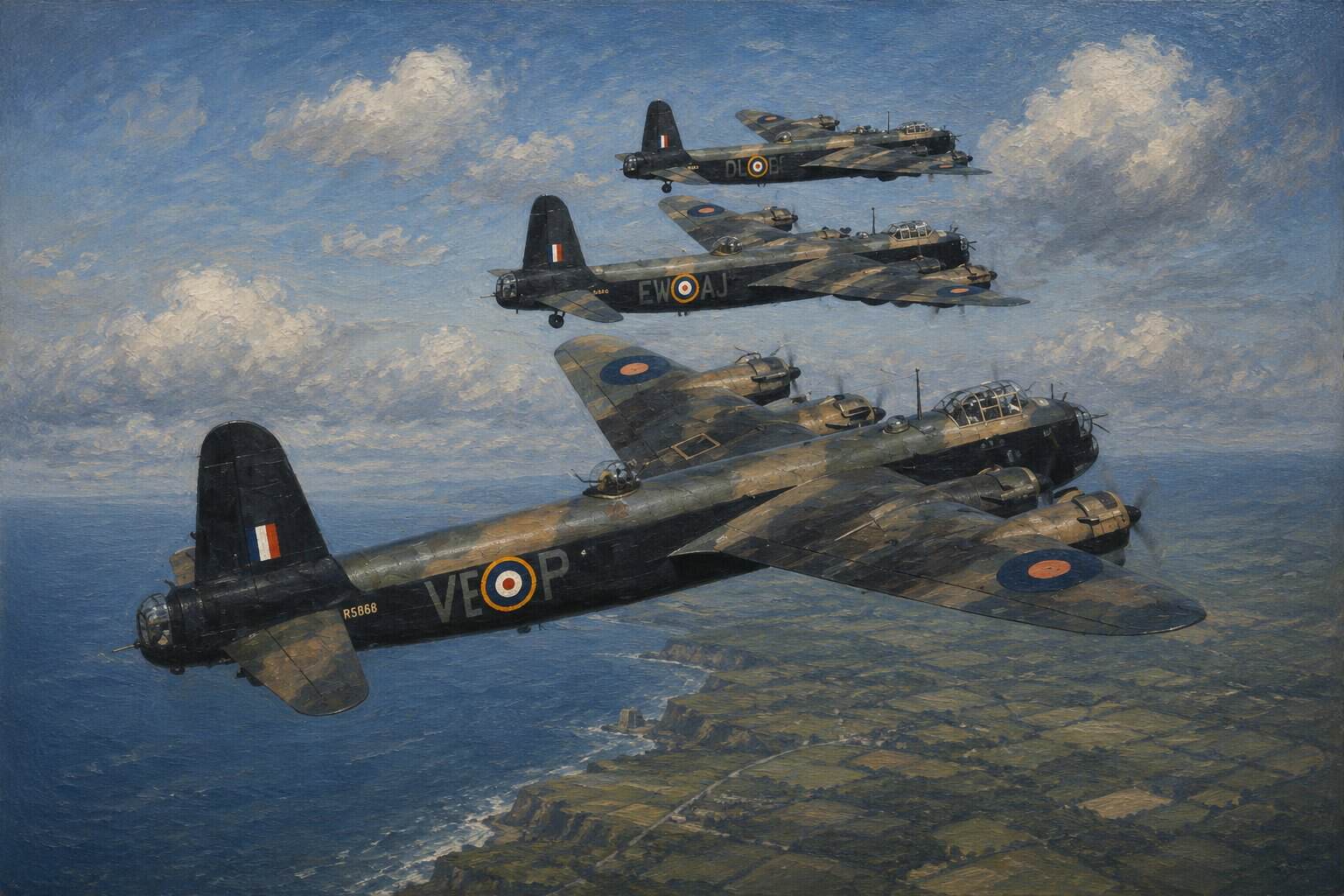
Bomber Command’s mid-war transition took shape as the RAF moved from the limited offensive of the early war years towards a far larger and more technically organised campaign. Between 1942 and 1944, the command changed not through a single breakthrough, but through the combination of new aircraft, better navigation and target-finding aids, improved target marking, and a growing willingness to use specialised weapons for specific operational problems. The result was a force with greater striking power and a wider range of methods than had been available when the night offensive first expanded.
Background
Early wartime bombing had exposed serious limitations in aircraft performance, navigational accuracy and the practical difficulty of locating targets at night. The problems identified in the Butt Report made clear that Bomber Command could not rely on scale or determination alone. If the offensive were to have a larger operational effect, it would need greater range, heavier bomb loads, better methods of finding targets, and a more coherent system for concentrating force on the objective.
This period of adjustment unfolded while the wider bombing campaign was itself expanding. Under Arthur Harris, Bomber Command increased the size and frequency of its attacks, but the command that entered the middle years of the war was not the same force that had begun the offensive. It was being reshaped by technology, organisation and experience.
New Aircraft And Weight Of Attack
One part of that transition lay in the changing aircraft mix. Earlier twin-engined bombers, including the Vickers Wellington, had carried much of the burden in the first phase of the offensive, but they imposed limits on bomb load, range, and the scale of effort that could be brought to bear against distant targets. The growing prominence of four-engined aircraft altered those calculations.
The Short Stirling, Handley Page Halifax and above all the Avro Lancaster gave Bomber Command more lift, more reach and greater operational flexibility. Larger loads could be carried deeper into Germany, while repeated large-scale attacks became more practical than in the earlier period. The Lancaster, in particular, became closely associated with the command’s mature offensive, not only because of its capacity but also because it could be adapted for unusually demanding tasks.
Navigation, Marking And Control
Aircraft alone did not solve the command’s central problems. The mid-war transition also depended on navigation and target-finding systems that made night bombing more organised and, in relative terms, more accurate. Gee, Oboe and H2S did not remove the uncertainties of darkness, weather and enemy defences, but they gave crews and controllers more reliable means of locating routes, identifying urban areas and improving the concentration of attack.
These aids worked most effectively when combined with organisational change. The Pathfinder Force and the broader evolution of target marking enabled leading crews to indicate aiming points for the main force with increasing consistency. That development mattered because it turned technical improvement into an operational method. Raids could be assembled with greater control, and the relationship between specialist marking aircraft and the main bomber stream became a central feature of the mature offensive.
Specialised Weapons And New Methods
The transition also included a growing readiness to match particular weapons and tactics to particular targets. Large high-capacity bombs increased the destructive effect of conventional raids, but the period also saw experiments that pointed beyond standard area bombing. Operation Chastise, carried out by 617 Squadron with Barnes Wallis’s Upkeep weapon, demonstrated how Bomber Command could be directed towards a tightly defined engineering target under highly specialised conditions.
That development did not replace the main night offensive, but it showed that the command was becoming more varied in method. The same broader tendency later appeared in the use of weapons such as Tallboy, which linked heavy bombing power to more precise attacks against hardened or difficult targets. In that sense, mid-war change was not simply about dropping larger bomb loads. It was about widening the range of operational tools available to the RAF.
Significance
Bomber Command’s mid-war transition mattered because it turned an offensive that had often been diffuse and technically uncertain into one that was heavier, better guided and more adaptable. None of these changes removed the central difficulties of night bombing. Losses remained heavy, accuracy remained imperfect, and the moral and strategic controversies surrounding the campaign did not disappear. Even so, by the middle and later years of the war, the command had become a more complex and more capable instrument than it had been in 1940 or 1941.
The importance of the period lies in that cumulative change. Four-engined bombers, radio and radar aids, target marking and specialised weapons did not operate in isolation. Together they formed the basis of Bomber Command’s mature wartime method and shaped how the RAF conducted the night offensive for the rest of the war.