RAF Bomber Command created the Pathfinder Force in August 1942 to solve one of the most stubborn problems of the night-bombing offensive: finding the target and marking it accurately enough for the main force to bomb in concentration. By 1941 it was clear that many crews attacking Germany at night were missing their objectives by a wide margin, and that courage and growing aircraft numbers alone would not fix the problem. Bomber Command needed a better way to reach the right place and show everyone else where to aim.
The Pathfinder Force supplied that method. By gathering selected crews, the best available navigation aids and a growing set of marking techniques into a single specialist formation, the RAF turned target-finding into a disciplined operational craft. Night raids became noticeably more concentrated as a result, though accuracy remained imperfect and the wider arguments over the bomber offensive’s cost and effect continued regardless.
Why Bomber Command Needed Pathfinders
Bomber Command had shifted to night operations to cut losses against German defences, but darkness brought its own problems. Crews crossed a blacked-out continent in poor weather using dead reckoning, celestial navigation and early radio aids that could not always deliver a precise fix. Even a crew that reached the right area still had to identify the correct aiming point through haze, smoke or cloud, often while under fire.
The Butt Report, compiled in the summer of 1941, gave these concerns official weight. Analysis of bombing photographs showed that only a minority of aircraft were bombing close to their intended aiming point, and that results over the heavily defended and hazy Ruhr were worse still. The consequence was dispersal: aircraft, fuel and trained crews were being committed in large numbers without a matching concentration of effect. For a fuller account of how this shaped the wider night offensive, see RAF Bomber Command: Strategy, Impact and Legacy.
British planners also knew the Luftwaffe had used specialist marking methods during the Blitz, showing that a raid could be organised around selected aircraft whose job was to find and mark the target for those following. RAF planners adapted the underlying idea to their own aircraft, aids and tactics rather than copying German methods directly.
The Pathfinder Force Is Formed
The proposal to create a specialist target-finding force met sharp resistance. Arthur Harris, commanding Bomber Command, resisted stripping experienced crews from existing squadrons to build an elite formation, fearing it would weaken the rest of the force. Charles Portal, the Chief of the Air Staff, judged it the most effective way to improve results and pressed the case. The argument was settled in favour of a dedicated force, and on 15 August 1942 the Pathfinder Force was established, drawing its nucleus from squadrons already regarded as highly capable.
Group Captain Donald Bennett was appointed to command the new force. An exceptionally skilled navigator, Bennett placed heavy emphasis on navigational discipline and technical competence, and Pathfinder crews were among the first to receive improved aids as they entered service. The underlying principle was simple even if the practice was demanding: rather than asking every crew in the bomber stream to solve the same navigational problem under pressure, selected crews would go in first, find the target and lay down markers the main force could follow.
Navigation Aids: Gee, Oboe and H2S
Three aids shaped how Pathfinder crews found and marked their targets, and each had real limits. Gee, a hyperbolic radio navigation system that came into operational use in 1942, let crews fix their position by comparing signals from ground transmitters in Britain. It helped get bombers to the general target area, but its accuracy fell with distance from Britain, and German jamming steadily eroded its value as the war went on.
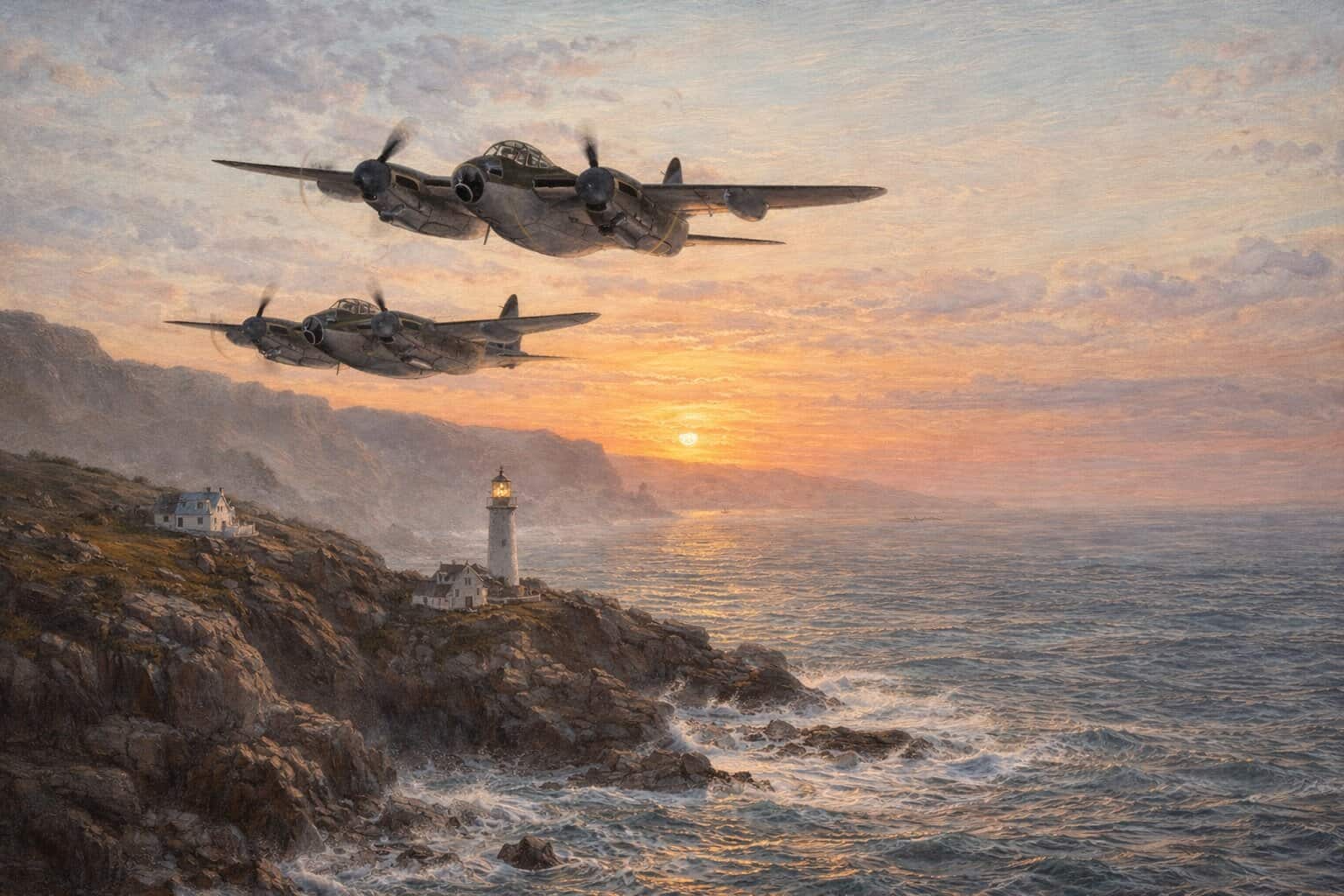
Oboe addressed some of Gee’s shortcomings with far greater precision. Two ground stations in England tracked an aircraft flying a fixed arc and radioed corrections to keep it on course, releasing markers at a calculated point with an accuracy of a few hundred yards. Its drawback was range: Oboe’s accuracy depended on line-of-sight to its ground stations, which limited effective use to targets within reach, chiefly the Ruhr and other targets in western Germany. It was particularly associated with the fast, high-flying Mosquitos of Pathfinder marking squadrons such as Nos. 105 and 109 Squadrons, distinct from the separate Mosquito force that flew diversionary and nuisance raids as the Light Night Striking Force.
H2S, an airborne ground-scanning radar carried in the aircraft itself, filled much of the gap Oboe’s range could not cover. It returned a radar picture of the ground below, distinguishing coastlines, rivers, and built-up areas regardless of cloud or darkness, allowing marking further into Germany than Oboe could reach. Reading an H2S picture accurately took skill and practice, and the technique worked best in combination with the other aids rather than alone.
Target-Marking Methods
Once over the target, Pathfinder aircraft dropped Target Indicators, pyrotechnic markers in distinctive colours designed either to burn on the ground or to burst in the air above cloud. Which method was used depended on what the crews could see. Newhaven, visual ground marking, was used when the aiming point could be identified by eye and markers placed directly on it. Parramatta, blind ground marking guided by Oboe or H2S, was used when cloud or haze hid the target, but radar or radio aid could still fix its position. Wanganui, sky marking by parachute flares burst above the cloud layer, was the fallback when the ground could not be seen at all, giving the main force a point in the sky to aim at instead of a point on the earth.
Large raids typically unfolded in stages. Illuminating flares opened the target area, primary markers went down from selected crews, and back-up followed to reinforce or correct markers that had drifted or burned out. This was dangerous, exposed work: Pathfinder crews arrived first, often before fires and smoke offered any help with orientation, and stayed over the target while the raid built around them, facing anti-aircraft fire, night fighters and the risk of bombs falling from aircraft above.
No. 8 Group and a Growing Force
As its role expanded, the Pathfinder Force was redesignated No. 8 (Pathfinder Force) Group on 13 January 1943, formalising what had begun as an improvised specialist unit into a permanent command structure within Bomber Command. More squadrons were added over the following two years, flying Lancasters, Halifaxes and the fast Mosquitos used for marking and for the diversionary raids of the Light Night Striking Force. The group’s growth mirrored the expanding demands placed on it, as target-marking became central to nearly every major raid rather than an occasional refinement.
To read about the day the force itself came into being, see The Pathfinder Force Is Formed.
Master Bombers and Evolving Control
As the marking system matured, Bomber Command added another layer of control: a master bomber who remained over the target throughout the attack, assessed the markers’ accuracy by radio, directed the main force onto the best of them, or ordered corrections when markers drifted or were extinguished. Wing Commander Guy Gibson performed this role over Peenemünde on the night of 17/18 August 1943, one of the clearer examples of a master bomber shaping a major raid in real time rather than leaving crews to interpret the markers unaided.
The master bomber concept extended what the Pathfinder Force had already established: that target-marking needed active management throughout a raid, since conditions, weather and enemy defences could all change while the attack was under way.
Effect and Limits
From late 1942 onward, the Pathfinder Force was integral to Bomber Command’s major operations, including the Battle of the Ruhr, the Battle of Berlin and the raid on the German rocket research establishment at Peenemünde. Pathfinder crews flew about 50,000 sorties during the war, and losses were heavy, with several thousand aircrew killed carrying out some of the most hazardous flying of the campaign.
Those figures point to two realities: target-marking made the Pathfinder Force operationally indispensable to the night offensive, but it did not make that work any safer for the crews who carried it out. The force improved concentration and made raids considerably more effective than in 1941, though it did not remove all error or turn night bombing into an exact science. Weather, enemy defences, equipment limits and the sheer complexity of coordinating hundreds of aircraft over one target at night ensured that uncertainty was never eliminated.
Legacy
The Pathfinder Force showed how organisation and technology, combined deliberately, could address an operational weakness that neither could solve alone. By treating target-finding as a specialist task rather than a general expectation placed on every crew, the RAF improved the concentration of the night offensive and introduced a more controlled way of directing large raids as they happened.
Its wider significance lies in that combination of doctrine, equipment and selected manpower. The force reshaped how the bomber stream was led and made specialist marking central to the RAF’s later offensive over Germany, from the Ruhr to Berlin and beyond, leaving a method of attack that later forces continued to refine.