On This Day, 1939: On 21 October 1939, 46 Squadron Hurricanes intercepted Heinkel He 115 floatplanes over the North Sea in the…
Read the entry →Short Stirling
Short Brothers
Learn how the Short Stirling became the RAF’s first operational four-engined heavy bomber before moving into airborne and transport roles.
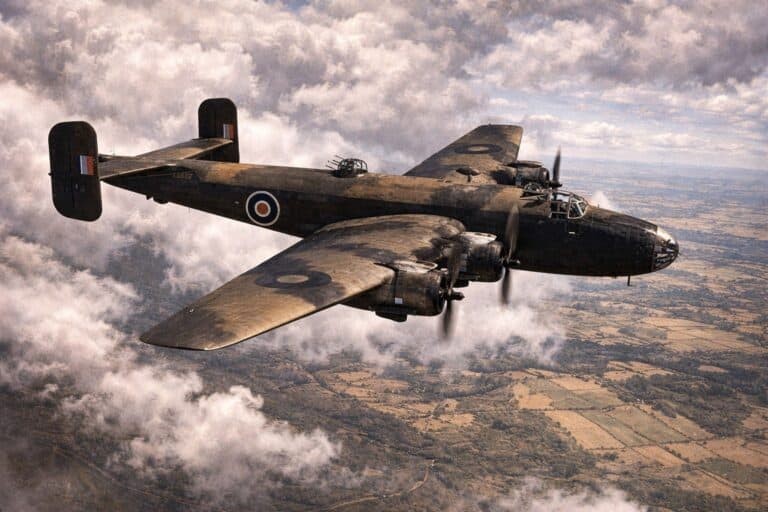
The Short Stirling marked a significant stage in British air power during the late 1930s and the early years of the Second World War. Conceived during the rearmament programme and entering squadron service in August 1940, it became the Royal Air Force’s first operational four-engined heavy bomber.
Its development followed Air Ministry Specification B.12/36, issued in 1936, which called for a long-range heavy bomber capable of carrying a substantial bomb load. The Stirling emerged as an ambitious design shaped by strategic doctrine, industrial capacity, and practical constraints, including the requirement to fit within existing RAF hangars. Although it introduced four-engined heavy bomber capability to Bomber Command, its operational performance revealed important limitations that became more apparent as the war progressed.
During a relatively short frontline bombing career, the Stirling served in strategic bombing and mine-laying roles before being adapted for use by airborne forces and for transport duties. Its service record illustrates both the rapid evolution of heavy bomber design and the transitional nature of early four-engined types.
Design Origins and Specification B.12/36
Air Ministry Specification B.12/36, issued in July 1936, required a four-engined heavy bomber with demanding performance characteristics. It called for a minimum speed of approximately 230 mph and a range approaching 3,000 miles. The aircraft also needed to carry an 8,000 lb bomb load over a significant distance and offer adaptability for troop transport.
The Short S.29 design was selected alongside Supermarine’s competing Type 317 programme, which was cancelled after wartime bombing damaged the Supermarine works. The Short design, therefore, became the RAF’s first operational four-engined heavy bomber.
The specification reflected the strategic importance attached to long-range bombing. A 100-foot wingspan limit, associated with contemporary airfield and hangar requirements, constrained the wing design and contributed to performance compromises.
Development and Testing
Short Brothers undertook development using a half-scale research aircraft, the S.31, to test aerodynamic characteristics. The S.31 first flew on 19 September 1938 and completed extensive trials, providing data for the full-scale design.
The first Stirling prototype flew in May 1939, powered by Bristol Hercules radial engines. It was written off after an undercarriage collapse on landing, attributed to a brake-related problem. A second prototype incorporating undercarriage changes flew later in 1939.
Confidence in the design was demonstrated by a production order placed before prototype testing was complete. Production faced wartime disruption, including Luftwaffe attacks on manufacturing facilities and the challenges of building a complex new heavy bomber.
Operational Characteristics
The Stirling possessed several favourable handling qualities for its size. Its large wing provided stable flight characteristics and good control response. Structurally, it was robust and capable of absorbing damage.
The aircraft was designed to carry a maximum bomb load of up to 14,000 lb. However, the bomb bay was divided into separate compartments, which later prevented the carriage of the largest high-capacity bombs used by Bomber Command.
One significant limitation was the restricted wingspan. The resulting wing geometry and loading, combined with the aircraft’s weight and engine performance, contributed to a comparatively modest operational ceiling, often around 16,000–17,000 feet with a wartime load. Later heavy bombers such as the Halifax and Lancaster operated at significantly higher altitudes.
The relatively low operational height increased exposure to anti-aircraft fire and night fighters. Its effective range with a useful bomb load also restricted its employment compared with later heavy bombers.
Bomber Command Service
No. 7 Squadron began receiving Stirlings in August 1940 and carried out the type’s first operational bombing attack on the night of 10–11 February 1941, when three aircraft joined a raid on oil storage facilities near Rotterdam.
At its peak, the Stirling equipped thirteen Bomber Command squadrons, although this total should not be confused with the number of units that operated it in transport, glider-towing or training roles. It participated in strategic bombing operations against industrial, naval and transport targets, as well as mine-laying missions.
As the Halifax and especially the Lancaster entered large-scale service from 1942 onwards, the Stirling’s limitations became increasingly evident. By 1943, Bomber Command began withdrawing the type from primary strategic bombing duties.
The Stirling’s remaining bombing operations ended in September 1944, including attacks associated with the fighting around Le Havre. By then the type had largely passed from the main strategic bombing campaign to specialist and airborne-support duties.
Published summaries commonly credit the Stirling with around 18,000 bomber sorties; the precise total depends on the operational counting basis. Its front-line bombing role was relatively short-lived, but it played a substantial part in the early expansion of the RAF’s heavy bomber force.
Airborne and Transport Roles
Following withdrawal from strategic bombing, the Stirling found a second career as a glider tug and transport aircraft. Stirling Mk IV aircraft participated in airborne operations during the Normandy landings on 6 June 1944, Operation Market Garden in September 1944 and Operation Varsity, the Rhine crossing, in March 1945.
In these roles, the aircraft towed gliders carrying troops, artillery and vehicles, or conducted parachute drops. Although vulnerable to ground fire, its lifting capacity and structural strength made it suitable for these tasks.
In the post-war period, the unarmed Stirling Mk V transport served briefly with Transport Command before being replaced by more modern transport types.
Production and Retirement
A total of 2,371 Stirlings were built by Short Brothers and associated production facilities, including Short Brothers and Harland in Belfast, and the Austin Motor Company. Production continued despite wartime disruption, including bombing damage to manufacturing facilities.
After the war, the type was quickly withdrawn from RAF service. The aircraft’s design was closely tied to wartime requirements, and it did not have a long post-war RAF career.
| Dimensions | |
| Wingspan | 99 ft 1 in (30.20 m) |
| Length | 87 ft 3 in (26.59 m) |
| Height | 22 ft 9 in (6.93 m) |
| Wing area | 1,460 sq ft (136 m²) |
| Weights | |
| Empty weight | 49,600 lb (22,498 kg) |
| Max takeoff weight | 70,000 lb (31,751 kg) |
| Max bomb load | 14,000 lb (6,400 kg) |
| Performance | |
| Maximum speed | 282 mph (454 km/h) |
| Cruise speed | 200 mph (320 km/h) |
| Service ceiling | 16,500 ft (5,000 m) |
| Range | 2,330 mi (3,750 km) |
| Powerplant | |
| Engines | 4 × Bristol Hercules XI radial engines |
| Power | 1,500 hp (1,100 kW) each |
| Armament | |
| Guns | 8 × .303 in Browning machine guns and up to 14,000 lb (6,400 kg) of bombs |
| Bombs / weapons | 14,000 lb (6,400 kg) |
Operation Market Garden
How the RAF supported Operation Market Garden through transport aircraft, glider towing, fighter control and resupply in September 1944.
Operation Millennium
Operation Millennium was Bomber Command’s first thousand-bomber raid, launched against Cologne on 30–31 May 1942 to demonstrate RAF striking power.
Operation Gomorrah
How RAF Bomber Command carried out Operation Gomorrah against Hamburg using concentrated area bombing and the new Window countermeasure.

RAF Losses and Attrition Across the Second World War
How RAF losses in war included combat, training and hidden attrition, shaping policy, doctrine and the…
28 April 2026 · 6 minFrom Cologne to the Ruhr: RAF Strategic Bombing Escalates
RAF strategic bombing moved from the Cologne mass raid to the Ruhr offensive, expanding Bomber Command’s…
16 June 2026 · 4 minFrom Radar to Night Fighting: How RAF Air Defence Evolved
How radar, ground control and specialist night fighters enabled the RAF to build a more effective…
21 July 2026 · 4 min