On This Day, 1939: On 21 October 1939, 46 Squadron Hurricanes intercepted Heinkel He 115 floatplanes over the North Sea in the…
Read the entry →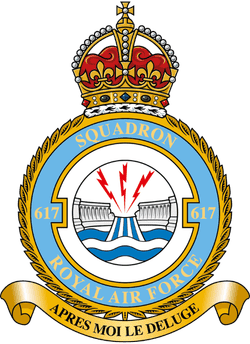
617 Squadron
“The Dambusters”
Après moi le déluge — After me, the flood
How 617 Squadron evolved from the Dams Raid and Tallboy operations to Tornado strike and today’s F-35B Lightning role.
Specialist precision strike squadron with a heritage stretching from Operation Chastise to carrier-capable fifth-generation combat operations.
617 Squadron, formed at RAF Scampton in March 1943, occupies a distinctive place in Royal Air Force history. Created for the attack on the Ruhr dams, it became known to the public as the Dambusters, but its record extends far beyond a single raid. Across repeated re-formations, the squadron retained an identity closely associated with precision attack, specialist weapons and adaptation to new forms of strike warfare. Its motto, Après moi le déluge, has remained the best-known expression of that inheritance.
617 Squadron’s historical significance lies not merely in fame, but in continuity of role. From modified Avro Lancaster bombers carrying Upkeep, through Tallboy and Grand Slam operations, the V-bomber era, Tornado stand-off strike and the modern F-35B Lightning force, the squadron has repeatedly been linked with advanced or specialised attack capability within the wider RAF. In that sense, its history provides a useful thread through the development of British precision strike doctrine across very different eras of air power.
Formation and Operation Chastise
The squadron was formed for a specific task. British planners had identified the great dams of the Ruhr, especially the Möhne and Eder, as critical infrastructure supporting German industry and power generation. Conventional bombing offered little confidence of success against such heavily built targets, and Barnes Wallis’s Upkeep mine was developed as a specialised solution.
Delivery of the weapon demanded exceptional accuracy. Lancasters had to fly at very low level at night and release the mine at carefully controlled speed, height and range. To make this possible, aircraft were specially modified with open bomb-bay arrangements, mounting gear, a spin mechanism for the weapon and a spotlight system to help maintain release height.
617 Squadron was assembled from experienced Bomber Command crews and trained intensively in low-level night flying and precise attack methods under Wing Commander Guy Gibson. On the night of 16–17 May 1943, nineteen aircraft were dispatched on Operation Chastise. The Möhne and Eder dams were breached, the Sorpe was damaged and the raid immediately established the squadron’s reputation. The cost, however, was severe: eight aircraft were lost and 53 aircrew killed.
Specialist precision role in the later war
After Chastise, Bomber Command retained 617 Squadron as a specialist precision-bombing unit rather than dissolving it after its original task. This reflected both the quality of its crews and the growing value of a unit already trained for difficult and unusual operations.
A costly daylight low-level attack on the Dortmund–Ems Canal in September 1943 demonstrated the danger of using heavy bombers in such conditions. Thereafter the squadron’s specialist work increasingly moved towards higher-altitude precision attack. Under Wing Commander Leonard Cheshire, 617 Squadron refined methods of target marking and exact strike delivery, often in conjunction with specialist tactics that supported the main bombing force.
The squadron later became closely associated with Barnes Wallis’s Tallboy and Grand Slam bombs, large deep-penetration weapons intended for hardened or heavily protected targets. These were used against V-weapon sites, railway and viaduct targets, industrial objectives and fortified installations. In November 1944, Tallboy attacks by 617 Squadron and 9 Squadron contributed to the sinking of the German battleship Tirpitz. By 1945, the squadron had become one of Bomber Command’s principal specialist precision formations.
Post-war service and the V-bomber era
After the war, 617 Squadron continued into the post-war RAF, first with the Avro Lincoln. This phase included overseas deployment and a North American goodwill tour, showing that the wartime squadron was being carried into a very different strategic environment.
In 1952 the squadron converted to the English Electric Canberra and saw service in the Malayan Emergency, marking both its entry into the jet age and a move into post-war colonial and limited-war operations.
A more substantial transition followed in 1958, when 617 Squadron re-formed at RAF Scampton as part of the V-bomber force, operating the Avro Vulcan in the strategic nuclear role. During the 1960s it also introduced the Blue Steel stand-off missile. This gave the squadron a place within Britain’s nuclear deterrent and linked its older specialist-attack identity to the strategic realities of the Cold War. When the Royal Navy’s Polaris force assumed the primary national deterrent role, the squadron continued in low-level tactical and conventional strike work until the Vulcan era ended with disbandment in 1981.
Tornado and the return to specialist strike
617 Squadron re-formed again in May 1982 at RAF Marham as a Panavia Tornado GR1 unit. This was another important transition because the Tornado’s terrain-following radar, navigation systems and strike role aligned naturally with the squadron’s long association with specialist attack.
The squadron deployed on Operation Granby during the 1991 Gulf War, later moved to RAF Lossiemouth and briefly operated the Tornado GR1B in the maritime strike role. With conversion to the Tornado GR4, it entered the modern precision stand-off era and became one of the RAF units associated with the operational use of the Storm Shadow cruise missile during Operation Telic in Iraq. It later took part in operations in Iraq, Afghanistan and Libya before disbanding again in 2014.
The F-35B era
The squadron’s most recent phase began with re-formation as the RAF’s first operational F-35B Lightning unit. The first aircraft arrived at RAF Marham in 2018, and the squadron soon moved into operational service. It later deployed to RAF Akrotiri on Operation Shader and has since become a key component of Britain’s carrier-capable air power, operating in conjunction with HMS Queen Elizabeth and wider carrier strike planning.
This stage of the squadron’s history has broadened its role from specialist strike alone to a more flexible multi-role and carrier-capable profile. Even so, the connection with advanced attack capability remains clear.
Historical significance
617 Squadron matters because it links several different chapters of RAF history that might otherwise appear separate: wartime special operations, post-war transition, nuclear deterrence, modern precision strike and fifth-generation carrier-capable air power. Its repeated disbandments and re-formations did not erase its identity. Instead, they marked the extent to which the squadron name was repeatedly attached to roles judged especially important or symbolically weighty within the service.
For RAF history, 617 Squadron is therefore more than the Dambusters. It is one of the clearest examples of how a squadron identity could survive across changing aircraft, weapons and doctrines while remaining associated with specialist strike capability for more than eight decades.
Ruhr 1943
Dams Raid 1943
France and Germany 1944–1945
Biscay Ports 1943–1944
Tirpitz 1944
Baltic 1944–1945
Channel and North Sea 1944–1945
Gulf 1991
Iraq 2003
Afghanistan 2009–2014
Operation Chastise (Dams Raid), May 1943
Attack on the Dortmund–Ems Canal, September 1943
Attack on Tirpitz, November 1944
Operation Granby, 1991
Operation Telic, 2003
Operation Shader, 2019–present
Two Victoria Crosses were awarded to members of 617 Squadron. Wing Commander Guy Gibson VC DSO & Bar DFC & Bar received the award for leading Operation Chastise on 16–17 May 1943. Flight Lieutenant Bill Reid VC later served with the squadron after earning his Victoria Cross in 1943 while with No. 61 Squadron.
| Period | Station | Notes |
|---|---|---|
| March 1943–June 1945 | RAF Scampton | Formed and based through the main wartime specialist bombing period. |
| June 1945–January 1946 | RAF Waddington | Post-war transition. |
| 1958–1981 | RAF Scampton | Vulcan and nuclear-deterrent era. |
| 1982–2014 | RAF Marham | Tornado strike era. |
| 2018–present | RAF Marham | F-35B Lightning era. |
| Name | Dates | Notes |
|---|---|---|
| Guy Gibson | March–August 1943 | Led Operation Chastise and established the squadron’s specialist identity. |
| George Walton Holden | August–September 1943 | Succeeded Gibson and was later killed in action. |
| Leonard Cheshire | 1943–1944 | Developed important wartime precision-marking methods. |
Operation Chastise
On the night of 16–17 May 1943, 617 Squadron breached the Möhne and Eder dams using Barnes Wallis's…
Operation Granby
How Operation Granby saw the RAF fight in the 1991 Gulf War, from Tornado strike missions to the…
Operation Telic
How the RAF supported Operation Telic through strike aircraft, reconnaissance, tankers and transport in Iraq from 2003 onward.

617 Squadron’s Non-Stop Vulcan Flight to Australia in 1961
No. 617 Squadron flew a Vulcan non-stop from Britain to Australia, showing the reach, planning and…
20 June 2026 · 3 minVictoria Cross in RAF Service: Gallantry and Memory
A documentary history of the Victoria Cross in RAF service, examining wartime gallantry, operational context and…
7 July 2026 · 4 minFirst Operational Grand Slam Bomb Dropped on Bielefeld
On 14 March 1945, Squadron Leader C. C. Calder used the RAF’s first operational Grand Slam…
14 March 2026 · 3 min