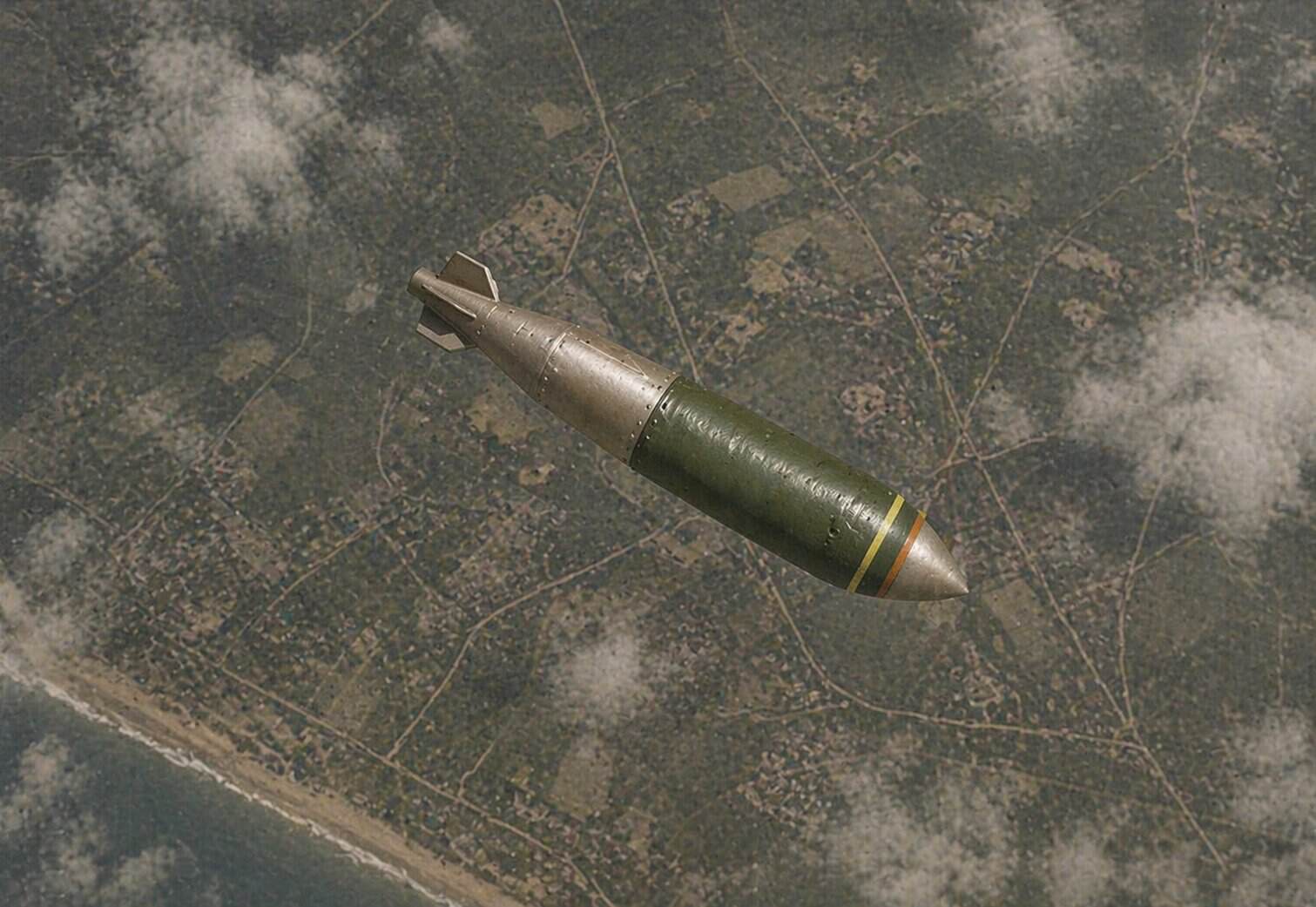
Tallboy represented one of the clearest signs that RAF heavy bombing had entered a more specialised phase by 1944. Designed by Barnes Wallis as a deep-penetration weapon, it was intended not simply to add more explosive force, but to destroy targets that ordinary bombing often struggled to break. Carried by modified Avro Lancaster bombers and used in carefully planned operations, Tallboy showed how Bomber Command could combine heavy striking power with a more exact operational purpose.
Background
By the middle of the war, the RAF had accumulated wide experience of large-scale bombing, yet some objectives remained resistant to conventional attack. Strongly built submarine pens, tunnels, viaducts, fortified sites and major warships could absorb blasts that might devastate less protected targets. The problem was not only one of weight, but of effect. To damage hardened structures decisively, a bomb needed to strike with great force, penetrate deeply and detonate in a way that disrupted the target from within or beneath it.
Wallis’s answer was Tallboy, a streamlined weapon designed to fall accurately from height and gain very high impact speed before detonation. Its purpose was to produce a destructive shock in the ground or in the fabric of a target rather than merely scatter fragments across the surface. That made it suited to a narrower class of objectives, but potentially far more useful against them than ordinary bomb loads. In RAF terms, it belonged to a wider wartime trend: the search for methods that could turn heavy bombers towards selected military effects rather than only broad cumulative damage.
Operational Use
Tallboy entered service in 1944, when Bomber Command had better navigation aids, more experienced crews and a growing capacity for specialised operations. It demanded careful preparation. Aircraft had to be adapted for the weapon, bombing runs had to be steady, and accuracy mattered far more than in a standard area raid. 617 Squadron became closely associated with this form of attack, and Tallboy employment drew upon the same culture of exacting planning that had already marked some of the RAF’s most demanding special missions.
The weapon was used against targets whose destruction promised effects disproportionate to the number of aircraft involved. Viaducts, tunnels, V-weapon sites, fortified positions and U-boat facilities all fell within that category. Tallboy did not replace the wider bombing offensive, which continued on a very large scale, but it broadened the range of how heavy bombers could be employed. Instead of asking whether a large formation could lay waste to a general target area, planners could increasingly ask whether a limited force could cripple a single, especially important point within a transport, naval, or industrial system.
Results and Losses
When conditions allowed accurate delivery, Tallboy could achieve results that were difficult to obtain with standard weapons. Its most celebrated use came in the attacks on the German battleship Tirpitz, where penetrating hits from Lancaster bombers finally helped destroy a target that had long absorbed British attention and resources. Elsewhere, the same principle was applied against lines of communication and other hardened objectives whose loss could impose immediate operational strain.
These successes did not remove the hazards of the missions themselves. Tallboy operations still required long flights, exposure to anti-aircraft fire and, at times, difficult weather or exacting approach conditions. The crews involved were not performing an easier form of bombing, but a more specialised one. Precision reduced waste against certain targets, yet it also placed greater pressure on aircraft performance, navigation, bombing discipline and the quality of intelligence behind target selection.
Significance
Tallboy mattered because it illustrated how RAF heavy bombing had evolved by the later stages of the war. Bomber Command remained an instrument of mass attack, but by 1944, it was also capable of concentrated strikes against specific objectives whose destruction had immediate military value. The shift was technical and operational at the same time: improved navigation, better target marking, more refined planning and specialised weapons all worked together.
In that sense, Tallboy was not an isolated curiosity. It sat within a broader movement towards more discriminating use of heavy bombers, even while the larger strategic bombing campaign continued. It also showed that innovation in RAF service did not stop with aircraft alone. Weapons design, delivery method, and target analysis could alter the meaning of bombing just as much as airframe performance does.
Wider Context
The importance of Tallboy can therefore be seen beyond any single raid. It marked a stage in which the RAF could use the Lancaster not only as a platform for the weight of attack, but also as an instrument for precision strikes against hardened targets. That development helped prepare the way for later special-purpose weapons and confirmed the value of highly trained crews operating with carefully defined objectives.
In the wider air war, Tallboy did not replace attritional bombing, nor did it make every difficult target vulnerable at once. What it did show was that by 1944, British heavy bombing had become more flexible, more technically ambitious and, in certain circumstances, markedly more precise.