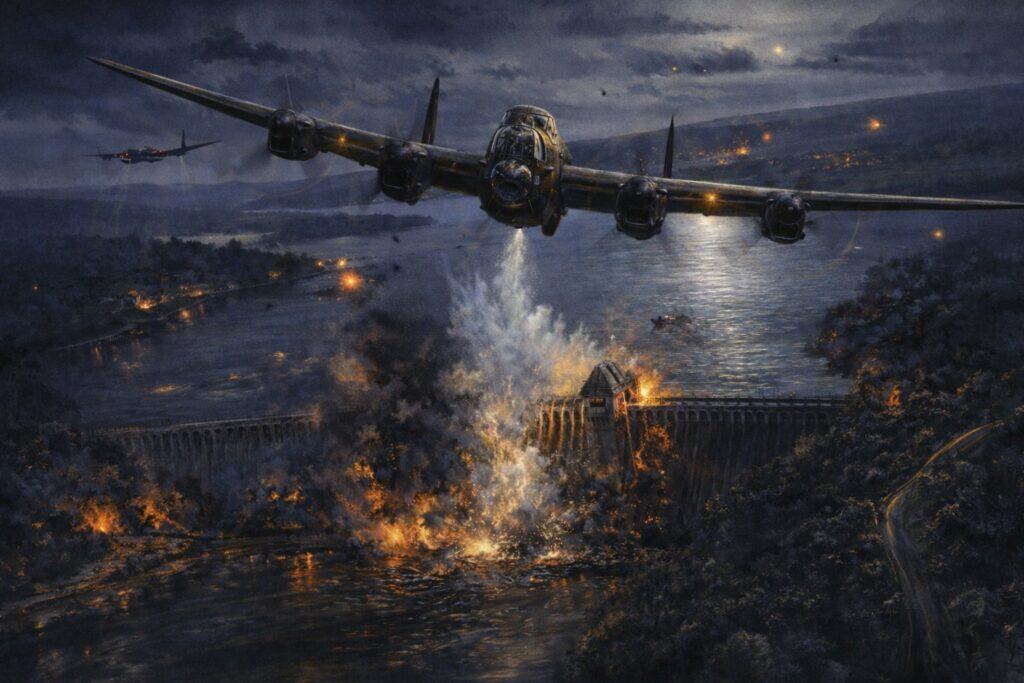
The Royal Air Force carried out Operation Chastise on the night of 16-17 May 1943. It was a low-level attack by 617 Squadron against three dams in Germany’s Ruhr valley: the Möhne, Eder and Sorpe. These dams supported a major industrial region through water supply, hydroelectric power and control of inland waterways.
The operation formed part of RAF Bomber Command’s effort in 1943 to disrupt German war production. Rather than a massed high-altitude raid, it involved a small number of modified Avro Lancasters carrying a weapon devised by Dr Barnes Wallis. The Upkeep mine was designed to skip over water, pass above torpedo nets and detonate against dam walls at depth. Its use required night operations at low altitude, with strict speed and release parameters.
The raid combined technical development, specialised training, and low-level flying, resulting in the loss of aircraft and crews. It caused localised damage. Its longer-term strategic effect has been subject to historical assessment. The following sections set out the background, the development of the weapon, the formation and training of No. 617 Squadron, the execution of the raid, and its consequences.
The Strategic Context And Development Of The Bouncing Bomb
By early 1943, the Ruhr valley was a central area of German armaments production. The region contained steelworks, coal mines, chemical plants and factories dependent on water supply and electrical power.
The Möhne, Eder and Sorpe dams regulated river levels, fed canals and inland waterways, supplied drinking water, and powered hydroelectric stations that supported nearby industries.
British planners assessed that disruption to this water network could affect transport, industrial processes and production.
The dams presented structural and defensive challenges. The Möhne and Eder were masonry gravity dams. The Sorpe was an earth embankment with a central concrete core. Anti-aircraft guns defended all three, and torpedo nets protected the reservoirs. Conventional bombing methods lacked the required accuracy and effect.
Dr Barnes Wallis developed a method based on a rotating weapon designed to skip across water. Initial experiments involved small-scale tests examining the effect of backspin on water impact. The concept was adapted for fixed targets such as dams.
The resulting Upkeep mine was carried beneath a Lancaster and rotated backwards at approximately 500 revolutions per minute before release. Trials established three critical conditions: an approach speed of around 232 miles per hour, a release altitude of just 60 feet, and sufficient backspin to ensure the mine made contact with the dam wall before sinking.
Under these conditions, the mine would bounce across the water, pass over defences and strike the dam. Backspin would carry it down the wall to a depth of about 30 feet, where a hydrostatic fuse initiated detonation.
Formation And Training Of No. 617 Squadron
RAF Bomber Command formed a unit to deliver the weapon under operational conditions. In late March 1943, a new squadron was established at RAF Scampton in Lincolnshire. It became No. 617 Squadron under the command of Wing Commander Guy Gibson.
The squadron comprised 133 aircrew drawn from the RAF and allied air forces, including personnel from Britain and Commonwealth countries. Many had operational experience. Operational security was maintained, with only a limited number of personnel informed of the targets.
The Avro Lancaster was selected and modified for the role. Bomb bay doors were removed and a mounting installed beneath the fuselage, with a mechanism to rotate the weapon. Some equipment was removed to reduce weight. An optical system using two downward-pointing spotlights enabled crews to maintain the required altitude.
Training concentrated on the core skills of low-level night flying, precise navigation, and refined attack procedures to ensure operational readiness.
The crews practised over reservoirs in Britain and conducted repeated low-altitude exercises. By mid-May 1943, the squadron was prepared for operations.
Execution Of The Raid On 16-17 May 1943
On the evening of 16 May 1943, nineteen modified Lancasters departed RAF Scampton in three waves. Moonlight aided navigation but increased exposure. The aircraft flew at low altitude across the North Sea, the Netherlands and western Germany.
The route was fraught with dangers, including high-voltage cables strung across the path, unpredictable terrain variation, and intense anti-aircraft fire. Two aircraft struck cables and were lost before even reaching their targets, while others were destroyed by enemy fire.
The first wave attacked the Möhne dam. After multiple attack runs, a mine released by Pilot Officer David Maltby caused a breach, resulting in flooding downstream.
Aircraft then proceeded to the Eder dam, where terrain required repeated approaches. A mine released by Flight Lieutenant Les Knight breached the structure.
The Sorpe dam was attacked later and sustained damage, but was not breached.
Eight of the nineteen aircraft were lost.
Immediate Consequences And Casualty Assessment
Breaches in the Möhne and Eder dams released an estimated 330 million tonnes of water. Flooding destroyed infrastructure, including bridges, roads and railways, and affected industrial facilities. Two power stations were destroyed.
Fatality estimates range between approximately 1,200 and 1,600 individuals, including forced labourers and prisoners of war. Approximately 749 prisoners, many from Eastern Europe, died in flooding below the Eder.
RAF losses included eight aircraft. Eleven returned. Fifty-three aircrew were killed and three captured. Of the 133 participants, 48 survived the war.
Strategic Impact And Historical Assessment
German authorities undertook repairs following the attack. Temporary measures restored elements of water control and power generation, and reconstruction of the dams was completed within several months. Industrial disruption occurred but was short-lived.
Resources were allocated to repair work and to strengthen infrastructure protection. Statements by Air Chief Marshal Sir Arthur Harris reflected the wider strategic bombing policy in place at the time.
The Upkeep weapon was not used again operationally. Operation Chastise is therefore regarded as a specialised operation whose wider strategic implications continue to be examined in studies of infrastructure targeting and bombing policy.
Propaganda Value And Recognition Of 617 Squadron
The operation influenced public morale in Britain. Official communications emphasised the conduct of the attack and the damage caused. The term “Dambusters” entered general usage.
Guy Gibson was awarded the Victoria Cross. Thirty-three other members of No. 617 Squadron received decorations. The squadron later undertook further precision operations.
The 1955 film The Dam Busters contributed to public awareness of the raid.