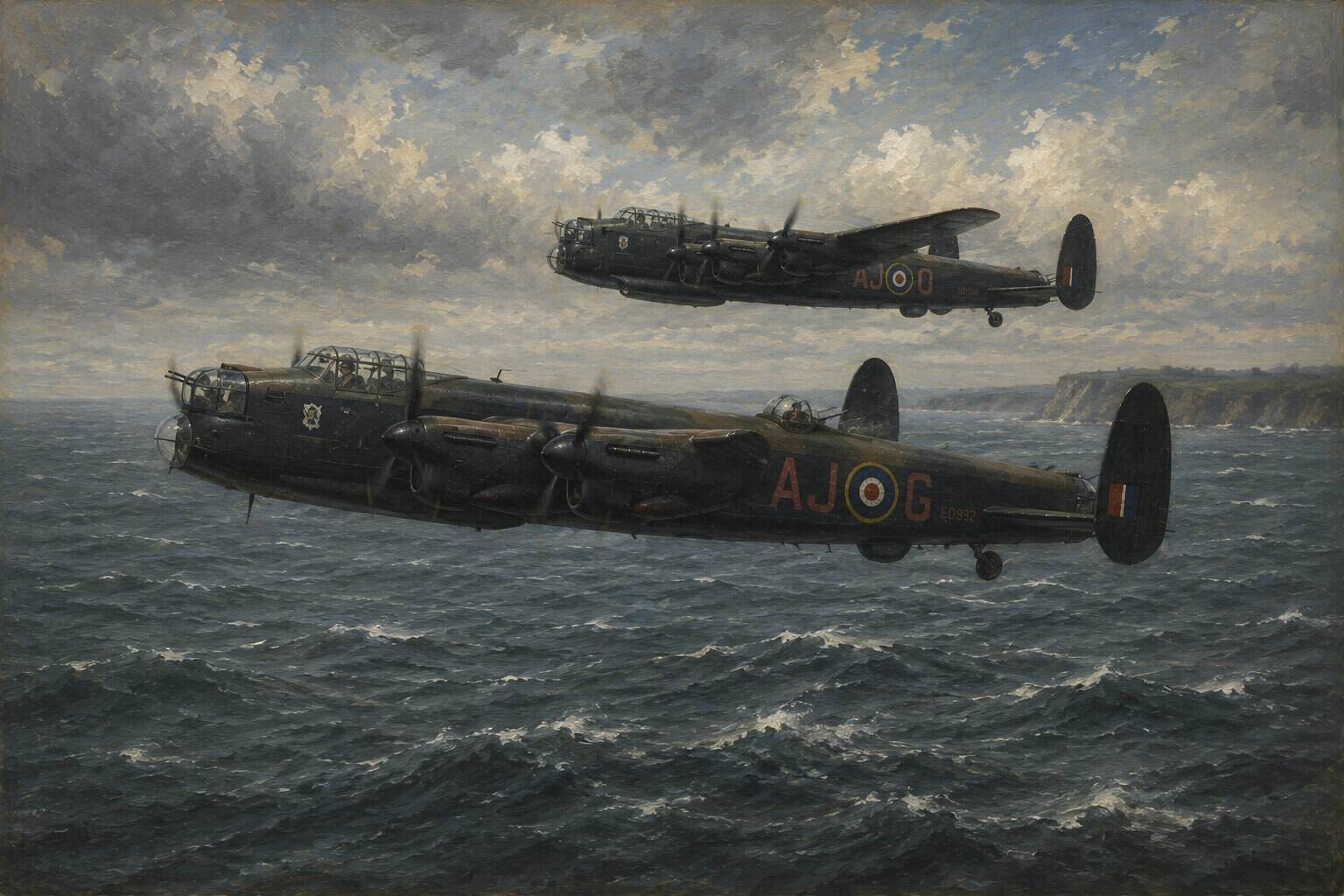
617 Squadron was formed in 1943 for a singular and demanding task: the execution of Operation Chastise against the Ruhr dams. Its creation was rapid, its training exacting and its identity shaped almost immediately by one of the most famous missions in RAF history. Yet the making of the squadron was not simply a matter of legend. It was a practical process of selection, concentration and operational preparation under unusual pressure.
Formation For A Specific Task
The squadron was assembled for a mission that required a specially prepared unit rather than the routine employment of an existing formation. Operation Chastise depended on a novel weapon, very low-level flying, strict coordination and crews capable of absorbing a demanding training programme in limited time. The squadron therefore emerged from a deliberate concentration of selected aircrew and supporting personnel around a clearly defined objective.
This gave 617 Squadron an unusual beginning. It was not shaped gradually through a long sequence of operations before achieving distinction; it was created in direct relation to a single planned strike whose success depended on extraordinary precision.
Training And Preparation
The preparation of the unit involved more than enthusiasm or reputation. Crews had to master low-altitude navigation and formation discipline under conditions that left little room for error. The demands of the operation required careful rehearsal, technical adaptation and the forging of confidence inside a newly constituted squadron.
The pressure of time mattered greatly. The unit had to become operationally coherent at speed while also absorbing the peculiar requirements of the Upkeep weapon and the tactical method intended for its delivery. In that sense, the making of 617 Squadron was inseparable from the making of Chastise itself.
Identity And Immediate Reputation
Because the squadron’s first major operation became so famous, public memory often compresses its formation, training and combat identity into a single legend. In reality, that identity was built through rapid institutional effort and the raid’s later fame. The selection of crews, the intensity of preparation and the risks accepted by those involved all contributed to the squadron’s early character.
The mission also imposed a heavy burden. A unit created for exceptional performance had to prove itself immediately in combat, and the costs of failure would have been severe in operational, strategic and reputational terms.
Significance
The making of 617 Squadron illustrates how the RAF could create a specialist striking force for a tightly defined objective. It also shows that celebrated units are not only products of memory but of organisation, training and concentration of effort. Operation Chastise gave the squadron its lasting fame, but the squadron’s formation reveals the disciplined RAF process behind one of the war’s most distinctive operations.