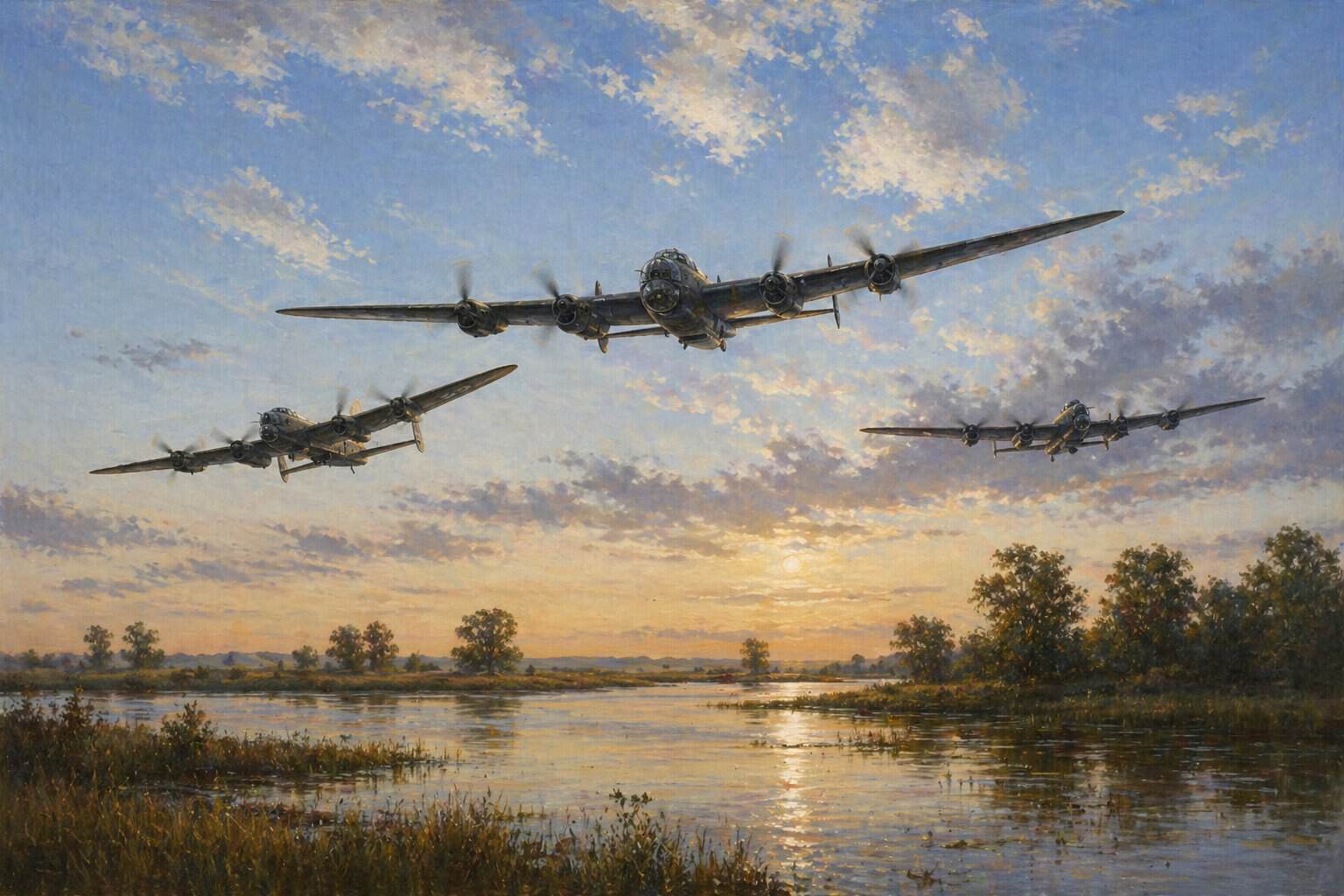
On 16 May 1943, nineteen Avro Lancaster aircraft of 617 Squadron set out for the Ruhr dams carrying Barnes Wallis’s Upkeep mines. The operation, later known as Operation Chastise, became one of the most famous RAF raids of the Second World War. Its immediate objectives were the Möhne, Eder and Sorpe dams, targets intended to disrupt German industry, transport and power in the Ruhr.
The mission combined technical innovation, demanding flying and careful operational planning. It also required crews to attack at low level, at night and with unusual precision against heavily defended objectives. In RAF history, the launch of the raid remains one of the clearest examples of how specialist weapons and highly trained crews could be combined for a single high-risk strike.
A Special Operation and a New Weapon
The raid was built around the Upkeep mine devised by Barnes Wallis. Instead of conventionally striking a target, the weapon was designed to bounce across the water, pass defences and explode against the dam wall at the required depth. That concept demanded extensive testing and equally exacting operational technique.
617 Squadron had been formed specifically for the task. Its crews had to master very low-level night flying, strict speed and altitude limits, and the navigational discipline required to reach targets deep inside Germany. The aircraft used was the Avro Lancaster, adapted to carry the unusual weapon and to support the special demands of the raid.
This was not simply a matter of courage in the air. The operation depended on preparation, engineering and training in equal measure. It stood at the intersection of invention and execution in a way few RAF missions did.
The Raid and Its Cost
When the force was launched on the night of 16 May, the crews faced one of the most difficult operational tasks yet attempted by Bomber Command. The Möhne and Eder dams were eventually breached, and the raid exacted a high cost on the attacking force.
That balance between success and sacrifice has always been central to the historical understanding of the mission. The raid achieved a dramatic and highly visible result, but it also imposed severe losses on the squadron. In that respect, it reflected the broader wartime reality that striking results in the bomber offensive often came at a great human price.
The operation’s immediate strategic effect has long been debated, but its significance in RAF history is beyond doubt. It demonstrated the service’s capacity to mount a highly specialised attack with a unique weapon and to strike targets that ordinary bombing methods would have struggled to reach.
Operational Legacy
The launch of the dams raid brought together many of the defining characteristics of wartime RAF operations: innovation, specialist planning, elite crew training and the hazards of deep-penetration attack. It also gave 617 Squadron a place in public memory that has endured ever since.
The raid that followed would enter RAF legend, but its significance lies equally in what it revealed about wartime air power: careful preparation, specialised technology and highly trained crews used in pursuit of a narrowly defined strategic effect.