On This Day, 1939: On 21 October 1939, 46 Squadron Hurricanes intercepted Heinkel He 115 floatplanes over the North Sea in the…
Read the entry →
Wing Commander
Guy Gibson
Guy Gibson led 617 Squadron on Operation Chastise, but his wider RAF career spanned 177 operations across Bomber and Fighter Command.
Wing Commander Guy Penrose Gibson VC, DSO and Bar, DFC and Bar (12 August 1918 – 19 September 1944) flew operational tours in RAF bombers and night fighters before leading No. 617 Squadron in the Dams Raid of May 1943. Awarded the Victoria Cross for his leadership during Operation Chastise, he was killed the following year while flying a Mosquito as Master Bomber over Germany.
Early Life and RAF Entry
Gibson was born at Simla, British India, on 12 August 1918. He spent much of his childhood in England, attended school there and entered RAF flying training in 1936. An ambitious and determined young officer, he developed operational skills that would take him through several demanding forms of air warfare. His later reputation combined exceptional persistence and personal courage with a forceful command style that could cause friction.
Early War: Hampdens and Night Fighters
Gibson flew his first operational sortie in September 1939, days after war was declared. With No. 83 Squadron, he operated Handley Page Hampdens on bombing and minelaying missions. Crews of these early-war bombers faced the combined hazards of navigation, weather, mechanical difficulties, anti-aircraft fire and enemy fighters. Gibson completed his first operational tour and received the Distinguished Flying Cross in 1940. His experience was gained through repeated sorties at a time when Bomber Command‘s methods and equipment were still developing.
Rather than accept an extended rest from frontline flying, Gibson volunteered for a second tour with Fighter Command. Flying Bristol Beaufighters with No. 29 Squadron, he became part of Britain’s developing night-defence system. Night interception depended on ground control, airborne radar and close cooperation between pilot and radar operator. Gibson was credited with destroying enemy aircraft and received a Bar to his Distinguished Flying Cross. The transition demonstrated his ability to adapt from bomber operations to a very different form of combat.
Command of No. 106 Squadron
In 1942 he returned to Bomber Command to command No. 106 Squadron, initially flying the Avro Manchester and subsequently the Avro Lancaster. The transition brought new capability but also placed demands on crews learning a heavy bomber with different handling and operating requirements. Gibson continued to lead operations personally, including attacks on heavily defended targets. He received the Distinguished Service Order in November 1942; a Bar was announced in April 1943 for his sustained operational leadership. The citation described a record of 172 sorties, including his persistence in completing an attack on Stuttgart despite engine difficulties. His achievements at No. 106 Squadron were therefore established before Operation Chastise.
617 Squadron and Operation Chastise
In March 1943 Gibson was asked by Air Vice-Marshal Ralph Cochrane whether he would undertake another operation, the nature of which could not yet be disclosed. He agreed and transferred from No. 106 Squadron to Headquarters No. 5 Group on 15 March. No. 617 Squadron formally came into being at RAF Scampton on 24 March 1943, assembling experienced crews from across Bomber Command. Gibson had only weeks to build an effective unit and prepare it for an extraordinary specialist mission. The demanding programme included repeated low-level flights over land and water, often in darkness, and exacting coordination between pilots, navigators and bomb aimers.
The targets were dams serving the Ruhr industrial region. The Möhne, Eder and Sorpe supplied water and contributed to the region’s infrastructure. Barnes Wallis designed the rotating Upkeep weapon to bounce across a reservoir, pass defensive obstacles, sink close to the dam wall and detonate underwater. Modified Lancasters had to maintain a carefully controlled speed and a height of approximately 60 feet above the water, then release at a precisely judged distance. Special equipment helped crews measure height and range. The accuracy required was exceptional, particularly under fire and in darkness.
On the night of 16–17 May 1943, nineteen specially modified Lancasters departed Scampton in three groups. Gibson led the first formation in Lancaster ED932, AJ-G. Flying at very low level across occupied Europe exposed the crews to obstacles, navigation hazards and ground fire, and several aircraft were lost before reaching their targets.
Gibson attacked the Möhne Dam first, but his weapon did not breach it. Other crews followed. John Hopgood’s Lancaster was fatally damaged, and successive attacks took place under defensive fire. David Maltby’s attack finally breached the Möhne. Gibson deliberately drew fire towards his own aircraft while other crews made their runs, then continued to the Eder, where difficult surrounding terrain complicated the approach. The Eder was also breached. The Sorpe Dam was attacked and damaged but not breached.
Eight of the nineteen Lancasters failed to return and 53 aircrew were killed. Flooding from the breached dams caused extensive destruction downstream and killed civilians, including forced labourers. Although the raid disrupted water supplies, transport and industry, its longer-term strategic effects were more limited than the dramatic initial damage suggested. Gibson’s Victoria Cross, announced on 28 May 1943, recognised his conspicuous leadership and willingness to remain exposed to enemy fire to protect the attacking crews. The operation remains both a remarkable technical and flying achievement and an event with severe human consequences.
Public Recognition and Return to Flying
After Operation Chastise, Gibson was withdrawn from routine operational flying and undertook a widely publicised tour of the United States and Canada. He became a national figure at a time when the RAF was eager to communicate the achievement of its bomber crews. He also wrote his memoir Enemy Coast Ahead, published posthumously in 1946.
Public recognition brought an unusual dilemma for an officer who had spent much of the war on operations. During 1944 Gibson served in staff appointments and repeatedly sought opportunities to return to active flying. His determination reflected a reluctance to remain separated from operational aircrews. Eventually he was permitted to take part in a No. 5 Group raid as Master Bomber, directing an attack from the air rather than flying as a conventional Lancaster captain.
Final Mosquito Mission and Death
On 19 September 1944 Gibson flew de Havilland Mosquito B.XX KB267, coded AZ-E, associated with No. 627 Squadron. His navigator was Squadron Leader James Brown Warwick DFC. Acting as Master Bomber for the No. 5 Group attack on Mönchengladbach and Rheydt, Gibson was responsible for directing the attacking force and assessing the target area. The task demanded clear communication and precise judgement, and he had comparatively limited operational experience in the Mosquito.
The aircraft failed to return and crashed near Steenbergen in the Netherlands, killing both men. The exact cause remains unresolved. Suggested explanations include enemy action, friendly fire and fuel-related difficulties, but the surviving evidence does not establish one conclusively. Gibson was twenty-six years old. He and Warwick are buried in Steenbergen-en-Kruisland Roman Catholic Cemetery.
Historical Significance
Gibson remains one of the best-known figures in RAF history because his career combined sustained operational flying, command and public symbolism. He flew in both Bomber Command and Fighter Command, led No. 106 Squadron through the transition to the Lancaster and assembled No. 617 Squadron for an exceptionally demanding specialist operation.
Operation Chastise demonstrated remarkable engineering ingenuity and flying precision, but its historical assessment must also recognise the heavy RAF losses, the deaths and destruction caused by flooding, and the limits of its lasting strategic effect. Gibson’s courage and leadership can be recognised without reducing the raid to a simple story of triumph. His death in September 1944 also places the famous Dams Raid within the broader story of an operational commander who continued seeking active service until the end of his life.
| Dates | Role | Unit | Aircraft |
|---|---|---|---|
| 1937–1939 | Pilot Officer / Flying Officer | 83 Squadron | Hawker Audax; Handley Page Hampden |
| 1939–1940 | Flying Officer, bomber operations, first tour | 83 Squadron | Handley Page Hampden |
| 1940–1941 | Flight Lieutenant, night fighter operations | 29 Squadron | Bristol Beaufighter |
| 1942–1943 | Squadron Leader / Wing Commander, Commanding Officer | 106 Squadron | Avro Manchester; Avro Lancaster |
| March–May 1943 | Wing Commander, Commanding Officer, Operation Chastise | 617 Squadron | Avro Lancaster, Type 464 Provisioning |
| 1943–1944 | Staff, liaison and publicity duties | Headquarters Bomber Command | |
| September 1944 | Controller, bombing operations | 55 Base | De Havilland Mosquito XX |
Guy Gibson’s name has become inseparable from the Dambuster Raid, to the point where the wider arc of his operational career is often overshadowed. He flew 177 operations across Bomber Command and Fighter Command, a total achieved by very few airmen of the Second World War. His decorations reflect sustained operational leadership rather than a single act of gallantry.
His memoir, Enemy Coast Ahead, written in 1944 and published posthumously in 1946, remains one of the most detailed first-hand accounts of Bomber Command operations. 617 Squadron continues to serve in the Royal Air Force, today operating the F-35B Lightning II; its Dambuster heritage is retained in its badge and motto, Après moi le déluge.
He is buried at Steenbergen in the Netherlands. Memorials in Lincolnshire, including a statue near Lincoln Cathedral and the former RAF Scampton, continue to mark his association with 617 Squadron. His wartime story remains one of the most studied and debated within RAF history.
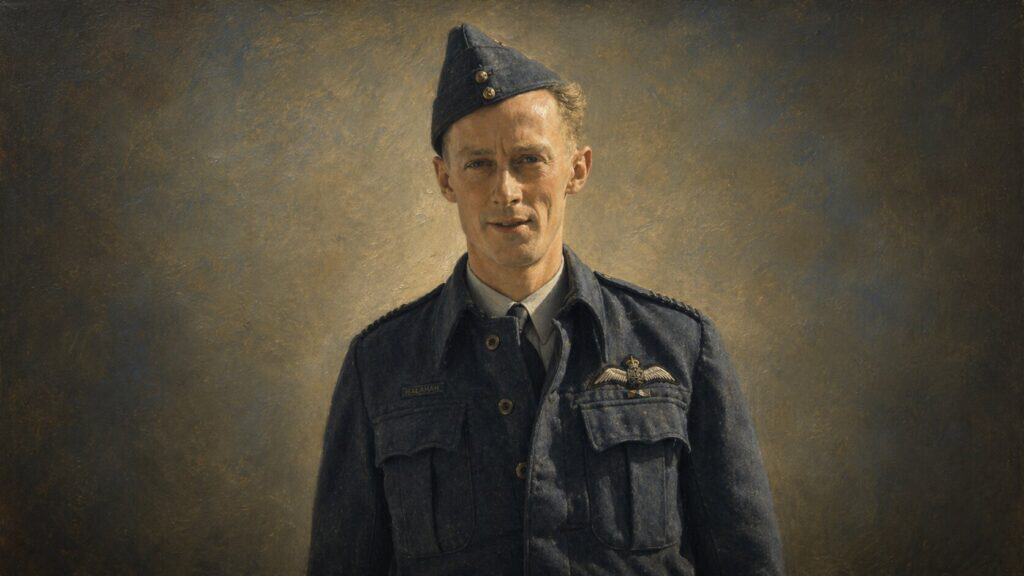

Guy Gibson Killed Returning from Operations in 1944
Wing Commander Guy Gibson was killed on 19 September 1944, a loss that reflected both his…
19 September 2026 · 3 minVictoria Cross in RAF Service: Gallantry and Memory
A documentary history of the Victoria Cross in RAF service, examining wartime gallantry, operational context and…
7 July 2026 · 4 minS for Sugar Flies Its Final Mission with Bomber Command
Lancaster R5868 ‘S for Sugar’ flew its 137th and final operation in 1945 before becoming one…
23 April 2026 · 3 min