On This Day, 1956: On 11 October 1956, a Valiant of No. 49 Squadron dropped a live Blue Danube atomic bomb at…
Read the entry →
12 Squadron
“Shiny Twelve”
Leads the field
How 12 Squadron’s history runs from the Albert Canal bridge attack and VCs of 1940 to Tornado strike and modern Typhoon service.
Long-established RAF squadron whose modern significance rests on strike and maritime-strike roles in the Tornado era and its later Typhoon partnership role.
No. 12 Squadron is one of the Royal Air Force’s longest-serving units, with a history stretching from the Royal Flying Corps in the First World War to modern Typhoon operations. Its responsibilities have encompassed reconnaissance, light and heavy bombing, nuclear deterrence, maritime strike and fighter operations.
The squadron is particularly remembered for the attack on bridges over the Albert Canal in Belgium on 12 May 1940, when Flying Officer Donald Garland and Sergeant Thomas Gray earned posthumous Victoria Crosses. Its later service included Bomber Command, Buccaneer maritime strike, Tornado operations and a joint RAF–Qatari Typhoon partnership.
Formation and First World War service
No. 12 Squadron formed at Netheravon on 14 February 1915 as a Royal Flying Corps unit and deployed to France later that year. It undertook reconnaissance, photography and artillery cooperation in support of British forces on the Western Front.
The squadron’s equipment changed as military aviation developed. Among the types associated with its First World War service were Royal Aircraft Factory B.E.2 aircraft and, later, the R.E.8. Its crews worked closely with troops on the ground, observing enemy movements and helping artillery identify targets while facing increasingly dangerous air and ground defences.
The squadron was disbanded in 1922.
Re-formation and the interwar years
No. 12 Squadron re-formed at RAF Northolt on 1 April 1923 with the Airco DH.9A. It subsequently operated the Fairey Fox, a notably fast light bomber whose performance helped establish the squadron’s interwar reputation and its motto, Leads the Field.
By the outbreak of the Second World War, the squadron had converted to the Fairey Battle. Designed as a modern light bomber, the Battle proved dangerously vulnerable when sent against well-defended targets without adequate fighter protection.
The Fairey Battle and the Albert Canal attack
No. 12 Squadron deployed to France in September 1939 with the RAF’s Advanced Air Striking Force. After Germany invaded Belgium and the Netherlands on 10 May 1940, its Battles were tasked with attacking bridges used by advancing German forces.
On 12 May, six Fairey Battles were assigned to attack the Albert Canal crossings at Vroenhoven and Veldwezelt, near Maastricht. Five aircraft actually took off. Four were lost, and the survivor returned badly damaged. The attack faced intense anti-aircraft fire and fighter opposition.
One of the attacking aircraft was flown by Flying Officer Donald Garland, with Sergeant Thomas Gray as observer and Leading Aircraftman Lawrence Reynolds as wireless operator and air gunner. All three were killed. Garland and Gray received posthumous Victoria Crosses for their determination in pressing home the attack. Reynolds shared the danger and died alongside them, but did not receive the same decoration.
The operation became a defining episode in the squadron’s history, although its effect on German movement was limited: the crossings were not put out of action for long, and German engineers rapidly restored their usefulness. The courage of the crews must be understood alongside the exceptionally heavy losses and the Fairey Battle’s vulnerability.
Wellington and Lancaster operations
After the Battle of France, No. 12 Squadron returned to Britain and converted to the Vickers Wellington. It joined the RAF’s night-bomber offensive against targets in occupied Europe and Germany.
In 1942 the squadron converted to the Avro Lancaster. Operating from RAF Wickenby in Lincolnshire, its crews took part in Bomber Command‘s sustained strategic bombing campaign. Night navigation, enemy fighters, anti-aircraft fire and adverse weather made these operations dangerous, and the squadron’s wartime record extended far beyond its famous actions in May 1940.
Canberra, Vulcan and the Cold War
In the post-war period No. 12 Squadron operated the Avro Lincoln before converting to the English Electric Canberra in 1951. The Canberra marked its transition into the jet-bomber era.
The squadron re-formed with the Avro Vulcan in 1962, joining Britain’s V-bomber force and contributing to the RAF’s nuclear deterrent posture. This phase ended in 1967 amid changes to defence priorities and the reorganisation of Britain’s strategic nuclear forces. The squadron’s next role would be very different.
Buccaneer maritime strike and the Gulf War
No. 12 Squadron re-formed at RAF Honington in October 1969 with the Blackburn Buccaneer S.2, subsequently operating from RAF Lossiemouth. The Buccaneer’s low-level performance made it well suited to maritime strike, allowing the squadron to contribute to the RAF’s anti-shipping capability during the Cold War.
During Operation Granby in the 1991 Gulf War, No. 12 Squadron operated Buccaneers in the Middle East. Their laser-designation equipment supported precision attacks by RAF Tornados. This was the squadron’s own Gulf War contribution: its conversion to the Tornado did not take place until 1993.
Tornado GR1B and GR4 operations
No. 12 Squadron converted to the Panavia Tornado GR1B in 1993. Adapted for maritime strike and capable of carrying the Sea Eagle anti-ship missile, the GR1B allowed the squadron to continue its established role after the Buccaneer’s retirement.
The RAF’s Tornado force increasingly concentrated on precision attack against land targets, and No. 12 Squadron subsequently operated the Tornado GR4. Its operational history included Operation Desert Fox in 1998, Operation Telic in Iraq in 2003, deployments supporting operations in Afghanistan in 2010, and Operation Ellamy over Libya in 2011.
The squadron stood down in 2014 but re-formed with Tornado GR4 aircraft in January 2015, subsequently supporting Operation Shader against Islamic State. Its final Tornado operational sortie took place on 14 December 2017, and the squadron formally disbanded on 14 February 2018.
Re-formation with the Typhoon
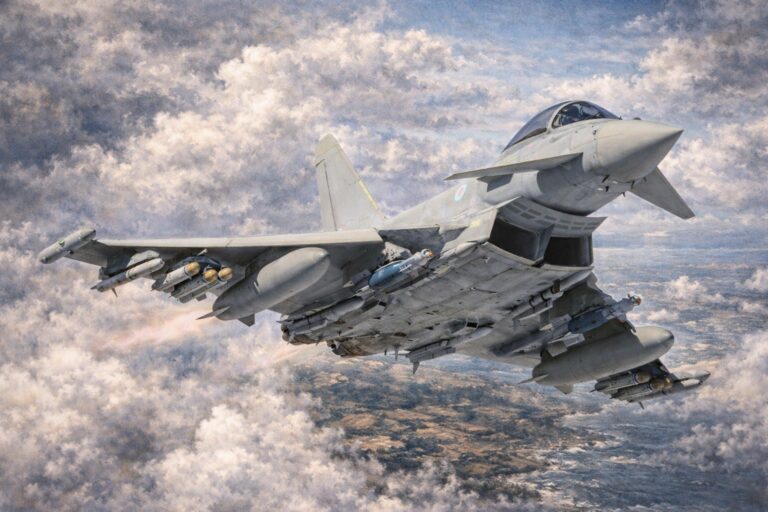
No. 12 Squadron re-formed at RAF Coningsby in July 2018 as a joint Royal Air Force and Qatar Emiri Air Force unit associated with the Eurofighter Typhoon. Joint flying commenced in June 2020.
The arrangement supported the training and development of Qatari personnel as Qatar introduced the Typhoon. It marked a new chapter for a unit that had previously been associated with bombing and strike operations, combining flying training, operational experience and international defence cooperation.
Historical significance
No. 12 Squadron’s history charts major changes in British air power. Its First World War reconnaissance work belonged to the formative years of military aviation. The Albert Canal attack demonstrated both the determination of RAF aircrews and the devastating limitations of an inadequately protected light bomber in 1940.
The squadron later served with Bomber Command’s heavy bombers, entered the jet and nuclear eras with the Canberra and Vulcan, maintained maritime strike capability with the Buccaneer and Tornado, and took part in expeditionary operations after the Cold War.
Its modern Typhoon partnership adds another dimension to that history. Across more than a century, No. 12 Squadron has repeatedly adapted its aircraft and mission while retaining its identity within the Royal Air Force.
Western Front 1915–1918
Loos 1916
Somme 1916
Arras
Cambrai 1917
Somme 1918
Hindenburg Line
France and Low Countries 1939–1940
Meuse Bridges
Fortress Europe 1940–1944
German Ports 1941–1945
Biscay Ports 1940–1945
Berlin 1941–1945
Ruhr 1941–1945
France and Germany 1944–1945
Rhine
Gulf 1991
Afghanistan 2001–2014
Iraq 2003–2011
Battle of France, 1940
Attack on the Albert Canal bridges, 12 May 1940
Operation Granby, 1991
Operation Telic, 2003
Afghanistan deployments in the modern era
Flying Officer Donald Garland VC and Sergeant Thomas Gray VC were both posthumously awarded the Victoria Cross for the squadron’s attack on the Albert Canal bridges on 12 May 1940.
| Period | Station | Notes |
|---|---|---|
| 1915 | Netheravon | Squadron formed and prepared for overseas service. |
| 1915–1922 | France and Army of Occupation bases in Germany | Western Front corps-reconnaissance service and long post-war occupation period. |
| 1923–1935 | RAF Northolt | Re-formed in the bomber role and developed its inter-war identity. |
| 1935–1936 | Aden | Abyssinian crisis deployment. |
| 1939–1940 | France with the Advanced Air Striking Force | Fairey Battle operations and the Albert Canal VC action. |
| 1940–1945 | RAF Binbrook and RAF Wickenby | Wellington and Lancaster bomber operations in Bomber Command. |
| 1946–1952 | RAF Wickenby | Lincoln post-war bomber service. |
| 1952–1961 | RAF Coningsby | Canberra jet-bomber period including the Suez campaign. |
| 1962–1967 | RAF Cottesmore | Vulcan V-Force phase. |
| 1969–1993 | RAF Honington and RAF Lossiemouth | Buccaneer maritime-strike era. |
| 1993–2018 | RAF Lossiemouth | Tornado GR1 and GR4 strike service. |
| 2018–present | RAF Coningsby | Typhoon joint-squadron phase with the Qatar Emiri Air Force. |
| Name | Dates | Notes |
|---|---|---|
| Cyril L N Newall | 14 February 1915 | First commanding officer on the squadron’s formation and later Chief of the Air Staff. |
| Arthur C Bayley | 22 October 1934 | Commanded during the inter-war period as the squadron remained part of the RAF’s established bomber force. |
| R W G Lywood | 16 May 1938 | Led the squadron during late rearmament as war approached. |
| V Q Blackden | 1 July 1940 | Commanded during the early wartime bomber period. |
| Brian J R Roberts | 14 October 1941 | Led the squadron during the Second World War and later became an air commodore. |
| H I Dabinett | 4 August 1942 | Commanded during the wartime bomber offensive as the squadron’s operational role intensified. |
Operation Granby
How Operation Granby saw the RAF fight in the 1991 Gulf War, from Tornado strike missions to the…
Operation Telic
How the RAF supported Operation Telic through strike aircraft, reconnaissance, tankers and transport in Iraq from 2003 onward.
Battle of France
An RAF-centred history of the Battle of France, from the opening German offensive to Dunkirk, losses in the…


The RAF Deploys Blackburn Buccaneers to the Gulf
On 26 January 1991, RAF Blackburn Buccaneers reached Bahrain to support laser designation for Tornado strikes…
26 January 2026 · 4 minRAF UAV Operations and the Rise of StormShroud Systems
How RAF uncrewed air systems evolved from early experiments to operational use, with StormShroud marking a…
27 April 2026 · 5 min11 January 1956: RAF Preparations for Operation Mosaic Reported
On 11 January 1956, an air element was formally organised to support forthcoming British atomic trials…
11 January 2026 · 3 min