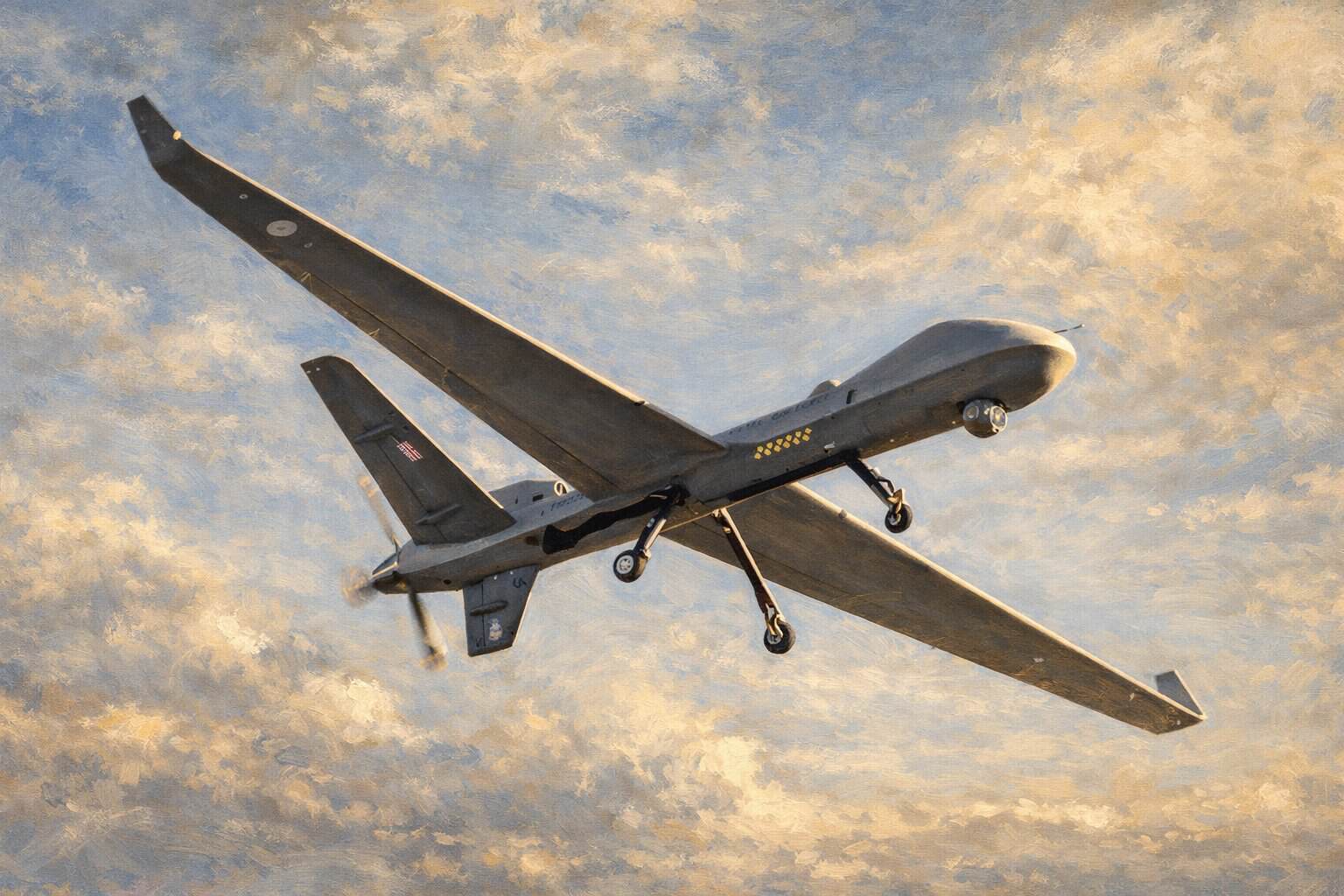
RAF use of uncrewed air systems has developed from limited experimentation into an established part of contemporary air power. The shift was gradual rather than sudden. Early remotely controlled and pilotless systems were mainly associated with trials, targets and narrow reconnaissance roles, but advances in sensors, communications and control gradually broadened what such aircraft could do. By the twenty-first century, uncrewed systems had become part of routine RAF operational planning alongside crewed fighters, transport aircraft and intelligence platforms.
The significance of this change lies in function rather than novelty. Uncrewed systems offered persistence, reduced risk to aircrew in certain roles and, more recently, a way of distributing sensors and effects across a wider force. StormShroud, introduced as an Autonomous Collaborative Platform, represents the latest stage in that progression by moving beyond surveillance into electronic warfare in direct support of front-line fast jets.
Early Development
RAF engagement with remotely piloted technology began on the margins of front-line air power. Adapted target drones and experimental reconnaissance platforms provided the service with practical experience in remote control, safety procedures, and data transmission. These systems were limited by endurance, payload and the quality of available electronics, but they established the principle that useful tasks might be carried out without placing a pilot in the aircraft itself.
As technology improved, attention turned more seriously to surveillance and battlefield observation. Early systems remained constrained by line-of-sight communications, relatively modest sensor performance and cumbersome launch or recovery arrangements. Even so, they demonstrated operational possibilities that crewed aircraft could not always match economically, particularly where long periods of watchfulness mattered more than speed or heavy payload.
In this phase, uncrewed aircraft were not replacing conventional RAF types. They were defining a separate set of requirements centred on endurance, remote sensing, and information management.
Operational Service In Afghanistan And Iraq
The decisive change came when uncrewed aircraft moved from trial and specialist use into sustained operational employment during campaigns in Afghanistan and Iraq. Medium-altitude remotely piloted systems offered long-endurance surveillance, electro-optical and infrared imagery, and in some cases precision strike capability. Their main value lay in persistence. They could watch routes, compounds and patterns of movement for extended periods in a way that would be difficult to sustain with crewed aircraft alone.
This persistence made them useful for joint operations. They supported convoy protection, fed intelligence into command centres and worked alongside helicopters, fast jets and ground forces. When armed, they also introduced the possibility of engaging selected targets under established rules of engagement without changing platform.
Operational use exposed new requirements as well as new possibilities. Remote crews needed specialist training. Communications links had to be robust and secure. Integration into controlled airspace demanded clear procedures, and the burden on ground-based operators required its own support structure. In other words, uncrewed capability could not be treated as simply buying an aircraft. It required a wider system of control, personnel and doctrine.
StormShroud And The Move Into Collaborative Warfare
StormShroud marks a further step because it extends RAF uncrewed capability into the electronic-warfare field. Rather than functioning primarily as an intelligence platform, it is intended to support crewed combat aircraft by disrupting hostile radar and integrated air-defence systems. In RAF terms, this places uncrewed aircraft directly inside the problem of contested airspace rather than around its edges.
The system combines the Tekever AR3 airframe with Leonardo’s BriteStorm electronic-warfare payload. The significance of that pairing is not simply technical. It creates a comparatively small, deployable platform capable of carrying stand-in jamming and deception effects closer to hostile emitters than would ordinarily be desirable for a crewed aircraft. In practice, that means StormShroud is designed to help aircraft such as the F-35B Lightning and Typhoon FGR4 operate with reduced exposure to enemy radar and missile networks.
StormShroud is also described as attritable. It is intended for recovery and reuse, but its loss may be accepted if that loss preserves a more valuable crewed aircraft or enables a wider mission to succeed. That reflects an important conceptual change. Some operational risk can now be transferred from crewed to uncrewed systems without abandoning the pursuit of advanced effects.
Responsibility for operating the system lies with 216 Squadron, whose makeup reflects the broader point that uncrewed capability depends on specialists, support teams, and close integration with the rest of the force. The programme’s relatively rapid progress also suggests a procurement model aimed at bringing useful capability into service more quickly than in some earlier generations of military aviation.
Wider Significance
The rise of RAF uncrewed operations is best understood as part of a broader change in how air power is organised. Modern operations increasingly depend on data, networking, electronic warfare, and the ability to distribute sensors and effects across multiple kinds of platforms. Uncrewed systems fit naturally into that environment because they can persist, operate in teams, and, in some roles, accept levels of risk that would be politically and operationally harder to place on crewed aircraft.
StormShroud illustrates this development clearly. It is not merely a surveillance aircraft with updated electronics. It points towards a force model in which crewed and uncrewed systems operate together, each contributing to the overall effect. Fighters remain central, but they are increasingly supported by autonomous or remotely controlled systems that complicate enemy targeting and widen the range of electronic and sensing options available to commanders.
Conclusion
RAF uncrewed aviation has moved from experimental beginnings to an established operational role. Campaign experience in Afghanistan and Iraq showed the value of persistent surveillance and, where authorised, precision strike. More recent developments show that the RAF now sees uncrewed systems as relevant not only to observation but also to high-end operations in contested airspace.
StormShroud represents that newer phase. Adding electronic warfare to the RAF’s uncrewed toolkit and operating in direct support of front-line fast jets mark a shift from remote observation towards collaborative combat support. The long-term significance lies in what that suggests about future air power: a force in which crewed and uncrewed aircraft are increasingly planned together rather than treated as separate worlds.