Avro Lincoln
A. V. Roe and Company (Avro)
Explore Avro Lincoln RAF history, from Bomber Command’s post-war heavy-bomber service to combat operations in Malaya and Kenya.
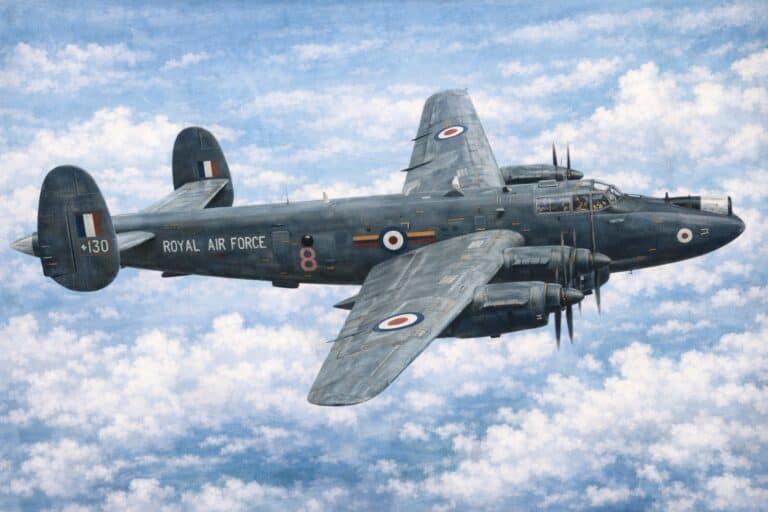
The Avro Lincoln was the Royal Air Force’s final piston-engined heavy bomber, developed from the Lancaster for longer-range operations and introduced just as the Second World War ended. It was intended to extend British heavy-bomber capability into the Pacific war, but instead became a principal aircraft of post-war Bomber Command. Its service took it from strategic exercises in Britain to operations in Malaya and Kenya, while specialist Lincolns continued flying into the early 1960s.
The Lincoln illustrates a transitional period in RAF history. It represented the most mature expression of the wartime four-engined bomber, yet it entered service when jet aircraft, Soviet air power and nuclear strategy were beginning to change the requirements of air defence and long-range attack. Its operational career was therefore shaped as much by the early Cold War as by the war in which it had been conceived.
From Lancaster to Long-Range Heavy Bomber
Avro developed the Lincoln to Air Ministry Specification B.14/43. Its origins lay in the Lancaster and the need for a bomber with greater range and improved high-altitude performance, particularly for a possible campaign against Japan. Early development designations included Lancaster IV and V before the new aircraft received the Lincoln name.
The first Lincoln prototype flew on 9 June 1944. Compared with the Lancaster, the Lincoln had a longer fuselage, increased wingspan, revised wing structure and more powerful versions of the Rolls-Royce Merlin engine. The enlarged wing was intended to improve performance at altitude, while the airframe retained the familiar four-engined layout, twin fins and substantial internal bomb capacity of its predecessor.
Production was delayed by the continuing priority given to Lancaster manufacture. Although the Lincoln was being prepared for the proposed Tiger Force, the British Commonwealth heavy-bomber contribution to operations against Japan, the war ended before the type could be employed in that role. It never undertook a wartime bombing mission against Germany or Japan.
Lincoln B.I and B.II: Technical Characteristics
The Lincoln normally carried seven crew members, including pilot, flight engineer, navigator, bomb aimer, wireless operator and two air gunners. It was powered by four Rolls-Royce Merlin engines. The B.I and B.II differed in engine installations and equipment, and individual aircraft were subsequently modified for specialised duties.
The Lincoln had a wingspan of approximately 120 feet and a length of around 78 feet 3 inches. Its maximum speed was approximately 295 mph, depending on mark, weight and altitude. It could carry a substantial conventional bomb load, commonly quoted at up to 14,000 lb, although fuel requirements and operational range affected the load actually carried. Defensive armament retained the turret-based philosophy of the Lancaster, with nose and tail positions and an upper gun position on standard bomber aircraft.
The larger airframe offered greater endurance and improved altitude performance compared with its predecessor. Nevertheless, it remained a large, relatively slow aircraft when measured against emerging jet fighters. That limitation became increasingly significant as the Cold War developed, particularly for operations against well-defended targets.
Entering Post-War Bomber Command
The first production Lincolns reached No. 57 Squadron in August 1945. Other RAF squadrons converted over the following years as Bomber Command reorganised after the war. The Lincoln gave Britain a conventional heavy-bomber force at a time when the wartime fleet was being reduced and the new generation of jet bombers was not yet ready for widespread service.
Lincolns undertook exercises intended to maintain the skills of long-range bombing, formation flying, navigation and coordinated operations. Their service also included overseas deployments and demonstrations of the RAF’s ability to move aircraft between theatres. These commitments depended on extensive maintenance and logistical support, especially for a four-engined aircraft operating far from its home stations.
The Lincoln was not replaced in one simple step by the English Electric Canberra. The Canberra provided a new jet-powered bombing capability, while Boeing Washington aircraft temporarily supplemented Bomber Command’s longer-range strength. The introduction of the V-bombers from the mid-1950s ultimately displaced the Lincoln from its principal heavy-bomber role. Different units converted at different times, and some Lincolns remained useful for specialist tasks long after the main bomber force had moved on.
Operation Musgrave and the Malayan Emergency
The Lincoln saw active service during the Malayan Emergency, where British and Commonwealth forces fought an insurgency in difficult jungle terrain. The aircraft’s endurance and bomb-carrying capacity made it suitable for missions requiring a heavy conventional load, but finding and accurately attacking dispersed targets beneath dense vegetation presented serious problems.
Under Operation Musgrave, eight Lincoln B.2 aircraft of No. 57 Squadron arrived at RAF Tengah in Singapore on 20 March 1950. Successive detachments from Nos. 100 and 61 Squadrons followed. Lincolns carried out bombing missions against areas identified through intelligence and ground operations, often employing pattern bombing rather than attacks on a clearly visible point target.
There were doubts about the effectiveness of this method. Dense forest could conceal insurgent positions and make it difficult to assess results, while the expenditure of bombs and the demand placed on Bomber Command resources raised concerns. The initial programme was suspended when the No. 61 Squadron detachment departed on 29 March 1951.
The commitment later resumed. In March 1953, a detachment from No. 83 Squadron arrived at Tengah under Operation Bold, followed by detachments from Nos. 7 and 148 Squadrons. The final detachment in that phase left on 1 March 1955. The Lincoln’s Malayan service therefore involved distinct periods of deployment rather than one uninterrupted operation by a single squadron.
These missions reflected the use of a heavy bomber in a counter-insurgency campaign for which it had never been designed. The aircraft could deliver substantial firepower, but the military value of that firepower depended on intelligence, the nature of the target and coordination with forces on the ground. The campaign’s wider political and human consequences should not be reduced to a tally of sorties or bomb tonnage.
Operations During the Kenya Emergency
RAF Lincolns also operated in Kenya during the Emergency associated with the Mau Mau uprising. On 11 November 1953, the first Lincoln detachment arrived at RAF Eastleigh, supplementing North American Harvards already employed on operations. Bomber Command squadrons in Britain supplied further detachments until July 1955.
Lincolns were used for pattern bombing of areas identified as insurgent camps or operating locations. These missions took place within a colonial conflict involving extensive security operations, detention and serious abuses. The presence of heavy bombers demonstrates the range of tasks assigned to the post-war RAF, but the use of large conventional weapons against concealed targets raises important questions about accuracy, intelligence and military effect.
The Kenya deployment confirms that the Lincoln was more than a peacetime deterrent or training aircraft. Its operational history included sustained conventional bombing in post-war conflicts, even as its prospects against modern fighter defences were diminishing.
The Shooting Down of Lincoln RF531, March 1953
On 12 March 1953, Lincoln RF531 of the Central Gunnery School at RAF Leconfield was shot down by Soviet MiG-15 fighters during a training flight over Germany. All seven RAF personnel aboard were killed. The RAF Museum records that the aircraft had inadvertently entered the Soviet Zone of Germany following a navigation error during a fighter-affiliation exercise.
The incident became a serious Cold War confrontation. The British and Soviet accounts differed over the aircraft’s position and the circumstances of interception. The loss exposed the vulnerability of a piston-engined bomber to modern jet fighters and the dangers faced by RAF crews operating near the division between Western and Soviet-controlled Europe.
RF531 was not on a bombing operation. Its destruction during training is an important reminder that the Lincoln’s Cold War service carried risks beyond conventional combat deployments, and that routine flights could have major diplomatic consequences.
Specialist Duties and Aircraft Development
As the Lincoln left the main bomber force, some aircraft were adapted for research and specialist work. Their size, range and ability to carry additional equipment made them useful for trials involving radar, electronic systems and other experimental installations. Specialist operations did not require the Lincoln to match the speed of contemporary jet bombers, allowing selected airframes to remain in service after the type’s front-line withdrawal.
The Lincoln also formed part of a wider Avro design lineage. The Avro Shackleton maritime reconnaissance aircraft drew on experience with the Lancaster and Lincoln family, although it was extensively redesigned for patrol operations. The Avro Tudor was another related Avro development, but it should not be described as a direct derivative of the Lincoln in the same sense. Shared design ancestry does not mean that the aircraft were interchangeable or identical in structure.
Lincoln service extended beyond the RAF. The Royal Australian Air Force operated Australian-built examples, including aircraft used in Malaya, while Argentina also employed the type. Production totals differ according to whether sources refer to British-built aircraft alone or the complete international programme; the RAF Museum gives 583 for the production programme it describes, while broader totals commonly include Australian manufacture.
Withdrawal and the Last RAF Lincolns
The Lincoln’s principal Bomber Command career ended during the 1950s as the RAF introduced jet bombers and reorganised its strategic striking force. The last aircraft were retained for specialist trials rather than conventional bombing. No. 151 Squadron of Signals Command employed Lincolns in radar-development work at RAF Watton.
The RAF Museum identifies May 1963 as the end of the last Lincoln service in these trials. Its history of preserved Lincoln RF398 records the disbandment of the Lincoln flight on 31 March 1963 and the aircraft’s final flight to storage on 30 April. These records support a final RAF withdrawal in 1963, not 1967. They also illustrate why the end of front-line bomber operations, the end of trials work and the final movement of individual airframes should be distinguished.
Why the Avro Lincoln Matters
The Lincoln was designed for the final phase of a global war but spent its operational life in the uncertain world that followed. It maintained the RAF’s conventional heavy-bomber capability during a period of rapid technological change, flew combat missions in Malaya and Kenya, and served in specialist research as jet aircraft replaced piston-engined bombers.
Its limitations were as historically revealing as its strengths. The Lincoln could carry a useful load over long distances, but it could not offer the survivability or performance required against increasingly sophisticated air defences. The aircraft therefore stands at the close of one chapter in RAF history: the era of the large piston-engined bomber, before the Canberra, Washington and V-bomber programmes transformed British long-range air power.
| Dimensions | |
| Wingspan | 120 ft (36.6 m) |
| Length | 78 ft 8 in (24.0 m) |
| Height | 20 ft 10 in (6.35 m) |
| Wing area | 1,421 sq ft (132.0 m²) |
| Weights | |
| Empty weight | 43,448 lb (19,708 kg) |
| Max takeoff weight | 70,000 lb (31,751 kg) |
| Max bomb load | 14,000 lb (6,350 kg) |
| Performance | |
| Maximum speed | 295 mph (475 km/h) |
| Cruise speed | 214 mph (344 km/h) |
| Service ceiling | 35,500 ft (10,820 m) |
| Range | 2,980 miles (4,795 km) |
| Powerplant | |
| Engines | 4 × Rolls-Royce Merlin 85 V-12 piston engines |
| Power | 1,750 hp (1,305 kW) each |
| Armament | |
| Guns | 6 × 0.5 in (12.7 mm) machine guns in nose, dorsal and tail turrets; maximum bomb load 14,000 lb (6,350 kg) |
| Bombs / weapons | 14,000 lb (6,350 kg) |

Operation Bold Resumes RAF Lincoln Deployments to Malaya
On 1 March 1953, Operation Bold resumed RAF Lincoln deployments to Singapore, reinforcing Operation Firedog during…
1 March 2026 · 3 minLast Lincoln Leaves Kenya as RAF Bomber Detachment Ends
On 28 July 1955, No. 49 Squadron’s Lincoln detachment left Kenya, ending the bomber phase of…
28 July 2026 · 3 minOperation Mop Up: RAF Hunters Attack the Torrey Canyon
On 28 March 1967, RAF Hunters joined Operation Mop Up, attacking the Torrey Canyon wreck as…
28 March 2026 · 3 min