On This Day, 1939: On 21 October 1939, 46 Squadron Hurricanes intercepted Heinkel He 115 floatplanes over the North Sea in the…
Read the entry →Avro Vulcan
A. V. Roe and Company
Explore the Avro Vulcan, the RAF V-bomber that moved from nuclear deterrence to low-level strike and the Black Buck missions of 1982.
The Avro Vulcan was one of the Royal Air Force’s most distinctive aircraft and a central element of Britain’s Cold War nuclear deterrent. Designed to carry nuclear weapons over long distances at high altitude, it entered service in 1956 and became part of the V-Force alongside the Vickers Valiant and Handley Page Victor. Its career extended well beyond that original purpose. The Vulcan adapted to low-level attack, retained NATO strike responsibilities after the strategic deterrent moved to submarines, fought during the Falklands War and ended its RAF service as an interim tanker.
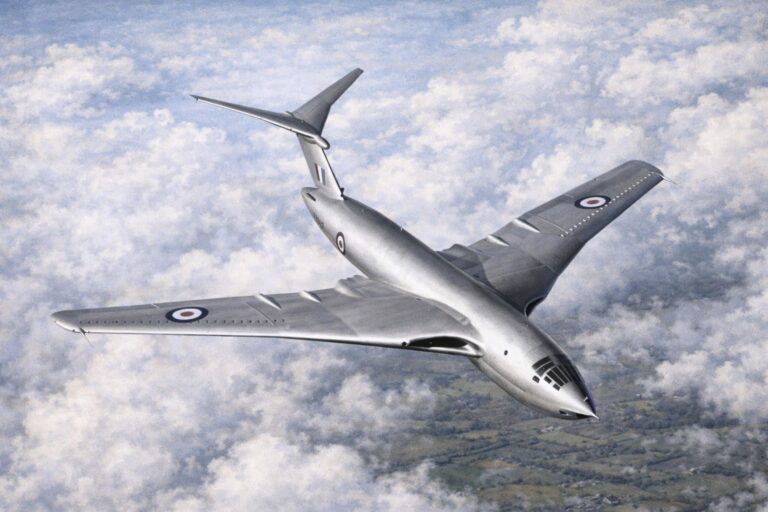
The Vulcan’s enormous delta wing and four Bristol Olympus engines made it instantly recognisable. Yet its historical importance rests equally on the work of its crews and engineers, the evolution of British nuclear policy and the difficulty of keeping an aircraft operational as its intended mission changed.
Britain’s Post-War Bomber Requirement
The Vulcan grew from Air Ministry Specification B.35/46, issued in January 1947. Britain wanted a fast, high-altitude bomber capable of carrying a nuclear weapon to distant targets. Wartime heavy bombers could not offer the required combination of speed, range and survivability against emerging jet fighters and radar-directed defences. The new aircraft needed ample internal fuel, a substantial weapons bay and equipment for accurate navigation and bombing in demanding conditions.
Avro’s chief designer Roy Chadwick helped establish the project before his death in an aircraft accident in August 1947. Stuart Davies subsequently led the design team. Rather than adopting a conventional fuselage, swept wings and tail, Avro pursued a broad tailless delta wing. Its internal volume accommodated fuel and structure, while its aerodynamic characteristics promised useful high-subsonic performance. The configuration also created uncertainties about stability and control, making experimental investigation essential.
The Avro 707 and First Vulcan Flight
Avro developed the smaller Type 707 research aircraft to explore aspects of delta-wing handling. The research programme helped engineers understand a configuration that had little precedent in British heavy bomber design. These aircraft were experimental tools, not simply reduced-scale operational Vulcans, and the full-size bomber still required extensive flight testing.
The first Vulcan prototype, VX770, flew on 30 August 1952 with test pilot Roly Falk at the controls. It established the feasibility of the design, but the programme continued through changes in engines, equipment and wing geometry. A second prototype and subsequent production aircraft contributed to testing before squadron service began. The design that entered service was therefore the product of a prolonged development programme rather than a direct copy of the first aircraft flown.
Vulcan B.1 and B.1A
The original Vulcan B.1 entered RAF service in 1956. It used the initial wing configuration and Bristol Olympus turbojets, with systems intended for high-altitude strategic bombing. The aircraft carried a crew of five and relied on speed, altitude and electronic equipment rather than defensive gun turrets. The later B.1A modification improved electronic countermeasures, reflecting the increasing threat from radar-guided interception and missiles.
The B.1 established the Vulcan’s basic operational qualities, but it also revealed the demands of maintaining a complex jet bomber. The type required specialised training, careful engine management and sophisticated navigation and bombing procedures. Its broad wing and unusual handling characteristics attracted attention, but operational reliability depended on maintenance personnel as much as the aircraft’s aerodynamic design.
The Definitive Vulcan B.2
The Vulcan B.2 introduced a substantially enlarged and revised wing, more powerful Olympus engines and updated electrical and electronic systems. Its wing shape was visibly different from the earlier B.1, and the changes supported higher operating weights and new equipment. The B.2 also accommodated the Blue Steel stand-off nuclear missile and became the principal version associated with the Vulcan’s later career.
A B.2 had a wingspan of approximately 111 feet and a length of about 105 feet. Maximum speed approached Mach 0.96 in appropriate conditions, although range, ceiling and speed varied with payload, fuel and operating profile. The aircraft’s internal bomb bay could accommodate nuclear weapons or a conventional load of twenty-one 1,000 lb bombs. Performance figures should be read as configuration-dependent rather than as capabilities simultaneously available on every sortie.
Four Bristol Olympus turbojets were installed within the wing roots, contributing to the aircraft’s clean external form and distinctive sound. The five-person crew comprised two pilots on the flight deck and three specialist officers in the rear compartment. Navigation, radar bombing and electronic countermeasures were coordinated through a tightly organised crew system. The rear compartment was comparatively confined, despite the aircraft’s immense external dimensions.
Training and Operational Squadrons
The Vulcan entered RAF service in July 1956. No. 230 Operational Conversion Unit trained aircrew for the new bomber, while No. 83 Squadron became the first operational Vulcan squadron at RAF Waddington in 1957. Other units followed as Bomber Command built up its V-bomber strength. Conversion required crews to master radar navigation, complex aircraft systems, emergency procedures and the discipline of operating within a nuclear strike force.
The aircraft also demanded extensive ground support. Engines, electronic systems, navigation equipment and the structure itself required regular inspection and maintenance. The availability of a bomber on paper did not automatically translate into an aircraft ready for immediate operations. Readiness depended on the integration of crews, technicians, weapons specialists, communications and airfield support.
Strategic Deterrence and the V-Force
In the late 1950s and 1960s, the Vulcan formed a major part of Britain’s airborne strategic nuclear deterrent. Its assigned purpose was to deliver nuclear weapons against targets if deterrence failed. The RAF’s V-Force operated within changing British and allied defence arrangements, and its existence was intended to discourage attack through the threat of retaliation.
Selected aircraft and crews maintained Quick Reaction Alert, ready to launch rapidly if ordered. Exercises tested alert procedures, dispersal to alternative airfields and the ability to sustain operations under pressure. The readiness arrangements evolved as aircraft, weapons and strategic planning changed. The Vulcan did not act alone: the Valiant and Victor also contributed to the bomber force, while Thor ballistic missiles deployed in Britain between 1958 and 1963 formed another part of the period’s deterrent arrangements.
The earliest Vulcan nuclear missions envisaged high-altitude penetration and free-fall weapon delivery. Speed, altitude and electronic countermeasures were expected to improve survival prospects. Those assumptions became increasingly doubtful as Soviet radar coverage, interceptors and surface-to-air missiles improved.
Blue Steel: Stand-Off Nuclear Strike
The Blue Steel missile entered RAF service in the early 1960s. Specially modified Vulcan B.2 aircraft could carry the missile beneath the fuselage and launch it before reaching the intended target. The weapon reduced the need for direct overflight, but it did not remove the danger to the bomber. Its range was limited, and the high-altitude conditions for which it was designed became increasingly problematic as Soviet defences improved.
Blue Steel was an important technological achievement but also a reminder that the V-Force was operating within a rapidly changing strategic environment. Improvements in air defences could undermine the usefulness of a delivery system even while the aircraft carrying it remained capable. The cancellation of subsequent British missile projects and the eventual adoption of submarine-based ballistic missiles reshaped the Vulcan’s future.
The Transition to Low-Level Operations
During the 1960s, the RAF increasingly trained Vulcan crews to approach targets at low altitude, using terrain and the radar horizon to reduce the time available for detection and interception. The change was substantial. An aircraft optimised for high-altitude cruising was now expected to operate at speed near the ground, often in poor weather and with much smaller margins for error.
Low-level flying increased crew workload, fuel consumption and structural stress. Navigation and timing became critical, and different weapons required different delivery and escape profiles. It is misleading to describe every mission as a simple low-level approach followed by a pop-up manoeuvre. The aircraft’s camouflage also changed from anti-flash white to darker schemes better suited to its revised role.
Fatigue and maintenance consequences mattered as much as the tactical changes. Repeated low-level sorties placed demands on an airframe originally designed around a different operational profile. The Vulcan’s continuing usefulness depended on inspections, modifications and the experience of crews and ground engineers.
Polaris and the Continuing RAF Nuclear Role
The Royal Navy’s Polaris submarines assumed responsibility for Britain’s strategic nuclear deterrent in 1969. This marked the end of the RAF’s principal national strategic nuclear role, but it did not immediately end all Vulcan nuclear responsibilities. Aircraft continued with NATO-assigned strike commitments, including nuclear tasks, while conventional bombing grew in importance.
The distinction between strategic and other nuclear roles is essential to the Vulcan’s chronology. The 1969 handover did not make the aircraft redundant overnight. It continued to serve within NATO planning, and crews trained for missions different from those envisaged when the bomber was designed in the late 1940s.
Conventional Strike and an Approaching Retirement
By the late 1970s and early 1980s, the Vulcan was an ageing aircraft approaching the end of its bomber service. Conventional strike training remained important, and the B.2 could carry a substantial load of standard bombs. Nevertheless, the aircraft’s size, maintenance demands and original design philosophy were increasingly at odds with the requirements of modern combat aviation.
The Falklands War of 1982 unexpectedly created an opportunity for the Vulcan to demonstrate a capability that had never been tested in combat. Argentina’s occupation of the islands prompted British planning for strikes against the airfield at Port Stanley and radar installations supporting Argentine forces.
Preparing for Operation Black Buck
Ascension Island provided a base for long-range operations, but the Falklands lay far beyond the Vulcan’s normal unrefuelled mission radius. Selected aircraft required work to restore and test air-to-air refuelling capability. Crews renewed conventional bombing practice and prepared for the demanding navigation and refuelling procedures. Aircraft were also modified for the use of American AGM-45 Shrike anti-radiation missiles during later missions.
The operation depended on Handley Page Victor K.2 tankers. Tankers had to refuel other tankers as well as the bomber, creating a carefully planned sequence of fuel transfers. Each aircraft needed enough fuel to complete its own part of the mission and return safely. The complexity meant that a single technical failure could disrupt the entire plan.
Operation Black Buck was therefore an achievement of tanker crews, planners, engineers and support personnel as well as the Vulcan crew flying towards the islands. The long flights required sustained concentration, precise timing and the ability to respond to unexpected difficulties.
Black Buck One: Port Stanley Airfield
On the night of 30 April–1 May 1982, Vulcan XM607, captained by Flight Lieutenant Martin Withers, carried out the first Black Buck bombing mission. The aircraft released twenty-one 1,000 lb bombs across the Port Stanley airfield area. One bomb struck the runway, creating damage that Argentine personnel subsequently repaired sufficiently to permit continued use by some aircraft.
The mission demonstrated the RAF’s ability to conduct an exceptionally long-range conventional bombing operation. Its practical effect was more limited than some later accounts implied. The runway was not permanently closed, and the airfield continued to play a role in Argentine operations. Assessing Black Buck requires distinguishing the impressive logistical achievement from the damage actually inflicted.
Further Black Buck Missions and Shrike Attacks
Further operations targeted the airfield and radar installations. Five Black Buck attack missions were completed in total, while other attempts were aborted. Some sorties used conventional bombs; others employed Shrike anti-radiation missiles intended to attack radar emitters. The radar missions involved different tactics and objectives from the runway attack, and their results should not be combined into a single claim of success or failure.
The attacks required extensive Victor tanker support for each Vulcan mission. This raised questions about the proportion of available resources committed to a comparatively small number of strikes. At the same time, the operations demonstrated an ability to project air power across a distance that would otherwise have placed the targets beyond reach.
During one Shrike mission, Vulcan XM597 encountered refuelling difficulties on its return and diverted to Brazil. The episode illustrated both the narrow margins of the operation and the diplomatic complications of an unexpected landing. Black Buck remained the Vulcan’s only combat employment, and its military effects continue to be assessed alongside its operational and symbolic significance.
The Vulcan K.2 Tanker Conversion
The Vulcan’s final RAF role was not bombing. Following the Falklands War, six Vulcan B.2 aircraft were converted to K.2 tankers to provide temporary aerial refuelling capacity. The conversion incorporated additional fuel and hose-and-drogue equipment, allowing the ageing bomber airframe to support other aircraft while newer tankers were introduced.
The tanker conversion was an interim measure rather than a long-term reinvention of the type. The Vulcan bomber force retired in 1982, but the K.2 aircraft continued until 1984. Both dates therefore appear in accounts of the aircraft’s retirement. The earlier date refers to the end of its bomber career; the later one marks its final RAF service.
Preservation and the Return of XH558
Several Vulcans survive in museums and collections, where their immense delta wings illustrate the scale and ambition of Britain’s Cold War bomber programme. Their preservation also allows visitors to appreciate the contrast between the aircraft’s imposing external shape and the confined working spaces of its crew.
Vulcan XH558 became particularly prominent when it returned to flight in 2007. It appeared at public events until its final flying season in 2015, bringing the sight and distinctive Olympus engine sound to audiences long after the type had left RAF service. That heritage flying career should be distinguished from operational service, which ended in 1984.
The Vulcan’s Place in RAF History
The Avro Vulcan served through profound changes in defence policy and military technology. It was conceived as a high-altitude strategic nuclear bomber, adapted to low-level operations as Soviet defences improved, retained NATO strike commitments after Polaris took over the national strategic deterrent, and carried out extraordinary long-range combat missions during the Falklands War. Its final conversion to a tanker extended its usefulness for another brief period.
The Vulcan’s legacy is not simply that it was a spectacular aircraft. It shows how design choices, strategic assumptions and operational realities interact over decades. Its crews and maintainers repeatedly adapted a demanding aircraft to new circumstances, making the Vulcan one of the defining aircraft of the RAF’s Cold War history.
| Dimensions | |
| Wingspan | 111 ft 0 in (33.83 m) |
| Length | 105 ft 6 in (32.16 m) |
| Height | 27 ft 1 in (8.26 m) |
| Wing area | 3,964 sq ft (368.3 m²) |
| Weights | |
| Empty weight | 83,573 lb (37,908 kg) |
| Max takeoff weight | 204,000 lb (93,000 kg) |
| Max bomb load | 21,000 lb (9,525 kg) |
| Performance | |
| Maximum speed | 646 mph (1,039 km/h) |
| Cruise speed | 567 mph (913 km/h) |
| Service ceiling | 56,000 ft (17,000 m) |
| Range | 2,607 mi (4,195 km) |
| Powerplant | |
| Engines | 4 × Bristol Siddeley Olympus turbojet engines |
| Power | 17,000 lbf (76 kN) thrust each (Olympus 201 series) |
| Armament | |
| Bombs / weapons | 21,000 lb (9,525 kg) |
Operation Corporate
How the RAF supported Operation Corporate through Vulcan raids, Victor tanker missions and later tactical air operations in the Falklands War.
Operation Black Buck
Operation Black Buck was the RAF’s long-range bombing and anti-radar effort during the Falklands War, flown by Avro Vulcan bombers with extensive Handley Page Victor tanker support. The missions showed the reach of British air power even where their direct physical effect remained limited.
Operation Grapple
How the RAF supported Operation Grapple through V-bomber delivery, cloud sampling and Pacific infrastructure during Britain’s H-bomb tests.
Vulcan XA897 Crash Near Heathrow and the Risks of Early V-Force
On 1 October 1956, Vulcan XA897 crashed near Heathrow, killing four crew and exposing the hazards…
1 October 2026 · 3 minRAF Cold War QRA and Britain’s Nuclear Deterrent Role
How RAF Quick Reaction Alert kept the V-force ready to launch and sustained Britain’s airborne nuclear…
25 April 2026 · 5 min617 Squadron’s Non-Stop Vulcan Flight to Australia in 1961
No. 617 Squadron flew a Vulcan non-stop from Britain to Australia, showing the reach, planning and…
20 June 2026 · 3 min