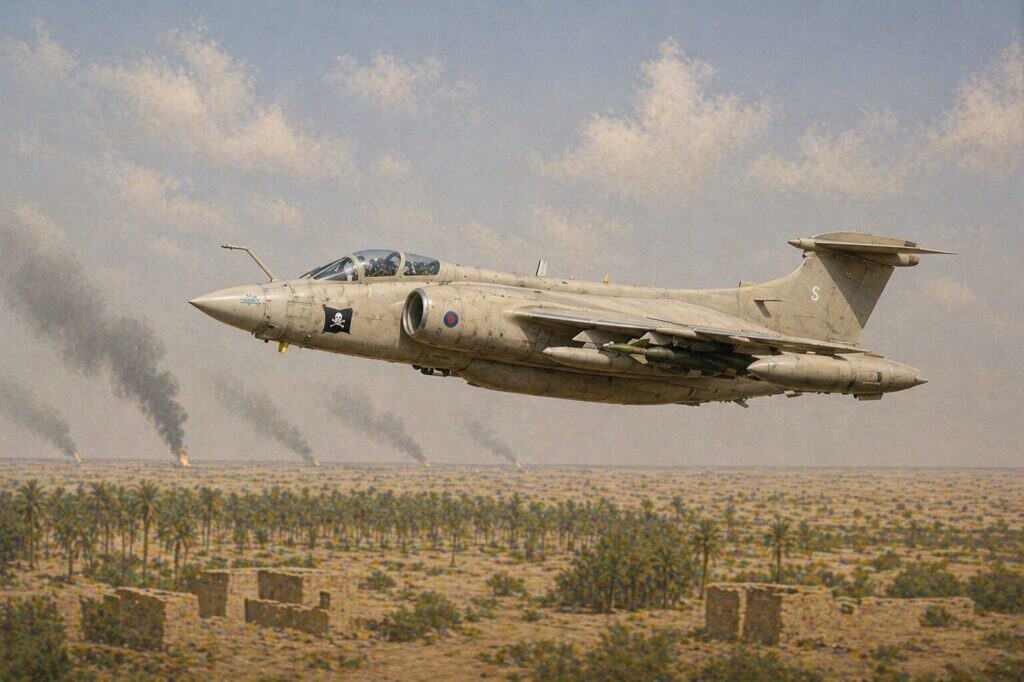
Operation Granby was the British codename for the United Kingdom’s military contribution to the 1991 Gulf War. For the Royal Air Force, it marked a defining post-Cold War campaign in which British air power was deployed on a large scale against Iraq as part of the wider coalition offensive known internationally as Operation Desert Storm. The operation is significant in RAF history because it tested equipment, doctrine and expeditionary readiness in a major coalition war far from Europe.
Granby showed both continuity and change. Some of the RAF aircraft and tactics deployed had been designed for a European Cold War conflict, yet they were now being used in the Middle East against a different opponent and under very different operational conditions. The resulting experience shaped British air-power thinking for years afterwards.
Background and deployment
The crisis began when Iraq invaded Kuwait in August 1990. Britain joined the international response and deployed forces to the Gulf region as part of the coalition assembled to compel Iraqi withdrawal. For the RAF, this meant moving substantial numbers of aircraft, personnel and support systems to bases in Saudi Arabia and elsewhere in the region.
Operation Granby began as much with deployment and preparation as with combat itself. Air transport, logistics, engineering support and coalition integration were all crucial before the first offensive sorties were flown. The RAF had to demonstrate not only combat capability, but also the ability to sustain a large expeditionary force in demanding conditions.
RAF role in the air campaign
The RAF contribution included strike aircraft, air-defence fighters, reconnaissance and support assets. The Panavia Tornado GR1 stood at the centre of the British strike effort and became the aircraft most closely associated with Granby. Early missions involved low-level attacks against Iraqi airfields and infrastructure, including hazardous use of the JP233 runway-denial system.
These early operations were among the most dangerous RAF sorties of the war. The losses suffered by the Tornado force highlighted the risks of low-level attacks against dense, short-range defences and helped drive a tactical shift towards medium-altitude precision strikes. In that sense, Granby became a turning point in RAF strike doctrine as much as a successful campaign.
The RAF's role was not limited to striking alone. Air defence, reconnaissance, transport and tanker support all mattered, and coalition warfare depended on integration across these different functions. Granby therefore demonstrated the breadth of modern air operations rather than simply the performance of one aircraft type.
Operational lessons
One of the operation’s lasting historical values lies in the lessons it provided. It confirmed the importance of precision-guided weapons, better targeting systems, electronic warfare support and joint coalition planning. It also showed that an RAF structured around late Cold War assumptions could adapt quickly when faced with a different type of campaign.
This adaptability was one of the most important results of the war from a British perspective. Granby forced tactical and technical reassessment at a moment when the Cold War had just ended and the future character of conflict seemed uncertain. The RAF emerged from the campaign with renewed evidence that modern air power increasingly depended on precision, information, and coalition interoperability.
Outcome and significance
Operation Granby ended as part of the wider coalition success that drove Iraqi forces from Kuwait and severely damaged Iraq’s military capacity. For the RAF, the operation demonstrated both capability and vulnerability. British air power had contributed materially to victory, but the campaign had also exposed areas where doctrine and equipment needed further development.
That combination makes Granby especially important in RAF history. It was not simply a successful modern operation; it was a war that accelerated change. The lessons learned from 1991 fed directly into the later development of RAF strike, support and expeditionary doctrine, making Operation Granby one of the key modern milestones in the service’s operational history.