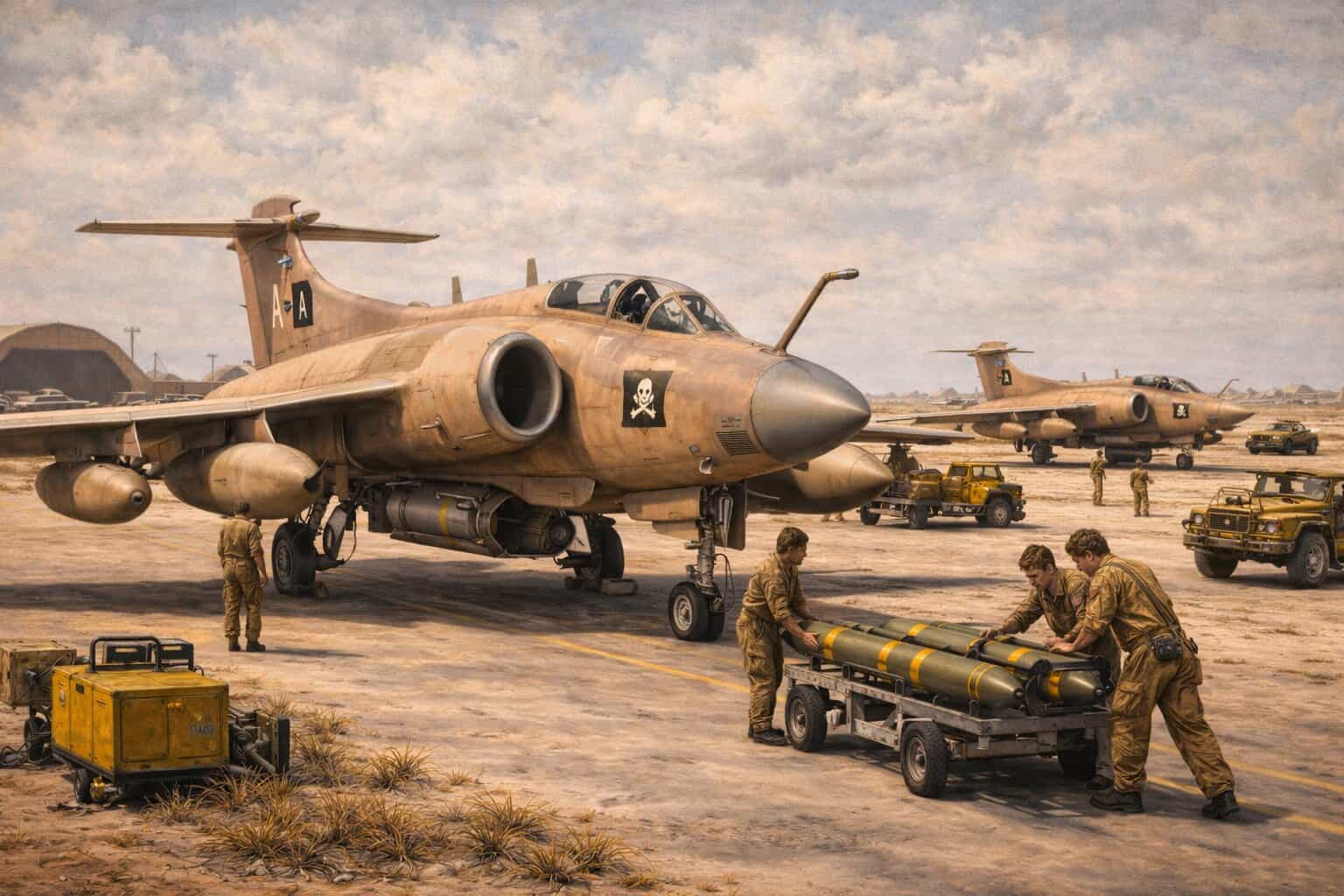
On 26 January 1991, Blackburn Buccaneer aircraft from Nos. 12 and 208 Squadrons, together with aircraft and personnel from 237 Operational Conversion Unit, arrived at Muharraq in Bahrain during the Gulf War. Their deployment formed part of a rapid adaptation of Royal Air Force tactics in response to operational experience gained during the opening phase of Operation Desert Storm.
Coalition air operations had begun on 16 January with intensive strikes against Iraqi airfields, command centres, and air defence systems. RAF Tornado GR1 aircraft were engaged in low-level attacks using the JP233 runway denial system and conventional bombs. Although these missions achieved significant effects, losses sustained during early operations prompted reassessment of strike profiles and weapon employment.
By late January, coalition air forces were increasingly employing precision-guided munitions to reduce exposure to heavy ground-based air defences. This shift required reliable laser designation to guide weapons accurately onto their targets.
The Buccaneer’s Role
The Buccaneer, originally designed as a low-level maritime strike aircraft during the Cold War, had by 1991 been adapted to carry the Pave Spike laser designator pod. This equipment enabled the aircraft to illuminate targets with a laser beam, allowing laser-guided bombs released by other aircraft to home precisely onto the designated point.
While Tornado GR1 aircraft were capable of delivering precision-guided bombs, their effective employment depended on reliable target designation. The Buccaneers were tasked primarily with providing that designation capability, enhancing the overall effectiveness of RAF strike missions.
Muharraq Air Base in Bahrain served as a key operating location for British forces during the conflict. The deployment required rapid preparation, coordination with coalition command structures, and integration into an already intense operational tempo.
Transition to Precision Strike
Although the Buccaneers arrived on 26 January, their first operational sorties in the Gulf campaign were flown on 2 February. By that stage, coalition suppression of Iraqi air defences had reduced the risk associated with medium-altitude strike profiles. The use of laser-guided bombs enabled attacks on hardened shelters, bridges, and other strategic targets with greater accuracy than earlier methods.
The introduction of dedicated laser designation aircraft marked a significant evolution in RAF operations during the conflict. It reflected a broader coalition trend toward precision engagement, aiming to maximise military effect while limiting collateral damage and reducing aircraft vulnerability.
The Buccaneers’ missions required close coordination with Tornado crews. Designating aircraft identified and illuminated targets, while accompanying strike aircraft released laser-guided bombs from safe standoff positions. This cooperative approach enhanced flexibility and effectiveness in a complex air environment.
Operational Impact and Legacy
The deployment of Buccaneers demonstrated the RAF’s capacity to adapt rapidly under combat conditions. Within days of recognising a capability gap, aircraft and trained crews were repositioned to the theatre. Their contribution improved the precision and survivability of subsequent strike operations.
Though the Buccaneer was nearing the end of its service life in 1991, its performance in the Gulf War underscored its continued operational relevance. The campaign would become one of the aircraft’s final major deployments before retirement later in the decade.
Significance in the Wider Air Campaign
The events of 26 January 1991 illustrate the dynamic nature of modern air warfare. Desert Storm combined large-scale coalition coordination with rapidly evolving tactics and technology. The shift from low-level runway denial to precision-guided strike reflected lessons learned in real time.
For the RAF, the Buccaneer deployment marked an important moment in the transition toward precision-led air power. Laser designation and guided munitions would become central to British air operations in subsequent conflicts. The integration of specialist platforms to support strike aircraft highlighted the increasing complexity and interdependence of modern air campaigns.
Their arrival symbolised the adaptation of doctrine and capability under operational pressure. In the broader history of RAF combat operations, 26 January 1991 stands as a demonstration of flexibility, technical innovation, and effective coalition integration during a high-intensity air campaign.