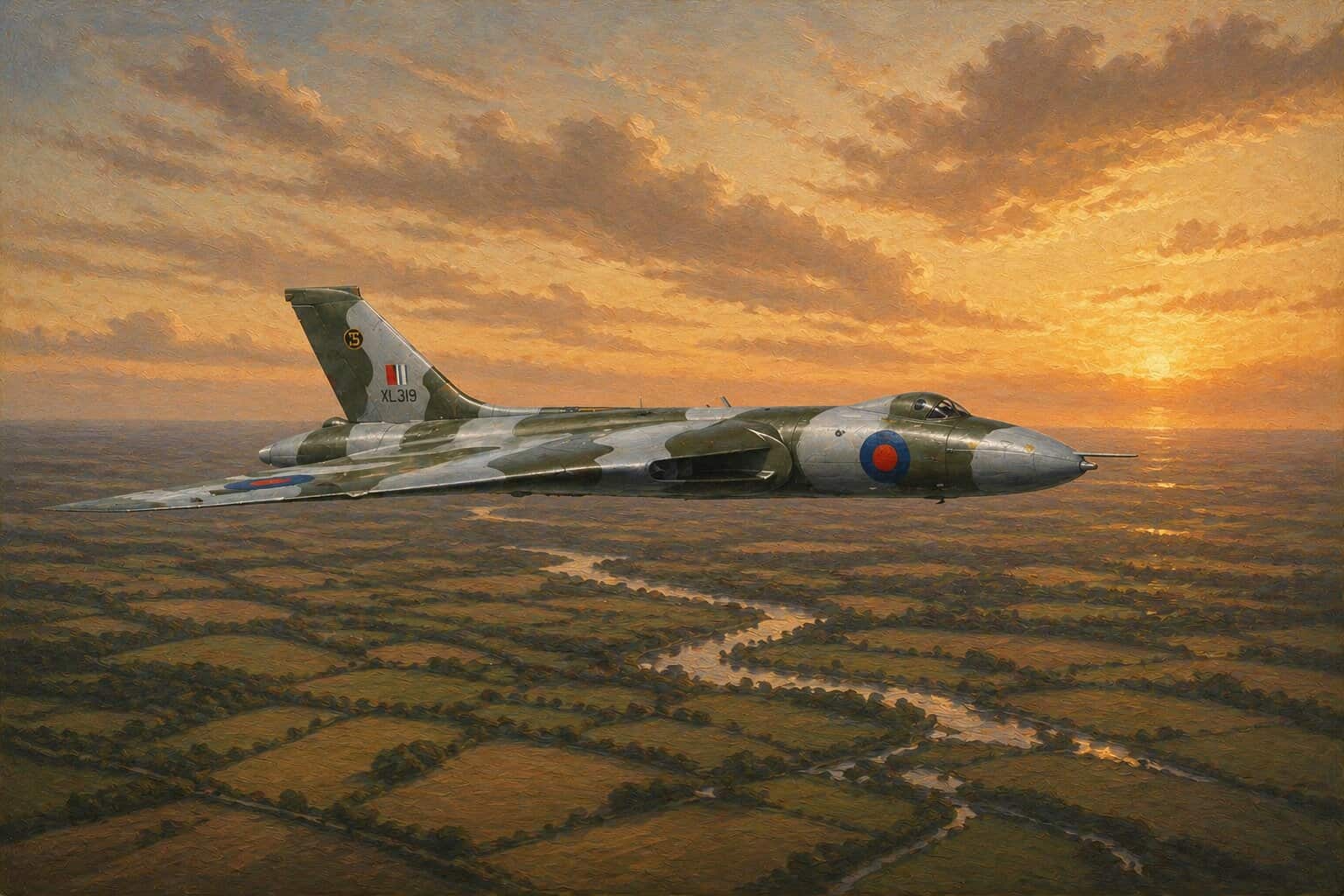
The RAF entered the nuclear age carrying institutional habits formed in the strategic bombing campaigns of the Second World War. Yet the move from Bomber Command to the V-Force was not a simple continuation of wartime practice. It involved new aircraft, new weapons, new readiness demands and a different political purpose for long-range air power.
Wartime Inheritance
Bomber Command left behind more than memories. It provided the RAF with experience in large-scale planning, long-range operations, technical adaptation and the management of a force built around striking power. Strategic bombing had established the bomber arm as one of the central expressions of modern air power, even though wartime experience also exposed the limits and costs of offensive doctrine.
That inheritance mattered after 1945 because Britain still saw value in a bomber force capable of carrying strategic weight. The question was how that weight would now be defined in a world transformed by nuclear weapons and superpower rivalry.
Entering The Nuclear Age
The V-Force represented a major shift in capability and purpose. Instead of a bomber force designed primarily for sustained wartime campaigns, the RAF now maintained aircraft that formed part of a deterrent posture. Their value lay not only in what they could do in combat but in the fact that they stood ready to do it.
This changed the operational culture around the bomber arm. Readiness, dispersal, survivability and command arrangements became especially important. The problem was no longer simply how to mount a sustained offensive, but how to preserve a credible strategic force under the conditions of the Cold War.
Continuity And Change
There was still continuity between the two eras. Both Bomber Command and the V-Force reflected the belief that air power could reach deep, act strategically and influence national policy at the highest level. But the differences were equally important. Wartime bombing aimed at sustained pressure on an enemy’s war-making system; deterrent bombing aimed above all to shape decisions before war began.
The aircraft, crews, and procedures of the nuclear age therefore operated according to a very different logic. Strategic reach remained central, but political credibility became as important as physical delivery.
Significance
In RAF terms, the path from Bomber Command to the V-Force marks one of the clearest transitions in the service’s history. It shows how an air arm built around wartime offensive power adapted to the demands of deterrence. The continuity lay in strategic ambition; the change lay in the meaning of readiness, the role of the bomber and the relationship between air power and national survival in the nuclear age.