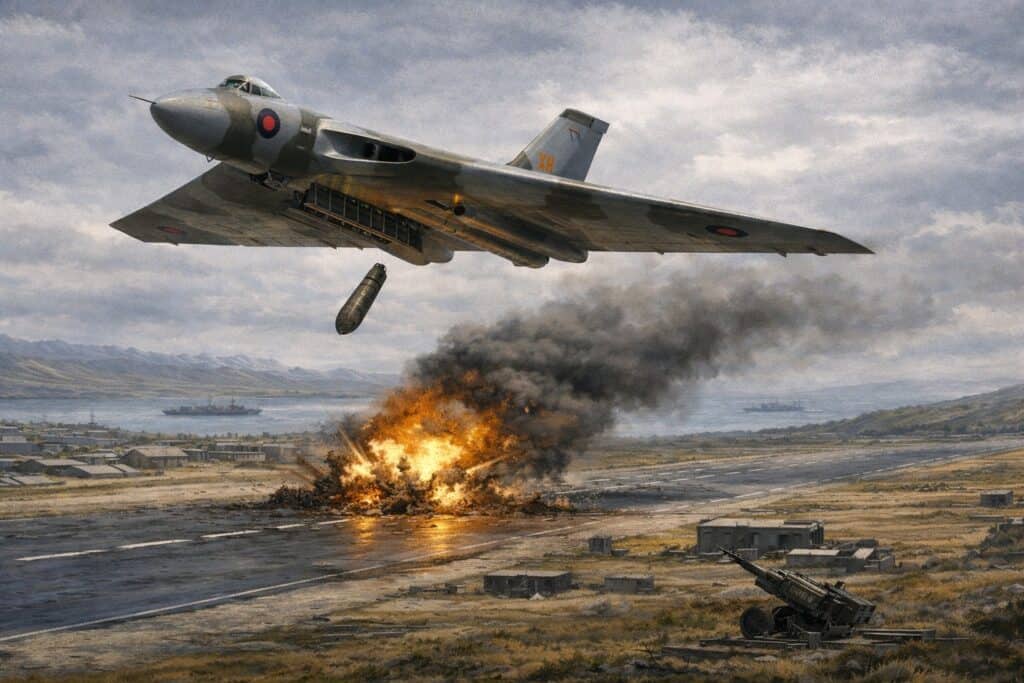
Operation Black Buck was a series of long-range Royal Air Force bombing and anti-radar missions carried out during the Falklands War in 1982. Flown by Avro Vulcan bombers from Ascension Island with extensive support from Handley Page Victor K.2 tankers, the sorties were directed primarily against Port Stanley airfield and later against Argentine radar systems. At the time, they represented some of the longest combat bombing missions flown.
The operation formed part of the wider British campaign in the South Atlantic under Operation Corporate. Its immediate purpose was to limit the military value of Port Stanley airfield and to demonstrate that the islands could be reached directly by long-range RAF strike aircraft.
Strategic Context And Planning
The occupation of the Falkland Islands by Argentine forces in April 1982 made Port Stanley airfield a concern for British planners. Even though the runway had technical limitations, the possibility that the airfield might support sustained or expanded military use had to be taken seriously. Denial of the runway became one of the early operational aims.
Carrier aircraft were heavily committed to fleet defence, and repeated low-level attacks on the airfield by Sea Harriers would have imposed further risk. The Vulcan, though developed for the strategic nuclear role, remained one of the few RAF aircraft with the payload and performance to undertake a long-range conventional bombing mission if sufficient tanker support could be arranged.
Crews from RAF Waddington were rapidly retrained for conventional bombing and extended-range operations. Aircraft were first adapted for 1,000-lb bomb loads and later for Shrike anti-radiation missile attacks. The resulting plan depended upon a highly complex pattern of refuelling in which Victor tankers not only refuelled the Vulcan but also one another.
Execution Of the Missions
Black Buck missions were flown between April and June 1982. Seven sorties were planned, though not all reached the target area. The first, Black Buck 1, took place on the night of 30 April–1 May and involved two Vulcans and eleven Victors leaving Ascension Island. One bomber returned early, leaving XM607 to continue to Port Stanley.
That mission demonstrated both the feasibility and fragility of the concept. Tanker planning had to be adjusted in flight, and fuel margins remained extremely tight. XM607 eventually climbed for the bombing run and released twenty-one 1,000 lb bombs in a pattern intended to cut across the runway. One bomb cratered the runway itself.
Later sorties had mixed results. A second runway attack caused limited direct runway damage. Other missions were cancelled or aborted because of weather or tanker problems. Later attacks shifted towards anti-radar work with Shrike missiles, damaging or destroying elements of Argentine radar coverage. In all cases, the operation remained highly sensitive to technical faults and the availability of tanker support.
Results, Losses, and Immediate Outcome
In purely physical terms, the damage inflicted by Black Buck was limited. Port Stanley continued to receive transport aircraft, and runway denial was not complete. The anti-radar attacks achieved more local success against specific systems than the bombing attacks did against the runway itself.
The effect of Black Buck cannot be judged only by visible damage. Its operational value lay partly in complicating Argentine planning and partly in demonstrating British strategic reach. The need to account for long-range Vulcan attack added pressure to an already constrained Argentine posture on the islands.
Historical Significance
Operation Black Buck remains significant because it illustrated the combination of strike aircraft, tanker support and planning discipline required for very long-range air attack. It also showed how an aircraft associated with the Cold War nuclear deterrent could be adapted to conventional bombing under campaign conditions.
The missions have remained central to debate because the physical results were limited relative to the scale of the effort involved. Even so, Black Buck occupies an important place in RAF history as an example of reach, logistics and political signalling operating together in wartime.
Conclusion
Operation Black Buck was a highly demanding RAF bombing and anti-radar campaign conducted at an exceptional range during the Falklands War. Flown by Vulcan bombers with extensive Victor tanker support, it aimed to reduce the military value of Port Stanley airfield and to reinforce British strategic intent.
Its direct physical effects were mixed, but the operation remains one of the clearest examples in RAF history of how logistics, range and operational planning can become as important as the weapon carried to the target.