On This Day, 1988: Sheila Scott died on 20 October 1988, leaving a legacy of solo world flights, polar exploration and record-breaking…
Read the entry →Vickers Valiant
Vickers-Armstrongs
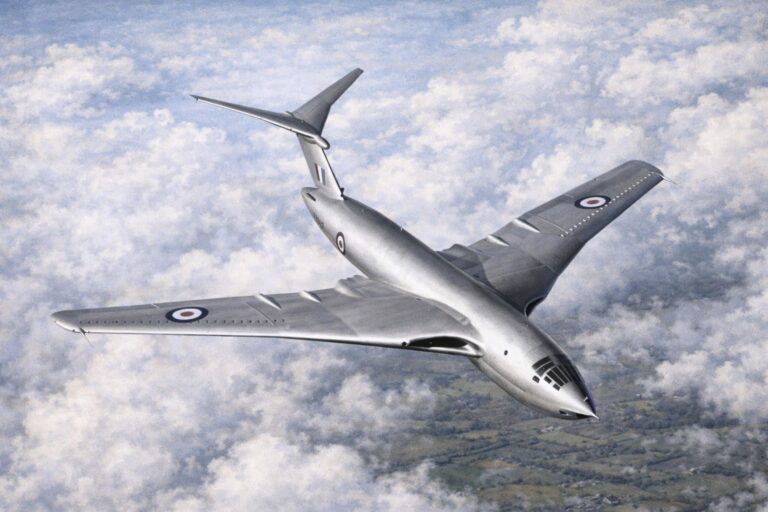
The Vickers Valiant was the first of Britain’s V-bombers to enter operational service, providing the Royal Air Force with a modern jet-powered strategic strike capability from 1955. Designed for high-altitude nuclear delivery, it formed the initial airborne element of the United Kingdom’s deterrent before being adapted for the tanker role. Structural fatigue issues curtailed its frontline career, and it was withdrawn in 1965, the shortest-lived of the V-force aircraft.
The Vickers Valiant sat at the centre of Britain’s first attempt to field a practical jet-powered strategic bomber force in the early Cold War. Conceived in the late 1940s and entering service in the mid-1950s, the Valiant became the Royal Air Force’s first operational V-bomber and the initial airborne carrier of the United Kingdom’s nuclear weapons. It formed a bridge between wartime piston-engined bombers and the later Vulcan and Victor.
After 1945, British planners faced the requirement to deliver nuclear weapons over long distances against increasingly capable air defences. A new generation of jet bombers was needed that could fly higher and faster than previous RAF aircraft, carry a heavy weapon load over long ranges, and operate within the limits of existing RAF basing and support.
From the first specification in 1948 to entry into squadron service in 1955, the Valiant was shaped by this strategic requirement. While less technically ambitious than the delta- and crescent-wing designs that followed, it reached operational status first and provided the RAF with an immediate nuclear strike capability.
The Valiant also supported conventional operations during the Suez campaign, provided high-altitude photo-reconnaissance capability in the jet era and formed the RAF’s first operational air-to-air refuelling force. Its early withdrawal due to structural fatigue did not diminish its significance. It established patterns of basing, training and weapons integration that were later inherited within the V-bomber force.
Genesis And Design Philosophy
The origins of the Vickers Valiant lay in the Air Ministry’s B.35/46 specification, issued in the immediate post-war period. It called for a jet bomber capable of carrying a 10,000-lb weapons load, flying more than 3,300 nautical miles, cruising at approximately 500 knots, and operating at around 50,000 feet. This requirement reflected the expectation of heavily defended targets and significantly exceeded the performance of existing RAF types.
Initial Vickers submissions did not match the specification as closely as competing proposals from Avro and Handley Page, which later produced the Vulcan and Victor. Vickers’ approach appeared comparatively conventional. The chief designer, George Edwards, argued that a straightforward airframe could be brought into service more quickly and with lower technical risk than more radical layouts.
This argument gained urgency as the United States Air Force introduced the Boeing B-47 Stratojet. A revised specification, B.9/48, was created around the Vickers Type 660 concept. The intention was to provide an early jet bomber while the more ambitious Avro Vulcan and Handley Page Victor matured. In effect, the Valiant combined immediate operational utility with a risk-reduction role for the wider programme.
Development And Prototypes
Development progressed rapidly once the revised specification was established. The first prototype, WB210, the Type 660, flew on 18 May 1951 with Joseph “Mutt” Summers at the controls. The aircraft used a high-wing layout with four Rolls-Royce Avon turbojets embedded in the wing roots, fed by leading-edge intakes. The arrangement supported a spacious fuselage for fuel and weapons.
On 12 January 1952, WB210 was lost during a test flight following an engine restart sequence that resulted in fire. The pilot and rear crew escaped, but the co-pilot, Squadron Leader Brian Foster, was killed when his ejection seat struck the tail.
The second prototype, WB215, the Type 667, first flew on 11 April 1952. It introduced enlarged engine intakes with internal strakes to improve airflow, along with improved fire detection and fuel vent arrangements. The basic airframe remained broadly stable during development, avoiding the scale of aerodynamic revision seen in other contemporary programmes.
Cancelled Variants And Alternative Proposals
Several Valiant variants were considered but not produced. The most advanced was the Valiant B.2, conceived as a pathfinder or target-marking aircraft. The B.2 prototype, WJ954, flew on 4 September 1953. It differed from the B.1 by incorporating structural strengthening intended for sustained low-level flight, a longer nose, and relocating the main undercarriage into underwing fairings, increasing internal fuel space.
The B.2 programme was cancelled for financial reasons and because the requirement was not pursued for the V-bomber force at that stage. Subsequent adoption of low-level tactics across the V-bombers highlighted the relevance of the strengthened structure.
Two further projects associated with the Valiant were cancelled. The V-1000 airliner, which drew on Valiant development, was abandoned, and the Blue Boar stand-off missile programme was cancelled after early trials, leaving the bomber reliant on free-fall weapons.
Operational Service And Squadron Formations
The first five production Valiant B.1 aircraft were effectively pre-production development airframes, used to refine manufacturing and assess maintenance demands under service conditions. Entry into RAF service began in June 1954 with the formation of No. 232 Operational Conversion Unit at RAF Gaydon. The first operational squadron, No. 138 Squadron, was formed in 1955, initially at Gaydon and later at RAF Wittering.
As the V-bomber force expanded, additional Valiant squadrons formed at RAF Marham and RAF Honington, including Nos. 214, 207, 49, 148 and 7 Squadrons. Aircraft were maintained on continuous readiness, forming an early nuclear deterrent posture. Underwing long-range fuel tanks extended the operating range. The fleet adopted an anti-flash white finish with pale national markings and serials, intended to reduce thermal effects from nuclear detonation.
Nuclear Weapons Trials And Strategic Validation
The Vickers Valiant played a central airborne role in establishing an operational British nuclear delivery capability. On 11 October 1956, Valiant B.1 WZ366 of No. 49 Squadron conducted the first British air-dropped atomic bomb trial at Maralinga, Australia. Released from approximately 35,000 feet, the Blue Danube weapon detonated at approximately 750 feet with a reduced yield of about 3 kilotons, demonstrating separation and weapon function under test conditions.
No. 49 Squadron operated as the specialist trials unit for early nuclear tests and developed procedures later adopted across the V-bomber force. These trials demonstrated carriage, release and escape procedures and validated associated navigation and bombing systems.
The thermonuclear test series Operation Grapple followed in the central Pacific. On 15 May 1957, Valiant XD818 dropped a prototype device known as Green Granite Small near Malden Island after departing from Christmas Island. Subsequent Grapple tests achieved yields in the megaton range, demonstrating a deliverable thermonuclear capability and validating the concept of an independent British nuclear bomber force.
Suez Crisis: The Valiant’s Only Combat Operations
The Suez Crisis of 1956 marked the Valiant’s only use of conventional weapons in combat operations. Following the nationalisation of the Suez Canal in July 1956, British and French forces prepared an intervention. Valiants provided a long-range jet bombing capability against Egyptian airfields and infrastructure.
Valiant squadrons, including Nos. 138, 148, 207 and 214, deployed to RAF Luqa, Malta, and commenced night raids on 31 October 1956. XD814 of No. 148 Squadron flew the first combat bombing sortie. Opposition consisted mainly of light anti-aircraft fire, and limited fighter interception was encountered.
The operation demonstrated that the Valiant could sustain conventional sorties from forward bases, deliver bomb loads at night, and maintain serviceability away from home stations. However, the limited level of opposition meant that performance against modern air defence systems was not tested under comparable conditions.
Photo-Reconnaissance And Air-To-Air Refuelling Variants
The Valiant supported additional roles in photo-reconnaissance and air-to-air refuelling. The B(PR) Mk. 1 replaced bomb-bay equipment with a camera installation providing long-range, high-altitude photographic capability. These aircraft entered service with No. 543 Squadron at RAF Wyton in June 1955.
Later production included multi-role variants. The B(PR)K.1 could be configured for bombing, reconnaissance, or tanker duties, depending on the bomb-bay equipment. The BK.1 tanker carried a hose-and-drogue refuelling unit in place of weapons or cameras. Trials conducted in 1955 using a modified B.1 demonstrated suitability for tanker operations.
By 1960, Valiant tanker variants provided most of the RAF’s air-to-air refuelling capability, supporting V-bombers and other aircraft types and enabling deployments and exercises. Valiant airframes also supported Blue Steel development by carrying and releasing test vehicles to gather aerodynamic data.
Low-Level Operations And Structural Crisis
The development of effective surface-to-air missiles, including the SA-2, and improved interceptors, reduced the viability of high-altitude penetration. Bomber Command adopted low-level tactics intended to reduce radar detection and missile engagement opportunities from around 1962. Valiant squadrons trained for low-level profiles. The anti-flash white finish on upper surfaces was replaced by camouflage, though white often remained on undersurfaces.
The Valiant structure had been designed primarily for high-altitude operation, with stress assumptions based on comparatively smooth air. Sustained low-level flight imposed different loads, particularly on wings and spars.
On 6 August 1964, Valiant WP217 of No. 232 Operational Conversion Unit suffered a major structural failure during a training sortie. The crew landed safely, but inspection revealed a severely fractured rear main spar on the starboard wing. The investigation linked the failure to fatigue in the DTD683 alloy used in the spar, an issue previously identified in Viscount airliner structures.
A subsequent inspection programme identified widespread fatigue cracking across the fleet. Low-level flying ceased, and operations were restricted while remedial options were assessed. Rebuilding or strengthening wings would have required extensive work. With Vulcan and Victor already in service and better suited to low-level operations, a full structural rebuild was not pursued.
Sudden Retirement And Scrapping
In early December 1964, the Air Staff decided to withdraw the Vickers Valiant from service due to structural fatigue and the scale of required repairs. Disbandment proceeded rapidly. No. 232 Operational Conversion Unit closed, and the last operational unit, No. 49 Squadron, disbanded in January 1965.
Withdrawal created an immediate gap in tanker capacity because much of the RAF’s air-to-air refuelling force used Valiant variants. A rapid programme converted Victor bombers to tanker configuration. Most of the 107 Valiant airframes were scrapped at or near operating bases. Some were used for fire training or damage trials. A small number continued briefly in test use, and XD816 flew in a commemorative flypast on 29 April 1968, marking the transition from Bomber Command to Strike Command.
Preservation And Legacy
Only one complete Vickers Valiant survives. XD818, which participated in Operation Grapple, later served as a BK.1 tanker and was retained rather than scrapped. It was displayed at RAF Marham before being moved to the RAF Museum at Hendon in 1982. In 2005, it was transferred to the RAF Museum Cosford, where it is displayed in the National Cold War Exhibition.
Historically, the Valiant was the first V-bomber to enter service, the initial airborne carrier of British atomic and thermonuclear weapons and the RAF’s first jet tanker. Its early withdrawal demonstrated the consequences of extended low-level operations on an airframe designed for high-altitude flight, and highlighted the implications of cancelling the strengthened B.2 variant.
| Dimensions | |
| Wingspan | 114 ft 4 in (34.85 m) |
| Length | 109 ft 4 in (33.32 m) |
| Height | 32 ft 6 in (9.91 m) |
| Wing area | 2,350 sq ft (218.3 m²) |
| Weights | |
| Empty weight | 75,000 lb (34,019 kg) |
| Max takeoff weight | 140,000 lb (63,503 kg) |
| Max bomb load | 21,000 lb (9,525 kg) |
| Performance | |
| Maximum speed | 567 mph (912 km/h) |
| Cruise speed | 520 mph (837 km/h) |
| Service ceiling | 54,000 ft (16,459 m) |
| Range | 4,500 mi (7,242 km) |
| Powerplant | |
| Engines | 4 × Rolls-Royce Avon RA.28 turbojet |
| Power | 10,500 lbf (46.7 kN) thrust each |
| Armament | |
| Bombs / weapons | 21,000 lb (9,525 kg) |
V-Force Stands Down as Polaris Assumes the Role in 1969
On 30 June 1969 the RAF’s V-force left the strategic deterrent role as Royal Navy Polaris…
30 June 2026 · 3 minFrom V-Force to Polaris: Why Britain Moved the Deterrent to Sea
Why Britain transferred its strategic nuclear deterrent from RAF V-bombers to Polaris submarines, from the Skybolt…
13 October 2026 · 5 minValiant Flies Direct from Maine to RAF Marham in 1956
On 2 September 1956, a Vickers Valiant flew direct from Maine to RAF Marham, proving the…
2 September 2026 · 3 min