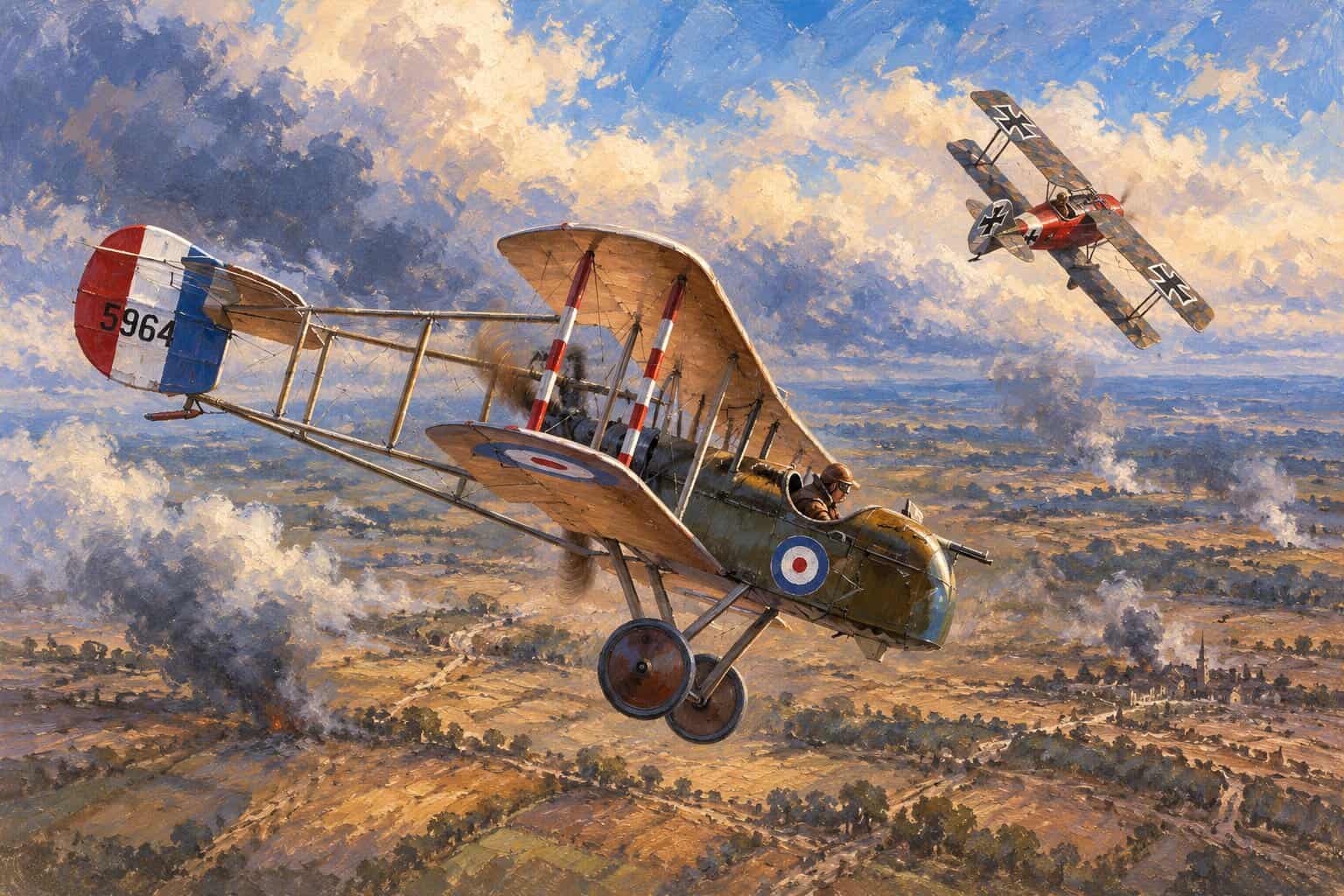
On 23 November 1916, Major Lanoe Hawker VC, DSO, of the Royal Flying Corps was killed in aerial combat with Manfred von Richthofen over the Somme. Flying an Airco DH.2, Hawker fought a prolonged engagement against a German pilot whose Albatros D.II possessed important advantages in speed and armament. His death cost the RFC an experienced fighter leader and an inventive contributor to its early development.
Hawker had built his reputation during the first years of the Western Front air war. By the autumn of 1916, the aircraft and methods of that conflict were changing rapidly. His final combat brought together the experience of an established British pilot and the growing strength of Germany’s newer fighters.
An early fighter innovator
Hawker obtained his Aviator’s Certificate after paying for flying instruction at Hendon in 1913. He subsequently joined the Royal Flying Corps and served in France. His approach to military flying combined practical ingenuity with a willingness to attack enemy targets, at a time when aerial fighting equipment was still developing.
His inventions included a ring gunsight and a rocking fuselage device for ground practice. Such work addressed the practical business of preparing pilots and improving their ability to use weapons in the air. Hawker also fitted a machine gun to his Bristol Scout, with the weapon angled to fire clear of the propeller.
On 25 July 1915, he attacked three German aircraft in succession in actions which earned him the Victoria Cross. The angled gun mounting placed particular demands on positioning the aircraft for an attack. His success helped establish his reputation as a skilled and determined combat pilot, alongside his earlier award of the Distinguished Service Order.
The DH.2 in a changing air war
The Airco DH.2 was a single-seat pusher fighter, with its engine and propeller behind the pilot. This arrangement allowed a forward-firing gun to be carried clear of the propeller. During 1916, the type played an important part in the RFC’s response to the German Fokker fighters.
No. 24 Squadron’s DH.2s arrived in France in February 1916. Together with other Allied aircraft, the type helped restore a measure of air superiority during the spring. Its operational value therefore belonged to a particular stage in a fast-moving competition between aircraft designs.
By late 1916, newer German fighters had altered that balance. The Albatros brought greater speed and heavier armament to encounters with the DH.2. Those advantages affected both the opportunities to attack and a pilot’s ability to leave a combat.
The engagement on 23 November
Hawker’s encounter with Richthofen developed into a prolonged contest of manoeuvring. With his fuel running low, Hawker eventually broke away and attempted to reach the British lines.
That attempt exposed him to the pursuing German fighter. Hawker was hit and killed, and his DH.2 crashed near Bapaume. His loss was credited as Richthofen’s eleventh aerial victory.
The sequence illustrates the practical limits within which a pilot fought: aircraft performance, position and remaining fuel all shaped the available decisions. Hawker’s skill sustained the engagement, while the effort to return towards friendly territory brought the combat to its fatal conclusion.
Hawker’s contribution to the RFC
Hawker’s death removed a pilot whose influence extended through combat leadership, weapons experimentation and training devices. His career linked the improvised armament of the early war with the increasingly specialised fighter operations of 1916.
He is commemorated on the Arras Flying Services Memorial, and his Victoria Cross forms part of the RAF Museum’s collection. His practical work on gunsights, training and aircraft armament remains a concrete part of the RFC’s development of fighter aviation.