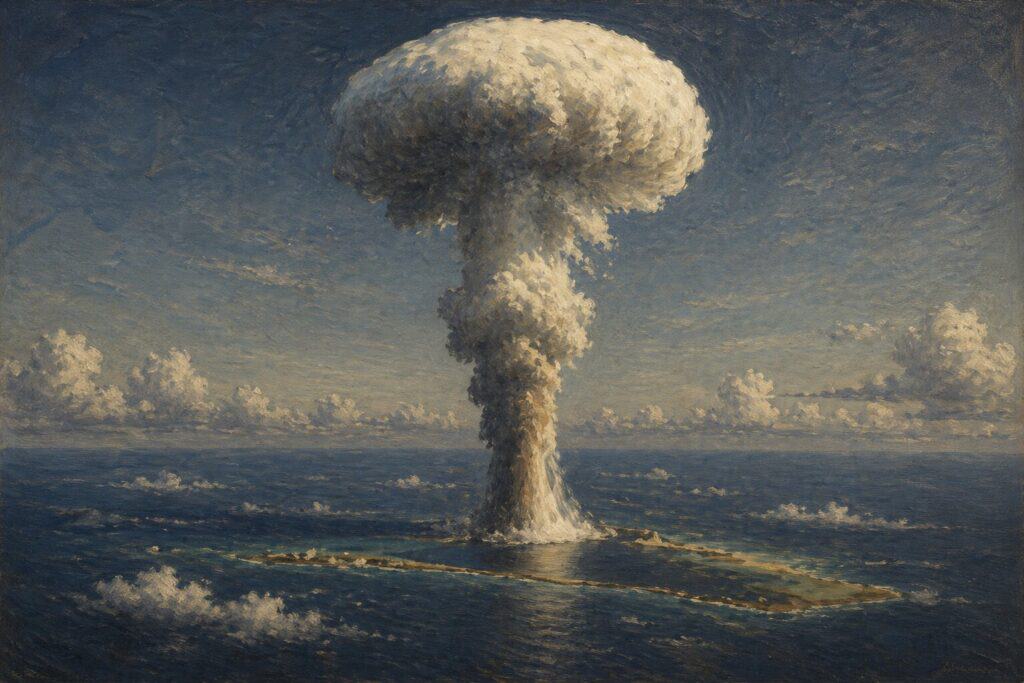
Operation Grapple was the British series of atmospheric thermonuclear tests carried out in the central Pacific in 1957 and 1958. For the Royal Air Force, it was not simply a nuclear-scientific programme but a major operational commitment involving V-bomber delivery aircraft, Canberra sampling sorties, meteorological support, communications, transport and substantial overseas infrastructure. In RAF terms, Grapple was one of the clearest demonstrations of how the service supported Britain’s emergence as a thermonuclear power.
The tests were conducted first near Malden Island and later near Kiritimati, or Christmas Island, with RAF aircraft playing a central role in both delivery and sampling. The operation formed part of Britain’s effort to demonstrate a thermonuclear capability before possible limits on atmospheric testing were imposed.
Strategic Context And Planning
By the mid-1950s, Britain had already developed and tested atomic weapons, but remained behind the United States and the Soviet Union in the field of thermonuclear weapons. British policy-makers regarded the successful demonstration of a deliverable thermonuclear device as strategically important both for national deterrent credibility and for the restoration of closer nuclear cooperation with the United States.
Time pressure shaped planning. There was widespread expectation that atmospheric testing might soon be restricted by international agreement. As a result, the programme had to combine scientific development, operational delivery, logistics and diplomacy within a compressed timeframe. The RAF was central to this because the tests had to be integrated with aircraft capable of carrying the devices and with the specialised support flights needed to assess the results.
Locations, Infrastructure And RAF Deployment
Operation Grapple depended on major infrastructure in the Pacific. Early tests were conducted near Malden Island, while Kiritimati became the principal operating base for the later and larger phases of the programme. Airfields were extended and strengthened for V-bomber operations, support sites were built, communications networks installed, and facilities developed for scientific and technical work.
RAF units deployed as part of a wider inter-service structure involving the Royal Navy, Royal Fleet Auxiliary, British Army, Atomic Weapons Establishment staff and contractors. Within this structure, the RAF supplied the aircraft and aircrew for weapon delivery, cloud sampling, meteorological support and general air operations. The scale of the deployment underscores that Grapple was an operational undertaking as well as a series of weapons trials.
The Malden Island Series
The first phase of Grapple involved tests near Malden Island in 1957. These included Short Granite, Purple Granite and Orange Herald. RAF V-bombers delivered the devices over the Pacific, allowing the British government to present the series publicly as a major advance in thermonuclear capability.
In technical terms, the results were mixed. Some devices did not achieve the level of thermonuclear performance originally hoped for, while Orange Herald was essentially a very large fission-based device rather than a fully developed two-stage thermonuclear weapon. Even so, the Malden Island phase provided crucial data and established the RAF operational role in long-range nuclear test delivery.
Christmas Island, Grapple X, Y And Z
The later phases of Operation Grapple were moved closer to Kiritimati, reducing the distance between the operating base and test area. This improved logistical control and simplified parts of the flying programme, though it also brought practical and safety implications for those working on or near the island.
Grapple X in November 1957 and Grapple Y in April 1958 produced the clearest British thermonuclear results of the series, with megaton-class detonations delivered by RAF V-bombers. These tests are generally regarded as the point at which Britain demonstrated a deliverable thermonuclear capability within the V-force framework.
The final Grapple Z series in 1958 further refined the designs, including tests aimed at more practical warhead forms. Some of these later shots used air-drop delivery and others suspended methods, but RAF participation remained central throughout the programme’s final stage.
RAF Sampling, Support And Exposure
Beyond bomb delivery, RAF aircraft also carried out cloud-sampling operations, particularly with Canberra aircraft equipped for radiation monitoring and collection. These flights were intended to provide data on yield, cloud composition and the wider characteristics of each detonation.
This role exposed RAF crews and support personnel to conditions that later became central to debates over radiation exposure and veterans’ health. Official studies and veterans’ testimony have not always aligned in interpretation, but there is no doubt that Grapple left a long documentary trail concerning monitoring, protective measures and later health concerns among participants.
In RAF history, this part of the operation matters because it shows that the service’s role in nuclear testing involved not only delivery of devices but also repeated technical and potentially hazardous support work after the main explosion.
Historical Significance
Operation Grapple was significant in both strategic and RAF terms. Strategically, it formed the test series through which Britain demonstrated a thermonuclear capability and strengthened the political case for renewed nuclear cooperation with the United States. Institutionally, it showed the RAF acting as the operational instrument through which Britain’s nuclear ambitions were made practical in the field.
The operation also illustrates the relationship between aircraft, weapons development, logistics and imperial-scale basing in the late 1950s. It belongs not only to the history of the bomb but to the wider history of RAF strategic service in the Cold War.
Conclusion
Operation Grapple was the British thermonuclear test series conducted in the Pacific in 1957 and 1958, with the RAF supplying delivery aircraft, cloud-sampling platforms and much of the wider operational support structure. From the early Malden Island shots to the later tests near Christmas Island, RAF participation was central to the programme's conduct and assessment.
The series helped establish Britain’s thermonuclear capability and left a lasting place in RAF history through its connection with the V-force, specialised support flying and the continuing historical debate over service exposure and nuclear testing.