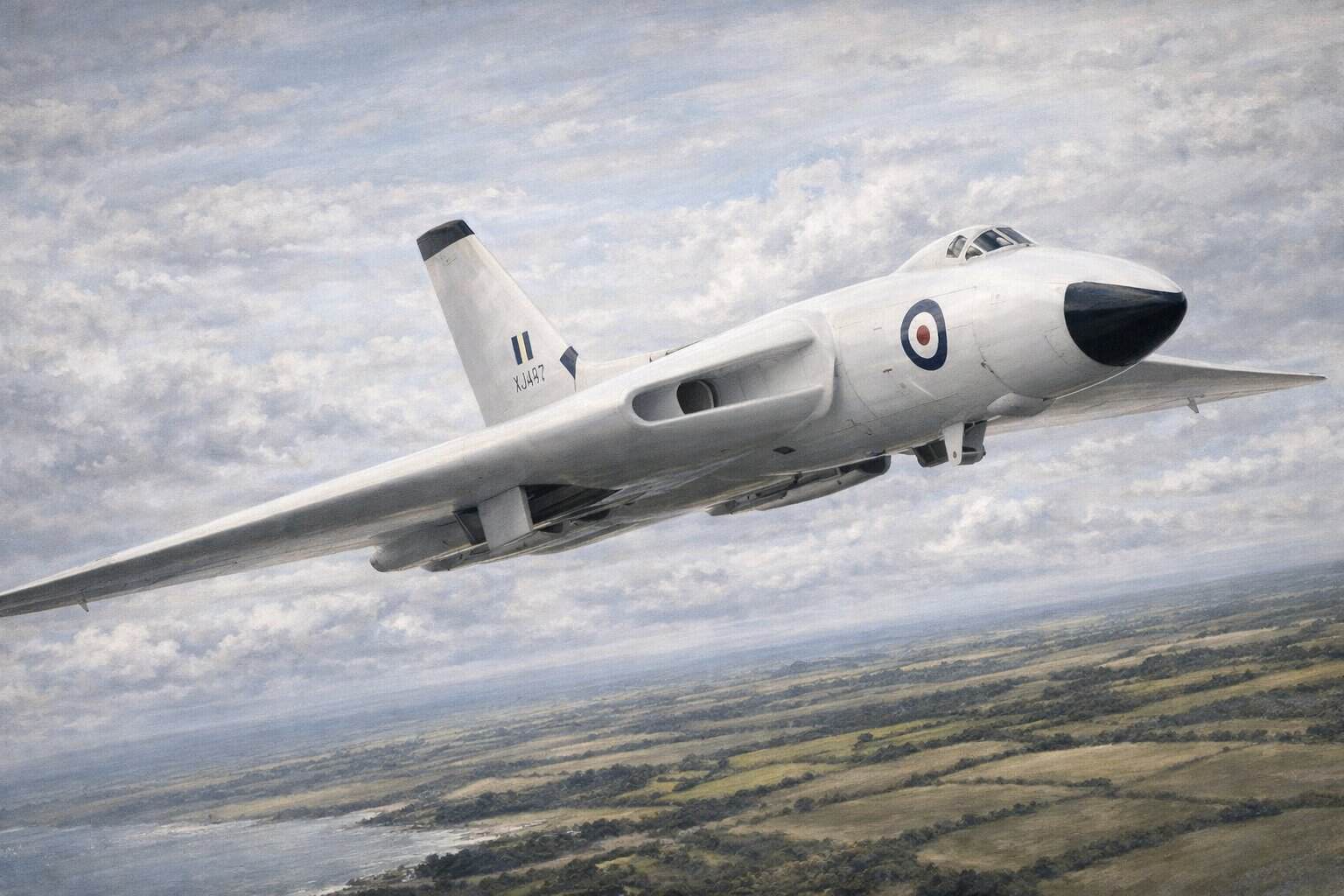
Cold War Quick Reaction Alert was the operational form taken by Britain’s airborne nuclear deterrent once it became clear that bombers on the ground could be destroyed before they had any chance to retaliate. In RAF service, QRA was not simply a matter of keeping crews ready at short notice. It was a structured system designed to preserve the credibility of the V-bomber force in an era of Soviet ballistic missiles, rapid warning times and increasingly sophisticated air defences.
Its importance lay in deterrence rather than use. The force existed so that an opponent could not assume a disarming first strike would remove Britain’s capacity to respond. Maintaining that assumption required aircraft, crews, ground staff, and command arrangements capable of functioning under severe time pressure. QRA translated strategic doctrine into a daily routine of readiness.
The Strategic Setting
After the Second World War, British governments concluded that nuclear weapons would remain central to national security and that an independent deterrent, though tied closely to the alliance with the United States and NATO, retained political and military value. The RAF became the instrument of that policy through the V-force. The Vickers Valiant entered service first, followed by the Avro Vulcan and Handley Page Victor, giving Bomber Command a modern jet striking force intended to deliver Britain’s nuclear weapons.
Early planning assumed that speed and altitude would help these aircraft penetrate Soviet airspace. That assumption weakened as Soviet radar, interceptors and surface-to-air missiles improved. More serious still was the growth of Soviet ballistic-missile capability. If missiles could hit known RAF bases with little warning, a bomber force standing in the open would be vulnerable before it had even begun to taxi.
QRA was introduced against that background in early 1962. Its purpose was simple in concept but exacting in execution: to ensure that at least part of the bomber force could get airborne quickly enough to survive a first strike and deliver a retaliatory strike.
How The Alert System Worked
Under the QRA system, each V-bomber squadron maintained an aircraft at permanent fifteen-minute readiness. Aircraft were fuelled, armed and positioned for the fastest possible departure. Crews and ground personnel worked to rehearsed procedures intended to reduce every avoidable delay between warning and take-off.
The compressed time scale behind this arrangement entered popular language as the “four-minute warning”. With RAF Fylingdales later contributing ballistic-missile early warning, the expectation was that any notice of attack would be extremely short. QRA demanded more than general preparedness. It required physical proximity to the aircraft, pre-planned drill sequences and infrastructure designed around launch speed.
Operational Readiness Platforms were established close to runway thresholds. Servicing arrangements were organised to keep aircraft in a constant launch state. The Simstart system, introduced in 1963, further reduced engine-start time by allowing near-simultaneous ignition. During periods of heightened international tension, alert states could be tightened, bringing crews even closer to immediate departure.
Dispersal formed another part of the concept. In a serious crisis, aircraft could move to alternative military and selected civil airfields around the United Kingdom. Such dispersal complicated an opponent’s targeting problem and reduced the chance that a single strike would cripple the force. At the same time, it carried political and military risk because dispersal could itself be read as a sign of impending escalation.
From High Altitude To Low Level
QRA was shaped not only by warning time but by the changing problem of penetration. The V-force was originally designed for high-altitude operations. As Soviet missile systems improved, that method became increasingly hazardous. In March 1963, Bomber Command adopted low-level penetration as its main tactic, using terrain masking to reduce radar exposure.
This change imposed major demands on aircraft and crews. Airframes designed for high-level flight had to endure repeated low-level stress, and the effect on the Valiant fleet was severe enough to contribute to its withdrawal in 1964. Vulcan and Victor aircraft then carried the burden of the alert role.
Weapons policy had to adapt as well. Earlier free-fall weapons had been associated with higher release profiles. Blue Steel's extended reach as a stand-off weapon, but low-level operations imposed new limitations. The WE177B, introduced later, was better suited to the low-level strike environment that the RAF had been forced to adopt.
The essential logic of QRA, however, remained unchanged throughout these tactical shifts. Whatever the route or delivery profile, the force had to be able to launch quickly enough to preserve a retaliatory capability.
The End Of The Bomber Alert Role
The long-term problem for a manned bomber deterrent was survivability. QRA improved the V-force’s chances of getting airborne, but it could not remove the wider vulnerability of fixed bases or the growing difficulty of penetrating advanced defences. British planners explored ways of extending the bomber role, including the proposed Skybolt missile, but that avenue did not endure.
A different solution emerged with the acquisition of Polaris under the Nassau Agreement. A submarine-based deterrent offered concealment at sea and therefore a more survivable second-strike posture than aircraft tied to known bases. As Polaris entered service, responsibility for the strategic nuclear deterrent began to pass from the RAF to the Royal Navy. The continuous V-force nuclear alert ended on 30 June 1969.
QRA itself did not disappear. It moved from its strategic nuclear role to air defence, where interceptor aircraft were kept ready to respond rapidly to unidentified or potentially hostile aircraft approaching British airspace. In that sense, the structure outlived the mission for which it had first been created.
Significance
Cold War QRA showed how deterrence depended on routine as much as on weapons. Aircraft, crews and command systems had to be kept in a condition that made political resolve believable. The RAF achieved this through sustained peacetime readiness maintained over years rather than days.
Its history also marks a transition in British defence policy. QRA helped preserve the credibility of the V-force during the period when an airborne deterrent still seemed viable, but it also exposed the limits of that model in the missile age. The eventual move to Polaris reflected technological and survivability changes, not the absence of professionalism within the RAF system.
The procedures, graded alert states and command habits developed during the V-force years nevertheless endured. Modern RAF air-defence QRA still rests on principles of readiness, integration and rapid response that were given one of their most exacting forms during the nuclear stand-off of the early 1960s.