On This Day, 1918: By 30 September 1918, Allied air power was helping breach the Hindenburg Line through reconnaissance, artillery support and…
Read the entry →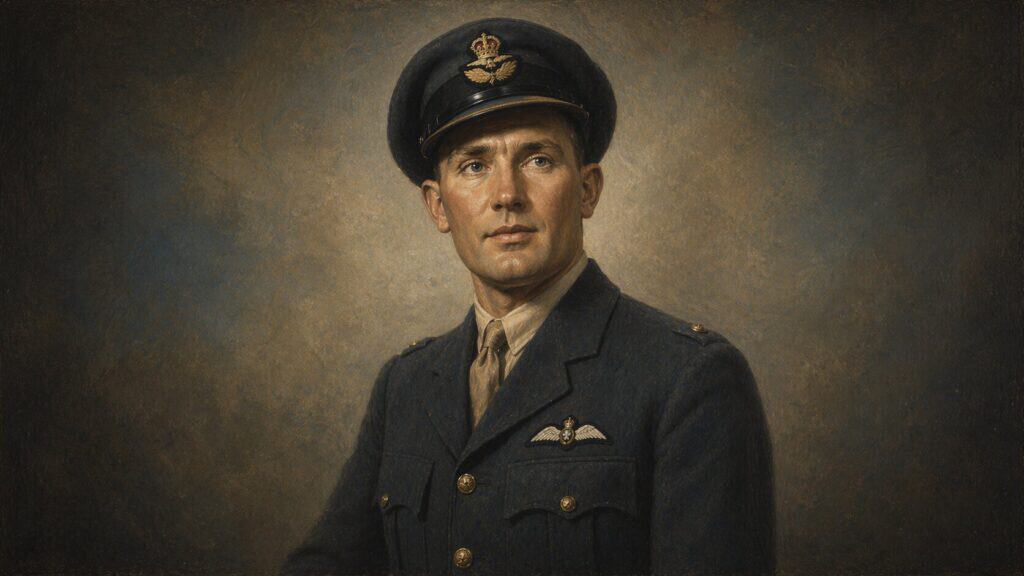
Wing Commander
Charles “Jock” Calder
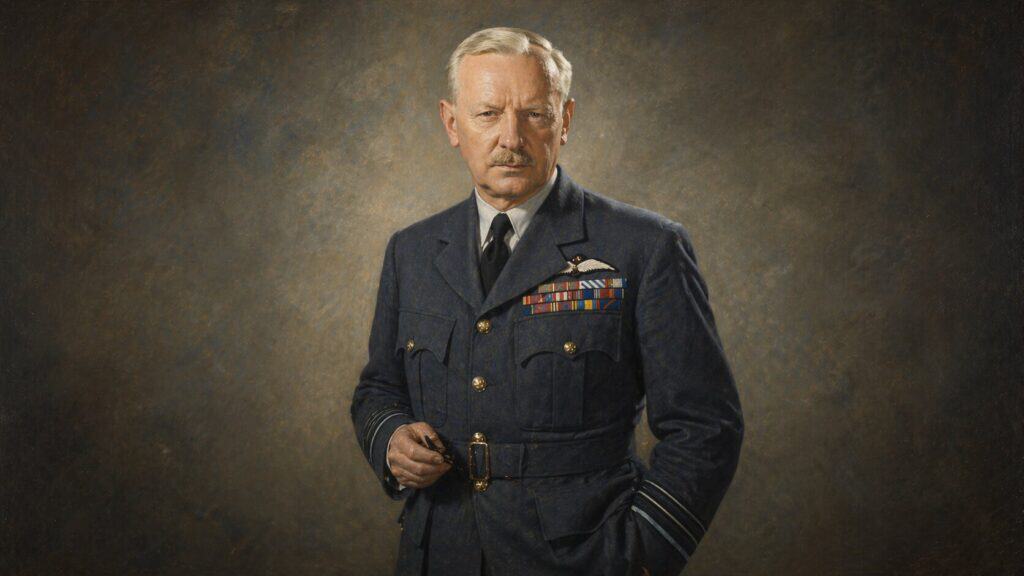
Charles "Jock" Calder was a Bomber Command pilot and 617 Squadron commander who led the first operational Grand Slam attack at Bielefeld.
Early Life
Charles "Jock" Calder was a Scottish RAF bomber pilot whose wartime career carried him from the early heavy-bomber campaigns of Bomber Command to the specialised operations of No. 617 Squadron. He is most closely associated with the attack on the railway viaducts at Schildesche, near Bielefeld, on 14 March 1945, when the first operational Grand Slam bomb used against an enemy target was released from his Lancaster. Later accounts of his service also remembered him as the last wartime commander of 617 Squadron.
Calder came from Dunphail in Morayshire, the son of a farming family. Accessible sources do not provide a securely verified full birth date in this run, but they do place his background firmly in north-east Scotland. That rural upbringing remained part of how he was remembered after the war, even as his service took him into some of Bomber Command's most technically demanding work.
Entry into Service
Imperial War Museums records Calder as serving with 76, 78 and 158 Squadrons of No. 4 Group, Bomber Command, between 1941 and 1944. In that phase of the war, he flew the Armstrong Whitworth Whitley, the Handley Page Halifax and later the Avro Lancaster, building the operational experience that made him valuable for more specialised work. The same source records his transfer to 617 Squadron on 1 November 1944.
Those squadron postings placed Calder within the main offensive against Germany at a time when Bomber Command was shifting from its early-war improvised methods to a far more systematic strategic campaign. His own recollections, preserved by IWM, connect him to both large-scale bomber operations, such as the thousand-bomber raid on Bremen, and the later precision attacks for which 617 Squadron became known.
Operational Career
By the time Calder joined 617 Squadron, the unit had moved far beyond the attack that had first made it famous. Under successive commanders, it had become a specialist formation for difficult targets that required accuracy, careful crew work, and confidence in new weapons. Calder's experience in 4 Group heavy bombers made him well-suited to that environment.
The best-documented episode of his operational career came in March 1945. On 14 March, fifteen Lancasters of 617 Squadron attacked the railway viaducts at Schildesche, Bielefeld. An Imperial War Museums photograph taken during the raid identifies Calder, then the raid leader, as the pilot whose 22,000-lb Grand Slam bomb exploded on the target shortly after 4.28 in the afternoon. The same catalogue entry describes the attack as the first occasion on which Grand Slam was used successfully against an enemy target.
That raid mattered both tactically and technically. The Grand Slam was the largest conventional bomb employed by the RAF in the war, designed for deep penetration against hardened structures. Bielefeld became not simply another bombing sortie, but a demonstration of a weapon and method intended for the last phase of the strategic air offensive. Calder's role in leading that attack secured his place in the history of 617 Squadron and of late-war Bomber Command.
Major Actions or Commands
Calder's decorations reflected that record of sustained operational flying. Contemporary and later sources support the award of the Distinguished Service Order, a bar to that award, and the Distinguished Flying Cross. An item preserved by the International Bomber Command Centre records that the pilot who dropped the first "Ten-Ton Tess" bomb on Germany at Bielefeld, Acting Wing Commander Charles Cranston Calder, was awarded the bar to his DSO for that work.
Later newspaper coverage in Scotland described him as having flown more than seventy wartime sorties and as having become the youngest squadron commander in Bomber Command at the age of twenty-three. That same coverage also remembered him as the last wartime commander of 617 Squadron. Those claims are part of how Calder entered public memory after the war, even though this run does not independently confirm every underlying appointment date from a primary document.
In 1945, he also served as the personal pilot to Air Marshal Sir Arthur Harris. That posting suggests the degree of confidence placed in him at the end of the war, and it linked him directly with the commander-in-chief of Bomber Command at a moment when the campaign in Europe was reaching its conclusion.
Later Life and Death
Calder remained in the Royal Air Force after the war. According to later reporting, he played an important role during the 1950s in bringing the Avro Vulcan into RAF service and in training early pilots on the new delta-wing bomber. His career therefore bridged two very different periods in RAF history: the piston-engined heavy bomber offensive of the Second World War and the opening phase of Britain's jet-powered V-bomber force.
After retirement, he kept close ties with the RAF and aircrew organisations, serving as chairman of the Highland branch of the Aircrew Association and supporting memorial work in the north of Scotland. He spent his later years at Balloch near Inverness before moving with his wife, Amy, to sheltered housing in Huntly, Aberdeenshire. He died there in 1997 after a long battle with cancer.
Historical Significance
Calder's significance lies in the breadth of his service as much as in one famous attack. He belonged to the generation of Bomber Command aircrew who moved from the gruelling main-force offensive into increasingly specialised operations, and his record clearly traces that development: early heavy-bomber service, precision-attack work with 617 Squadron, direct association with Arthur Harris, and a post-war contribution to the Vulcan force.
He is nevertheless remembered above all for Bielefeld. The first operational Grand Slam attack has an obvious place in the history of RAF weapons development and late-war bombing strategy, and Calder was at the centre of it. His legacy is therefore not only that of a decorated bomber pilot but also of an officer whose career spans several important stages in the RAF's transition from wartime heavy bombers to the early Cold War deterrent era.
| Dates | Role | Unit | Aircraft |
|---|---|---|---|
| 1941–1943 | Bomber pilot | 76 Squadron and 78 Squadron, No. 4 Group, Bomber Command | Armstrong Whitworth Whitley, Handley Page Halifax |
| 1943–1944 | Bomber pilot | 158 Squadron, No. 4 Group, Bomber Command | Handley Page Halifax |
| 1944–1945 | Pilot and later commanding officer | 617 Squadron, No. 5 Group, Bomber Command | Avro Lancaster |
| 1945 | Personal pilot to Air Marshal Sir Arthur Harris | Bomber Command | |
| 1950s | RAF officer involved in introducing the Vulcan into service | Royal Air Force | Avro Vulcan |
Calder is remembered chiefly for the Bielefeld raid, where his crew led the first successful operational use of Grand Slam against an enemy target. His wider importance lies in showing how experienced Bomber Command aircrew moved from the attritional heavy-bomber campaign into specialist precision work and then into the RAF's post-war jet age. Public memory also attached to his later association with 617 Squadron and to reports that he became Bomber Command's youngest squadron commander, although not every detail of that later reputation is equally well documented in easily accessible sources.
First Operational Grand Slam Bomb Dropped on Bielefeld
On 14 March 1945, Squadron Leader C. C. Calder used the RAF’s first operational Grand Slam…
14 March 2026 · 3 minRAF Air Cover in the Final Days of Operation Dynamo
How RAF fighter cover helped keep Operation Dynamo moving at Dunkirk, despite attrition, limited range and…
2 June 2026 · 4 minRAF Night Fighters in WW2: Radar, Tactics and Crews
How RAF night fighters used radar, specialist aircraft and crew coordination to defend Britain and conduct…
22 April 2026 · 5 min