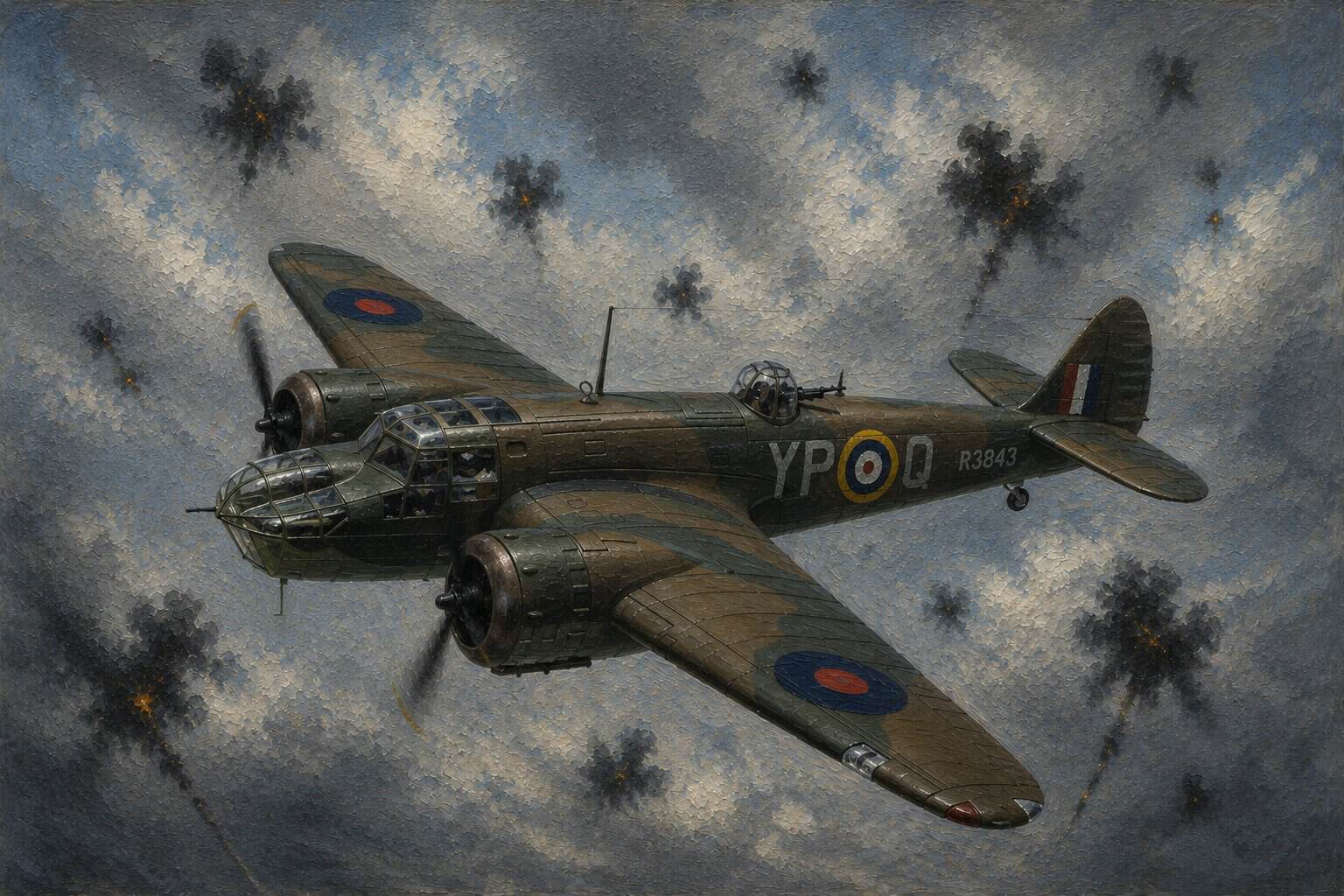
On 4 September 1939, Sergeant George Booth of No. 107 Squadron was captured after being shot down, becoming the first British prisoner of war of the conflict. His loss came during the RAF’s earliest operations against Germany, at a moment when the war was only just opening and many of its realities were still being learned under direct operational pressure. The significance of the episode lies not in scale, but in what it reveals about how quickly the abstract language of war became personal and irreversible.
The RAF in the first days of war
Britain had declared war only the previous day. Yet by 4 September, the RAF was already in action, and those first sorties were necessarily conducted under conditions of uncertainty. Plans made in peacetime had to be translated into combat experience at once. Navigation, target-finding, anti-aircraft fire, enemy opposition, and the simple difficulty of operating in a new war all combined to make the opening missions hazardous.
Booth’s capture belongs to that atmosphere of rapid adjustment. The conflict had scarcely begun, but crews were already facing the risks that would define wartime flying: mechanical vulnerability, hostile fire, separation from home territory and the possibility of capture if brought down. The date therefore stands as an early marker of the cost attached to RAF operations from the very start.
From sortie to captivity
There is a particular sharpness in the fact that Booth became the first British prisoner of war. Death in air operations was one possibility, but captivity carried a different meaning. It suggested not only a loss to the squadron but also a new and uncertain future in enemy hands. In the opening stage of the war, that possibility had not yet acquired the long history it would later hold. Booth’s capture was therefore one of the first signs that the conflict had already produced not simply casualties, but prisoners whose war would continue in a wholly different form.
That matters in RAF history because aircrews are often remembered for their actions in the air alone. Yet the war experience of many personnel extended beyond combat itself to include imprisonment, escape, endurance, and long absence from active service. Booth’s case sits at the beginning of that wider story.
A sign of how fast the war hardened
The episode also demonstrates how rapidly the transition from peace to war took effect. There was little grace period in which Britain might remain formally at war but operationally untouched. Within days, men were flying missions, being shot down and entering captivity. The mechanisms of modern conflict moved quickly.
For the RAF, this meant that learning and loss arrived together. The Service had to discover the practical character of the new war while already paying for that knowledge in aircraft and men. Booth’s capture therefore belongs not only to the personal history of one airman, but to the institutional story of an air force entering combat before it could fully settle into wartime routine.
Significance
4 September 1939 matters because it records one of the earliest human costs borne by the RAF in the new conflict. Sergeant George Booth’s capture showed how swiftly the war extended beyond declarations and strategy into the lives of individual airmen. As the first British prisoner of war, he stands at the beginning of a long and often difficult captivity story within the wider history of RAF operations. The episode is a small one in scale, but a sharp one in meaning.