On This Day, 1918: By 30 September 1918, Allied air power was helping breach the Hindenburg Line through reconnaissance, artillery support and…
Read the entry →Armstrong Whitworth Whitley
Armstrong Whitworth Aircraft
Learn how the Armstrong Whitworth Whitley carried the RAF from pre-war expansion into the first raids on Germany and later Coastal Command patrols.
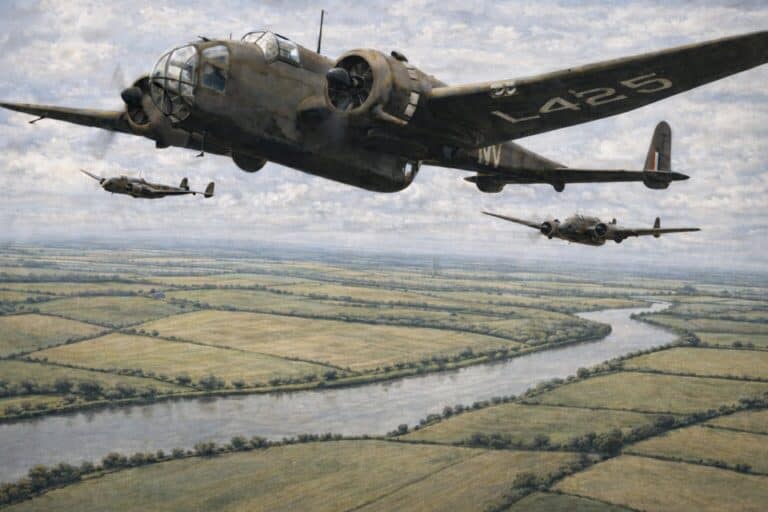
The Armstrong Whitworth Whitley was one of the RAF aircraft that carried Britain from pre-war expansion into the first hard years of the Second World War. Entering squadron service in 1937, it was the first of the RAF’s new twin-engined medium bombers to become operational, preceding the Handley Page Hampden and Vickers Wellington. Although later overshadowed by the four-engined heavies of Bomber Command, the Whitley played a central part in the RAF’s early offensive, in special duties work, and in Coastal Command patrols.
Designed to Air Ministry Specification B.3/34, the Whitley was created as a bomber capable of serving as a transport. Its slab-sided semi-monocoque fuselage marked an important step forward in British aircraft construction, even if the type was never graceful in the air. Because of the wing incidence chosen during development, it flew with a characteristic nose-down attitude in cruising flight, a feature that made it instantly recognisable.
From Rearmament Programme To Front-Line Service
Armstrong Whitworth’s design first flew on 17 March 1936 and quickly moved into production as the RAF expanded in response to the worsening European situation. No. 10 Squadron became the first operational Whitley unit in March 1937, replacing the elderly Handley Page Heyford. Early marks used Armstrong Siddeley Tiger radial engines, but later Merlin-powered versions brought a useful improvement in reliability and performance.
The most important wartime model was the Whitley Mk V, which accounted for the great majority of production. It introduced a longer rear fuselage, altered fin and rudder arrangements, de-icing equipment and increased fuel capacity. These changes improved the aircraft’s operational usefulness, even though it remained slower and more vulnerable than later bombers.
Crewed by five men, the Whitley carried its bomb load internally and was armed with hand-held or powered defensive gun positions, depending on mark. In RAF service, it became associated with the transitional phase between the biplane bomber era and the more capable heavy bombers that would later dominate the night offensive.
The Whitley In The Opening Air Offensive
When war began in September 1939, Whitleys were among the RAF bombers used on leaflet raids over Germany. They then took part in the first British bombing attacks of the war. In May 1940, Whitleys were involved in the RAF’s first deliberate raid on Germany, attacking targets in the Ruhr as the air war entered a more destructive phase.
The type served extensively with bomber squadrons such as 10, 51, 58, 77, 78 and 102 Squadrons. Among the aircrew who flew the aircraft was Leonard Cheshire, who served with 102 Squadron before later becoming one of Bomber Command’s most famous leaders. In operational use the Whitley was stable and capable of useful range, but by 1941–42 its comparatively low speed and limited defensive power were making losses increasingly difficult to sustain against improved German night defences.
That changing balance explains the aircraft’s place in RAF history. The Whitley was not the machine that won the later bomber offensive, but it helped keep pressure on Germany while Bomber Command built the force that could eventually do so.
Coastal Command, Special Duties And Legacy
As newer four-engined bombers entered service, the Whitley moved into other work for which its spacious fuselage and respectable endurance were still valuable. Coastal Command Whitley Mk VII aircraft carried ASV radar for maritime reconnaissance and anti-shipping patrols, extending the type’s usefulness well beyond its original bomber role. Other aircraft were adapted for parachute training, transport work and glider towing.
The Whitley also supported special operations. 138 Squadron and 161 Squadron used it on clandestine sorties, and it played a notable part in the Bruneval raid by towing the gliders used in Operation Biting. By the time Bomber Command’s last Whitley sortie was flown in early 1943, the aircraft had already made its contribution to the RAF’s transition from limited early-war raids to a much larger and more sustained air offensive.
A total of 1,814 Whitleys were built before production ended. Retired from RAF service in 1945, the type remains significant as an early-war bomber that bridged two different phases of British air power: the uncertain opening campaigns of 1939–40 and the more sophisticated combined air operations that followed.
| Dimensions | |
| Wingspan | 84 ft 0 in (25.60 m) |
| Length | 70 ft 6 in (21.49 m) |
| Height | 15 ft 0 in (4.57 m) |
| Wing area | 1,137 sq ft (105.6 m²) |
| Weights | |
| Empty weight | 19,300 lb (8,754 kg) |
| Max takeoff weight | 33,500 lb (15,195 kg) |
| Max bomb load | 7,000 lb (3,175 kg) |
| Performance | |
| Maximum speed | 230 mph (370 km/h) |
| Cruise speed | 185 mph (297 km/h) |
| Service ceiling | 26,000 ft (7,925 m) |
| Range | 1,650 mi (2,660 km) |
| Powerplant | |
| Engines | 2 × Rolls-Royce Merlin X liquid-cooled V12 engines |
| Power | 1,145 hp (854 kW) each |
| Armament | |
| Guns | 1 × .303 in (7.7 mm) Vickers K machine gun in the nose turret4 × .303 in Browning machine guns in the tail turretUp to 7,000 lb (3,175 kg) of bombs carried internally and in wing cells |
| Bombs / weapons | 7,000 lb (3,175 kg) |
RAF Whitleys Drop Leaflets Over Prague and Vienna
On 12 January 1940, RAF Whitley bombers carried out the service's first leaflet raid over Prague…
12 January 2026 · 4 minOperation Biting Begins with the Bruneval Radar Raid
On 27 February 1942, Operation Biting began at Bruneval as RAF aircraft carried airborne troops to…
27 February 2026 · 3 minThe RAF’s First Deliberate Raid on Germany Begins Over Rhine
On this day in 1940, Whitleys of 77 Squadron and 102 Squadron carried out what is…
10 May 2026 · 4 min