On This Day, 1988: Sheila Scott died on 20 October 1988, leaving a legacy of solo world flights, polar exploration and record-breaking…
Read the entry →McDonnell Douglas Phantom
McDonnell Douglas
Discover the RAF McDonnell Douglas Phantom, from Spey-powered British variants and Cold War air defence to withdrawal in 1992.
The entry of the McDonnell Douglas Phantom into Royal Air Force service in 1968 marked an important stage in the modernisation of British air power during the Cold War. Originally designed for the United States Navy as a fast, long-range, two-seat fighter, the Phantom combined speed, heavy weapon load and all-weather capability in a single airframe. In British service, the Phantom became central to both strike and air defence planning during a period of sustained tension in Europe.
Britain ordered 170 Spey-powered Phantoms: 52 FG.1 aircraft for the Royal Navy and 118 FGR.2 aircraft for the RAF. A portion of the naval FG.1 fleet subsequently entered RAF service. The RAF Phantom entered service at a time when the United Kingdom was required to defend national airspace while also fulfilling North Atlantic Treaty Organisation obligations in Germany. Its approximately 24 years of RAF service, from 1968 to its final withdrawal in 1992, closely corresponded with the later Cold War period and its conclusion.
To meet national requirements, the RAF McDonnell Douglas Phantom was fitted with Rolls-Royce Spey engines and British avionics. Over time, its role shifted from multirole strike and reconnaissance to a primary focus on air defence from 1977 onward. This development, together with its contribution to deterrence and airspace protection, firmly places the aircraft in the history of the Royal Air Force.
British Procurement And The Spey-Powered Variants
British interest in the Phantom arose from the need to replace older types in both the Royal Navy and the Royal Air Force with a modern missile-armed fighter. When the decision was taken to acquire the aircraft, the RAF McDonnell Douglas Phantom was adapted from the American standard configuration to meet British operational conditions. The most visible change was the replacement of the General Electric J79 engines with Rolls-Royce Spey turbofans, selected to improve low-level performance and acceleration.
Installation of the larger Spey engines required a substantial redesign of the rear fuselage and air intake area. The RAF Phantom gained wider air intakes, a re-profiled underside, and modified exhaust arrangements. These alterations changed its external appearance and influenced aspects of performance.
Two principal British variants emerged. The Phantom FG.1, also designated F-4K, was originally ordered for carrier operations with the Fleet Air Arm and featured a distinctive extendable nosewheel leg to increase the angle of attack during catapult launches. These aircraft served initially with the Royal Navy, with a number later transferred to the Royal Air Force for high-readiness interception duties. The Phantom FGR.2, or F-4M, became the principal RAF variant. With 118 examples procured, it was intended for fighter, ground-attack and reconnaissance roles. Many FGR.2 aircraft were based in Germany as part of RAF Germany, supporting NATO operations. Differences in radar equipment and reconnaissance wiring reflected the broader mission set of the FGR.2 compared with the more specialised FG.1.
Operational Service And Role Evolution
The operational career of the RAF McDonnell Douglas Phantom began in 1968 with the delivery of the first aircraft. No. 228 Operational Conversion Unit at RAF Coningsby trained pilots and navigators on the new type, instructing crews in radar operation, navigation systems and missile employment. From there, aircrew joined front-line squadrons as the Phantom entered regular service.
No. 6 Squadron became the first operational RAF Phantom unit when it re-formed at RAF Coningsby on 7 May 1969. During this initial phase, the aircraft performed both fighter and ground-attack duties, carrying conventional bombs, air-to-ground rockets, and air-to-air missiles.
Squadrons based in the United Kingdom concentrated on air defence and strike training, while those in Germany formed part of NATO’s forward deterrent posture. The type operated from multiple bases and participated in regular exercises and deployments consistent with its role in Cold War planning.
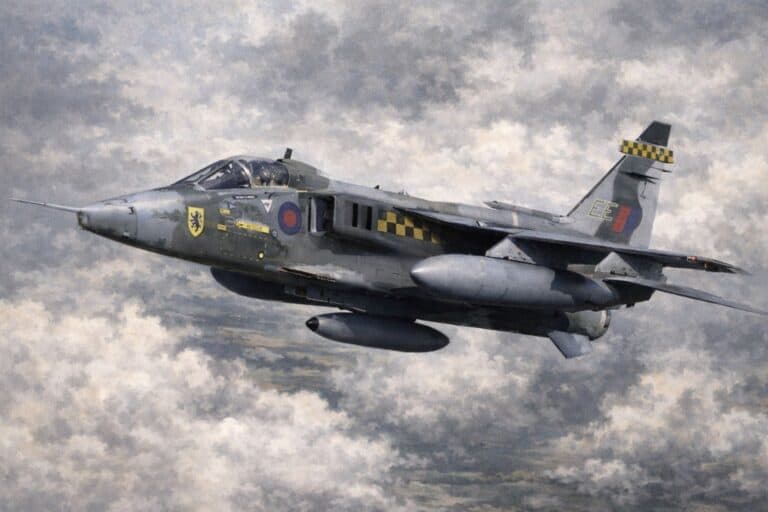
By the mid-1970s, organisational changes followed the introduction of the SEPECAT Jaguar. As the Jaguar assumed much of the ground-attack and reconnaissance role, the Phantom force was restructured. From 1977 onward, both FG.1 and FGR.2 variants concentrated primarily on air defence. In this capacity, the RAF McDonnell Douglas Phantom became a dedicated interceptor, maintained on alert to respond to unidentified aircraft approaching United Kingdom airspace and to support NATO air defence in Germany. Quick Reaction Alert scrambles against Soviet aircraft operating near airspace boundaries became a regular aspect of service.
The reassignment of aircraft between training, strike, reconnaissance and fighter squadrons reflected the changing demands placed on the RAF Phantom force.
RAF Germany, reconnaissance and air defence
In the early years, RAF Phantoms performed strike and tactical reconnaissance duties alongside their fighter role. Nos. 2 (AC) and 41 Squadrons employed the FGR.2 for reconnaissance, while Nos. 6, 14, 17, 31 and 54 Squadrons were among the strike operators. The Phantom’s radar, weapons and two-person crew also made it an effective interceptor. The arrival of the Jaguar and other changes in the RAF force structure accelerated its transition to air defence, including service with Nos. 19 and 92 Squadrons in RAF Germany. Nos. 23, 29, 43, 56 and 111 Squadrons also operated the type in air defence, alongside No. 74 Squadron‘s later F-4J(UK) aircraft.
The aircraft supported Britain’s regional commitments beyond NATO’s central front. RAF Phantoms also supported Britain’s wider overseas defence commitments, alongside their principal NATO and United Kingdom duties. In home defence, crews stood Quick Reaction Alert, identifying and intercepting aircraft approaching UK airspace, including Soviet long-range aircraft operating over the North Atlantic.
The Falklands War And Fleet Augmentation
The 1982 Falklands War created additional requirements for air defence. Following the conflict, a permanent fighter presence was established in the South Atlantic. No. 29 Squadron’s FGR.2s arrived at RAF Stanley on 17 October 1982, establishing a land-based air-defence force; No. 23 Squadron subsequently assumed the Falklands commitment. Maintaining this commitment, while continuing to defend the United Kingdom and support NATO obligations, increased demand on the RAF McDonnell Douglas Phantom fleet.
With production lines closed, the Royal Air Force acquired 15 second-hand F-4J aircraft from the United States Navy. These aircraft retained the General Electric J79 engines and corresponding airframe configuration. Before entering RAF service, they underwent refurbishment and modification, including the installation of British communications and avionics equipment. Once accepted, they were designated F-4J(UK).
The F-4J(UK) aircraft equipped No. 74 Squadron at RAF Wattisham from 1984, restoring United Kingdom air-defence capacity after Spey-powered Phantoms were committed to the Falklands. The J79-powered aircraft were withdrawn in January 1991; No. 74 Squadron continued with Spey-powered FGR.2s until October 1992.
Withdrawal From Service
The end of the Cold War and the dissolution of the Warsaw Pact prompted a reassessment of British defence requirements. Reductions in perceived threat levels led to restructuring across the armed forces. Although the RAF McDonnell Douglas Phantom remained operationally capable, it required substantially more maintenance and support resources than newer designs.
The Tornado F3 was selected to replace the Phantom in the air defence role. During the early 1990s, Phantom squadrons were gradually disbanded or re-equipped. Aircraft were withdrawn to storage, repurposed for ground training or preserved for display. The final RAF Phantom units withdrew the type in 1992, concluding approximately 24 years of RAF service.
The Phantom formed a central element of British and NATO air defence throughout the latter decades of the Cold War. It provided a stable platform for radar-guided and infrared missiles, adapted to changes in operational doctrine and geography, and contributed to the deterrent posture of the period. Its withdrawal marked the end of a significant phase in Royal Air Force development.
Conclusion
Between 1968 and 1992, the RAF McDonnell Douglas Phantom served as a principal component of British air power. It entered service as a multirole strike and reconnaissance aircraft and later evolved into a dedicated interceptor as strategic priorities shifted. The adaptation of an American design with Rolls-Royce Spey engines and British avionics demonstrated the capacity to tailor an existing platform to national requirements.
From Quick Reaction Alert duties in the United Kingdom to NATO commitments in Germany and the defence of the Falkland Islands, the RAF Phantom contributed to deterrence and airspace protection for nearly a quarter of a century. Its service reflects broader themes in late-twentieth-century Royal Air Force history, including technological adaptation, alliance integration, and post-Cold War restructuring.
| Dimensions | |
| Wingspan | 38 ft 4.5 in (11.70 m) |
| Length | 57 ft 7 in (17.55 m) |
| Height | 16 ft 1 in (4.90 m) |
| Wing area | 530 sq ft (49.2 m²) |
| Weights | |
| Empty weight | 31,000 lb (14,061 kg) |
| Max takeoff weight | 56,000 lb (25,402 kg) |
| Max bomb load | N/A |
| Performance | |
| Maximum speed | 1,386 mph (2,231 km/h) |
| Cruise speed | 940 km/h |
| Service ceiling | 60,000 ft (18,300 m) |
| Range | 1,750 mi (2,816 km) |
| Powerplant | |
| Engines | 2 × Rolls-Royce Spey 203 low-bypass turbofan |
| Power | 20,500 lbf (91.0 kN) thrust each with afterburner |
| Armament | |
| Guns | Air-defence fit of Sparrow or Skyflash missiles with Sidewinders; RAF strike aircraft could also carry a centreline SUU-23/A gun pod plus bombs, rockets and reconnaissance stores |
| Bombs / weapons | N/A |

Phantom FGR.2s Reach Akrotiri During the Cyprus Crisis
On 23 July 1974, two RAF Phantom FGR.2s of No. 41 Squadron reached Akrotiri to support…
23 July 2026 · 3 minNo. 29 Squadron Phantoms Take Ascension Island QRA in 1982
On 24 May 1982, No. 29 Squadron’s Phantom fighters took over Quick Reaction Alert on Ascension…
24 May 2026 · 3 minRAF Fighter Power Beyond 1940: From Spitfire to Deterrence
How RAF fighter power evolved from wartime Spitfire defence into overseas presence, air control and Cold…
18 August 2026 · 3 min