On This Day, 1939: On 21 October 1939, 46 Squadron Hurricanes intercepted Heinkel He 115 floatplanes over the North Sea in the…
Read the entry →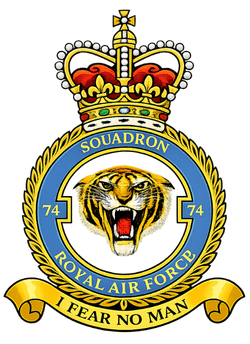
74 Squadron
“Tiger Squadron; "Trinidad Squadron" (wartime honorary title)”
I Fear No Man
Explore 74 Squadron RAF from First World War aces and the Battle of Britain to Lightnings, Phantoms and its final Hawk training years.
Single-seat fighter squadron later employed in air defence, fighter-bomber operations and, in its final incarnation, reserve fast-jet training.
No. 74 Squadron RAF flew as a fighter unit from the closing years of the First World War to the turn of the millennium, earning the nickname the Tiger Squadron for the aggressive combat record it built in France in 1918. Across more than eight decades of intermittent service it moved through several of the RAF’s defining chapters: Western Front air fighting, the Battle of Britain, Mediterranean operations, the introduction of jet and supersonic fighters, and a final decade spent training the fast-jet pilots who went on to fly with other squadrons.
Its history runs as a sequence of distinct eras, separated by disbandments and reformations that reflected the RAF’s changing needs at each stage rather than any failure of the squadron itself.
Origins and the First World War
No. 74 Squadron formed at Northolt on 1 July 1917 as a training unit of the Royal Flying Corps, flying Avro 504s while it built up its pilots and ground crew before moving to London Colney to prepare for front-line service. In March 1918 it re-equipped with the S.E.5a and crossed to France under the command of Major Keith Caldwell, entering combat on the Western Front. Its first action came on 12 April 1918 near Merville, and over the following seven months the squadron built one of the strongest combat records of any British fighter unit in the closing stages of the war, credited with well over 200 aerial victories.
Among Caldwell’s flight commanders was Major Edward “Mick” Mannock, whose reputation as a tactician and formation leader gave the squadron much of its early character, alongside fellow ace Ira “Taffy” Jones. Mannock left 74 Squadron in July 1918 to take command of No. 85 Squadron, where he was killed in action later that month. He was awarded a posthumous Victoria Cross for his record as a fighter pilot and leader, and although his death came after he had moved to another command, his time as a 74 Squadron flight commander remains one of the episodes the Tiger Squadron is best remembered for.
The squadron returned to Britain after the Armistice and disbanded at Lopcombe Corner on 3 July 1919, its personnel dispersed as the RAF contracted to a peacetime footing. The tiger badge and the motto “I Fear No Man” that the squadron carries today trace back to this combative early identity, formalised as squadron heraldry once the RAF began granting official badges to its units in the 1930s.
A New Squadron for a New War
No. 74 Squadron reappeared on 3 September 1935, formed aboard the troopship Neuralia during the Abyssinia Crisis as it carried reinforcements toward Malta. It initially flew Hawker Demons before returning to Britain the following year and settling at RAF Hornchurch, where it re-equipped with Gloster Gauntlet biplanes in 1937. Supermarine Spitfires followed in February 1939, placing the squadron at the centre of RAF Fighter Command’s rearmament in the months before the Second World War.
The squadron’s war began badly. On 6 September 1939, in the incident later known as the Battle of Barking Creek, 74 Squadron pilot John Freeborn mistakenly engaged Hawker Hurricanes of No. 56 Squadron near Ipswich, a friendly-fire action that cost the life of one of the other squadron’s pilots. It was an early and painful lesson in the difficulty of identifying aircraft under wartime conditions, and it did nothing to slow the squadron’s preparation for the fighting to come. In May 1940, 74 Squadron flew defensive patrols over the withdrawal from Dunkirk, its Spitfires among those covering the evacuation beaches during Operation Dynamo.
Malan and the Battle of Britain
The squadron’s most celebrated commanding officer took charge that summer. Adolph “Sailor” Malan led 74 Squadron through the Battle of Britain, developing tactical doctrine that influenced Fighter Command well beyond his own unit. Under his command, the squadron flew intensively from RAF Hornchurch and other south-eastern stations, and on 11 August 1940 alone its pilots claimed twenty-four enemy aircraft destroyed and fourteen damaged across four sorties, among the heaviest fighting the squadron saw that summer.
The pace of operations through the following weeks was relentless, and 74 Squadron, like the rest of Fighter Command, absorbed losses and rotated aircrew as the fighting continued into the autumn. Malan’s own approach to air fighting, later distilled into a widely circulated set of combat rules for RAF fighter pilots, grew directly out of his time leading the squadron that summer. By the close of the battle, 74 Squadron had established itself as one of the RAF’s most effective Spitfire units, a record built directly on his leadership and on the wider defence of south-east England that the battle represented.
War Beyond 1940
The squadron’s Second World War service extended well beyond 1940, continuing with offensive sweeps over occupied France through 1941 before it moved to the Middle East in 1942. The transition proved difficult: the aircraft intended for the squadron were lost in transit, and for a period it functioned in a non-flying capacity in Palestine and Iraq before receiving Hurricanes and resuming operational flying. From bases in Egypt, including a landing ground near El Dabaa in the Western Desert, it flew shipping escort and defensive patrols, converting back to Spitfires for service in the eastern Mediterranean, including support for the unsuccessful Dodecanese campaign and offensive operations over Axis-held Crete in the summer of 1943.
No. 74 Squadron returned to Britain in April 1944 in time for the air operations connected with the invasion of Normandy. It flew in the air defence role during the landings, took part in the campaign against the V-1 flying bomb, and then moved to the Continent with the Second Tactical Air Force, flying fighter-bomber and escort missions from advanced landing grounds in France, Belgium and the Netherlands as the Allied armies advanced into Germany. By the war’s end the squadron had added a substantial Second World War record to one already built on the Western Front a generation earlier.
Into the Jet Age
Peace brought a change of aircraft rather than a change of role. From 1945 the squadron re-equipped with the Gloster Meteor, forming part of the RAF’s first all-jet fighter wing alongside Nos. 616 and 504 Squadrons, and progressed through the Meteor F.3, F.4 and F.8 variants over the following decade as the type and the wider jet-fighter force matured. Flying from stations including RAF Colerne and RAF Horsham St Faith, the squadron took on the day-fighter interception role that defined RAF home air defence in the early Cold War, before converting to the Hawker Hunter in 1957 and flying the type for three years ahead of its next and most significant step forward.
In 1960, 74 Squadron became the first RAF squadron to receive the English Electric Lightning, taking the supersonic interceptor into service from RAF Coltishall. The squadron formed an aerobatic display team that flew the Lightning during 1962 and 1963, showcasing the aircraft’s Mach 2 performance and reinforcing the Tiger identity the squadron had carried since the First World War.
Lightning and Phantom Years
The squadron moved to RAF Leuchars during the Lightning years. It had already joined the newly formed NATO Tiger Association in 1961, and at Leuchars it went on to host its own Tiger Meet in 1966, part of a long association with the NATO Tiger community that continues to mark squadrons carrying the tiger emblem across allied air forces. In 1967 it deployed to RAF Tengah in Singapore, flying the Lightning F.6 in the air defence role in support of Britain’s Far East commitments until the squadron disbanded there in 1971 as that presence was wound down.
The Tiger identity returned to service in 1984, when 74 Squadron re-formed at RAF Wattisham with McDonnell Douglas F-4J(UK) Phantoms. These were ex-United States Navy aircraft, bought to reinforce the RAF’s air defence fighter force after the reorganisation that followed the 1982 Falklands conflict. The squadron flew the American Phantoms until 1991, when it converted to the definitive British Phantom FGR.2 for its final year in the fighter role. It disbanded again in October 1992, reappearing days later as No. 74 (Reserve) Squadron flying the BAE Hawk from RAF Valley.
Training Role and Final Disbandment
The Hawk years brought a change of purpose rather than a diminishment of the squadron’s standing. Operating as part of No. 4 Flying Training School at RAF Valley, 74 (Reserve) Squadron trained fast-jet pilots destined for operational squadrons elsewhere in the RAF, carrying the same fighter-pilot discipline that had defined the unit since the Western Front into the instruction of a new generation of aircrew flying the BAE Hawk T.1 and T.1A. The squadron disbanded for the final time on 22 September 2000, closing a service record that had run from S.E.5a fighters over France to supersonic interceptors and jet trainers.
Legacy
No. 74 Squadron’s history links some of the RAF’s most recognisable episodes: a First World War fighter record shaped in part by Mannock’s time as a flight commander under Keith Caldwell, a Battle of Britain squadron led by one of Fighter Command’s most influential tacticians in Malan, and a post-war record that included being the first RAF squadron into service with the Lightning. Its repeated disbandments and reformations reflected the RAF’s shifting requirements across more than eight decades of intermittent service, and each time the squadron returned it did so under the same tiger badge and the same aggressive flying reputation first earned over the Western Front in 1918, from its formation as a training unit at Northolt to the final Hawk training course at RAF Valley in 2000.
The squadron’s standard was laid up at the RAF College Cranwell after that final disbandment, formally retiring the colours that had accompanied the unit through its various incarnations. It was later moved to St Clement Danes, the RAF’s central church in London, where retired squadron standards are held in remembrance.
Western Front, 1918
France & Low Countries, 1940
Dunkirk
Battle of Britain, 1940
Fortress Europe, 1940–1941 and 1944
Home Defence, 1940–1941
Mediterranean, 1943
Walcheren
Normandy, 1944
France & Germany, 1944–1945
Rhine
Western Front, 1918
Dunkirk evacuation
Battle of Britain
Dodecanese campaign
Operation Overlord
V-1 flying bomb campaign
Allied advance through France, Belgium and the Netherlands
Major Edward "Mick" Mannock won a posthumous Victoria Cross for actions in July 1918 while serving with 74 Squadron, giving the unit one of its most notable gallantry associations.
| Period | Station | Notes |
|---|---|---|
| 1917–1918 | Northolt and London Colney | Formed and trained before fighter conversion. |
| April 1918–February 1919 | Saint-Omer and Western Front airfields | S.E.5a combat service. |
| February–July 1919 | RAF Lopcombe Corner | Return and disbandment after the First World War. |
| 1935–1936 | Malta | Re-formed during the Abyssinian crisis as the Demon Flights before resuming the 74 number. |
| 1936–1940 | RAF Hornchurch and RAF Rochford | Inter-war fighter development and opening of the Second World War. |
| 1940–1941 | RAF Wittering, Kirton in Lindsey, Coltishall, Biggin Hill, Manston and Acklington | Battle of Britain and subsequent fighter operations. |
| 1941–1942 | RAF Llanbedr, Long Kesh and Atcham | Regrouping before Middle East deployment. |
| 1942–1944 | Palestine, Iraq, Egypt and Cyprus | Maintenance, air-defence, shipping escort and Aegean operations. |
| 1944–1945 | RAF North Weald, Lympne, Tangmere, Sommervieu and advanced landing grounds in north-west Europe | Overlord, anti-V-1 and 2nd TAF operations. |
| 1945–1959 | RAF Colerne, Bentwaters, Horsham St Faith and a brief deployment to RAF Lübeck | Meteor era and first all-jet fighter wing. |
| 1959–1964 | RAF Coltishall | Introduction of the Lightning. |
| 1964–1967 | RAF Leuchars | Air-defence and Tiger Meet era. |
| 1967–1971 | RAF Tengah | Far East Lightning service. |
| 1984–1992 | RAF Wattisham | Phantom air-defence role. |
| 1992–2000 | RAF Valley | Hawk reserve and training role. |
| Name | Dates | Notes |
|---|---|---|
| A. H. O'Hara-Wood | 1917 | First commanding officer on formation. |
| Keith Caldwell | 1918 | Led the squadron in the First World War fighter phase. |
| Ira "Taffy" Jones | 1918 | Commanded in the closing months of the First World War. |
| Henry G. Crowe | 1935 | Associated with the squadron’s re-formation period. |
| G. E. Sampson | 1938 | Commanded in the pre-war Spitfire phase. |
| Adolph "Sailor" Malan | 1940 | Battle of Britain commanding officer and one of the squadron’s defining figures. |
| John Mungo-Park | 1941 | Succeeded Malan in the wartime fighter period. |
| J. C. F. Hayter | 1943 | Associated with the Middle East phase. |
| A. J. Reeves | 1944 | Commanded during the return to north-west Europe. |
| John F. G. Howe | 1960 | Led the squadron in the opening Lightning era. |
| Kenneth J. Goodwin | 1966 | Associated with the later Lightning period. |
| R. Northcote | 1984 | Commanded in the Phantom re-formation phase. |
Battle of Britain
How the Battle of Britain saw RAF Fighter Command defeat the Luftwaffe’s attempt to gain the air superiority…
Operation Overlord
How the RAF helped shape Operation Overlord through strategic bombing, airborne delivery, air cover and sustained support in…


The V1 Campaign and the RAF’s Air Defence Response
How the RAF met the V1 offensive through Operation Diver, fighter interception and an adapted air-defence…
23 June 2026 · 4 minOperation Oppidan and Operation Hansford Deliver Fighters to Malta
On this day in 1942, Operations Oppidan and Hansford delivered Spitfires to Malta, strengthening the island’s…
9 May 2026 · 3 minMosquito Enters Bomber Command Service with No. 105 Squadron
On 1 June 1942, No. 105 Squadron flew the Mosquito’s first operational bombing mission for Bomber…
1 June 2026 · 3 min