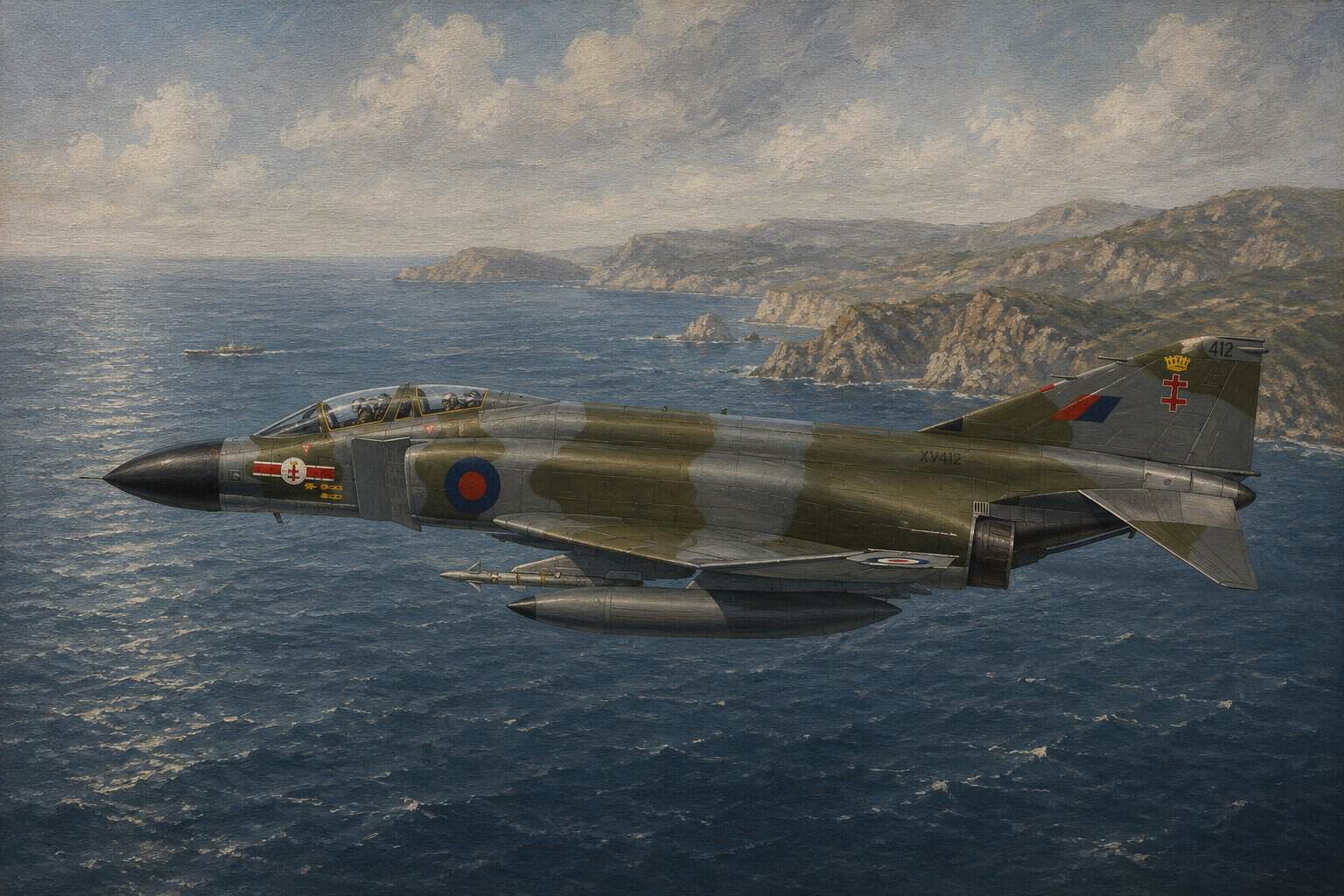
On 23 July 1974, two Phantom FGR.2 aircraft of No. 41 Squadron arrived at RAF Akrotiri to provide reconnaissance and deterrent support during the Cyprus crisis. Their deployment came in the tense aftermath of the Turkish intervention on the island, when Britain had to consider its responsibilities, its regional posture and the security of its sovereign base areas. Although small in numerical terms, the move demonstrated how quickly the RAF could project capable aircraft into a politically charged theatre.
A rapid response to a fast-moving crisis
The events in Cyprus developed at speed. Political upheaval on the island, military intervention, and the wider strategic sensitivity of the eastern Mediterranean created conditions in which both information and presence mattered. For Britain, Akrotiri was not merely a remote station. It was a critical base with regional significance, and any deterioration in the local situation had implications beyond Cyprus itself.
In such circumstances, the arrival of Phantom FGR.2s carried a dual purpose. The aircraft could contribute to reconnaissance, helping commanders and policymakers build a clearer picture of events, while also acting as a visible demonstration of capability. Air power is often used in precisely this way during crises: not solely to fight, but to reassure, observe and signal resolve.
Why the Phantom was suitable
The Phantom gave the RAF a fast, modern and flexible aircraft for uncertain circumstances. No. 41 Squadron was associated with reconnaissance, and the type’s speed and performance made it useful for rapid reaction in a theatre where events could outpace slower forms of intelligence gathering. Even a very small detachment could have value if it delivered timely information and represented a credible force.
That is an important point in understanding the deployment. A pair of aircraft was not intended to dominate the military balance in Cyprus. Rather, it offered a precise tool for a limited, immediate requirement. The RAF did not need a large formation to prove relevance; it needed the right capability in the right place quickly.
Deterrence, surveillance and British posture
Akrotiri’s importance in British strategy gave the deployment meaning beyond the island itself. The base had long served as a key staging point and listening post in the region, and its security mattered to wider British and allied interests. Sending Phantoms there formed part of a broader posture of alertness and contingency rather than an isolated local act.
Deterrence in this context was subtle. The presence of advanced RAF aircraft signalled that Britain was watching events closely and retained practical options. It also reassured personnel on the base and underlined that Akrotiri would not simply be treated as peripheral while the crisis unfolded around it.
A Cold War example of limited air power
This episode is a useful reminder that much Cold War air power was employed below the threshold of major war. Aircraft deployments often served political and strategic purposes at least as much as tactical ones. The Phantoms at Akrotiri were part of that pattern: a compact, measured response in which observation, readiness and presence were more important than combat.
For RAF history, 23 July 1974 illustrates the Service’s expeditionary usefulness in moments of sudden regional instability. The deployment did not become famous on the scale of a wartime battle, but it showed the same essential qualities of speed, adaptability and controlled signalling. In wider air-war terms, it stands as an example of how aircraft can shape events simply by arriving, watching and being unmistakably available if the situation worsens.