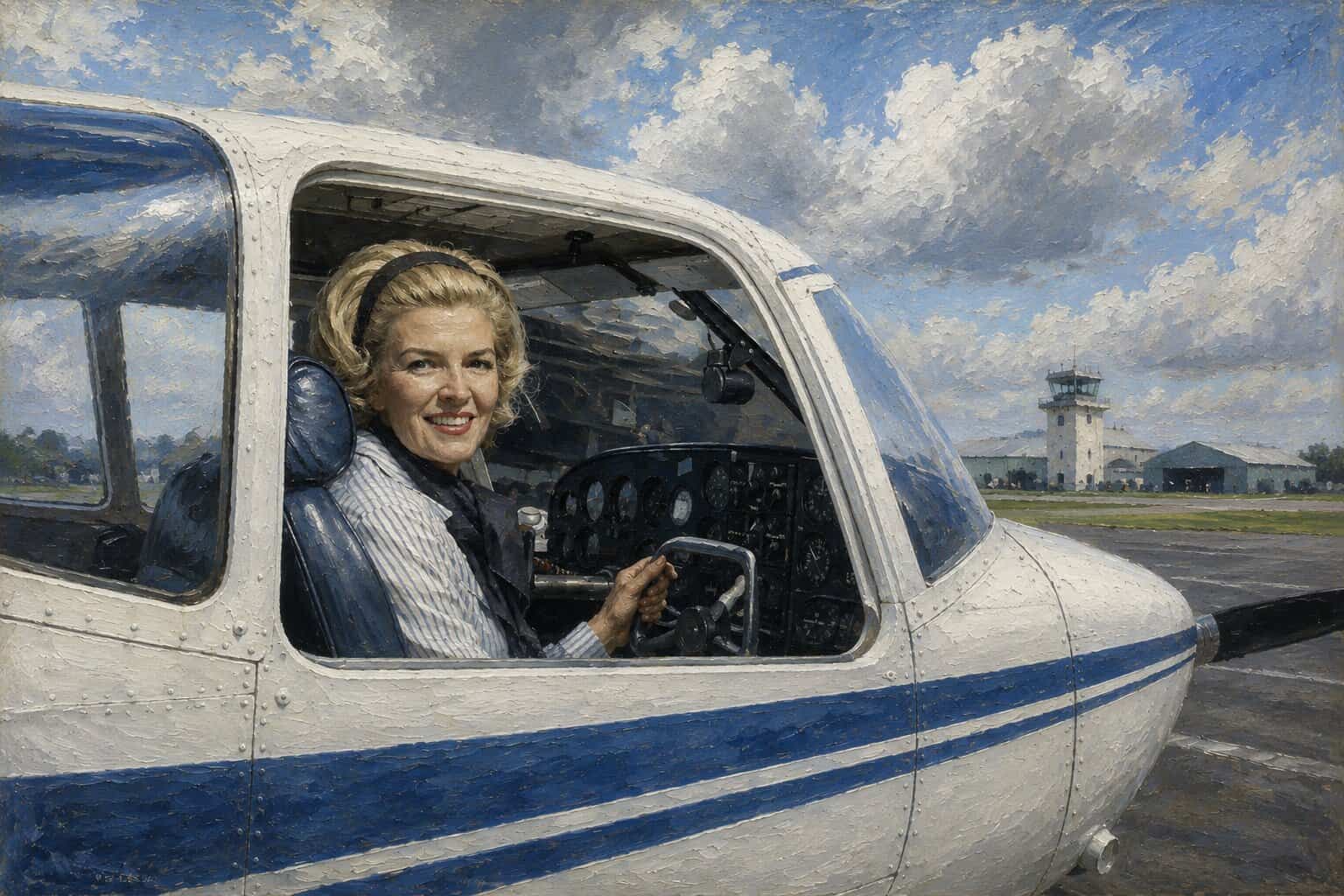
On 20 October 1988, Sheila Scott died after a flying career that had made her one of Britain’s best-known civilian aviators. Her achievements included the first solo circumnavigation of the world by a British pilot in 1966 and a flight over the North Pole during her 1971 ‘world and a half’ journey. Her place in British aviation rested on independent record-breaking, long-distance navigation and the practical demands of flying light aircraft across oceans.
Scott’s career belonged to civilian aviation. Its significance lay in the international reach she achieved as a private pilot and the public attention her flights brought to British flying during the post-war decades.
From flying lessons to Myth Too
Scott began taking flying lessons in September 1958 and gained her Private Pilot’s Licence the following year. Air races and rallies provided early challenges, and she progressively extended her ambitions towards international record attempts.
The aircraft most closely associated with her success was Piper Comanche 260B G-ATOY, named Myth Too. She bought it in April 1966 with financial help from the aviator Sir Alan Cobham. Its fuel capacity in relation to consumption made it suitable for the long stages of a round-the-world flight. Aircraft selection was a fundamental part of preparing for ocean crossings, where endurance determined the routes available.
On 18 May 1966, Scott departed from London Heathrow. Her route led through Europe, the Middle East and Asia to Australia and New Zealand, then across the Pacific to North America. The return journey carried her across the Atlantic through the Azores and Lisbon to London.
A solo circuit of the world
The journey demanded sustained flying through difficult weather and accumulating fatigue. A violent monsoon thunderstorm between Karachi and Delhi forced a diversion to Jaipur. Over the Pacific, a leaking cabin fuel tank created a serious hazard inside Myth Too. Illness and interrupted sleep added to the strain of operating alone.
Scott completed the circuit in 34 days, with 189 flying hours recorded. The achievement brought widespread recognition, alongside substantial debts from financing the flight. Supporters helped her retain Myth Too, allowing the aircraft to remain central to her subsequent flying.
Further record attempts followed. In 1967 she flew from London to Cape Town and made solo flights across the North and South Atlantic. In December 1969 she competed in the London to Sydney Air Race, then continued her journey eastwards to complete a second solo circumnavigation in 1970. These journeys established a sustained career in long-distance flying.
Across the Arctic in Mythre
The requirements of a polar journey led Scott to another aircraft. For her 1971 ‘world and a half’ flight she used Piper Aztec G-AYTO, named Mythre. Its role was distinct from that of the Comanche in her earlier achievements.
During this journey Scott flew over the North Pole and carried equipment for a NASA satellite communications experiment. The equipment transmitted information about her position to a Nimbus satellite, which relayed it to ground facilities. Her aircraft served as a mobile platform for testing the collection of location data from remote areas, giving the flight a scientific purpose alongside its record-breaking ambitions.
An aircraft preserved
Scott sold Myth Too in 1971. After a crash in 1979, the aircraft entered museum care and became part of National Museums Scotland’s collections. Its surviving structure and markings preserved a tangible connection with her journeys.
By her death in 1988, Scott had linked British private flying with global routes, polar exploration and satellite research. Her career was separate from the Royal Air Force, but formed part of the wider story of post-war British aviation in which private pilots continued to test the practical limits of light aircraft over extraordinary distances. Myth Too survives as a tangible record of the aircraft in which she achieved her first solo circuit of the world.