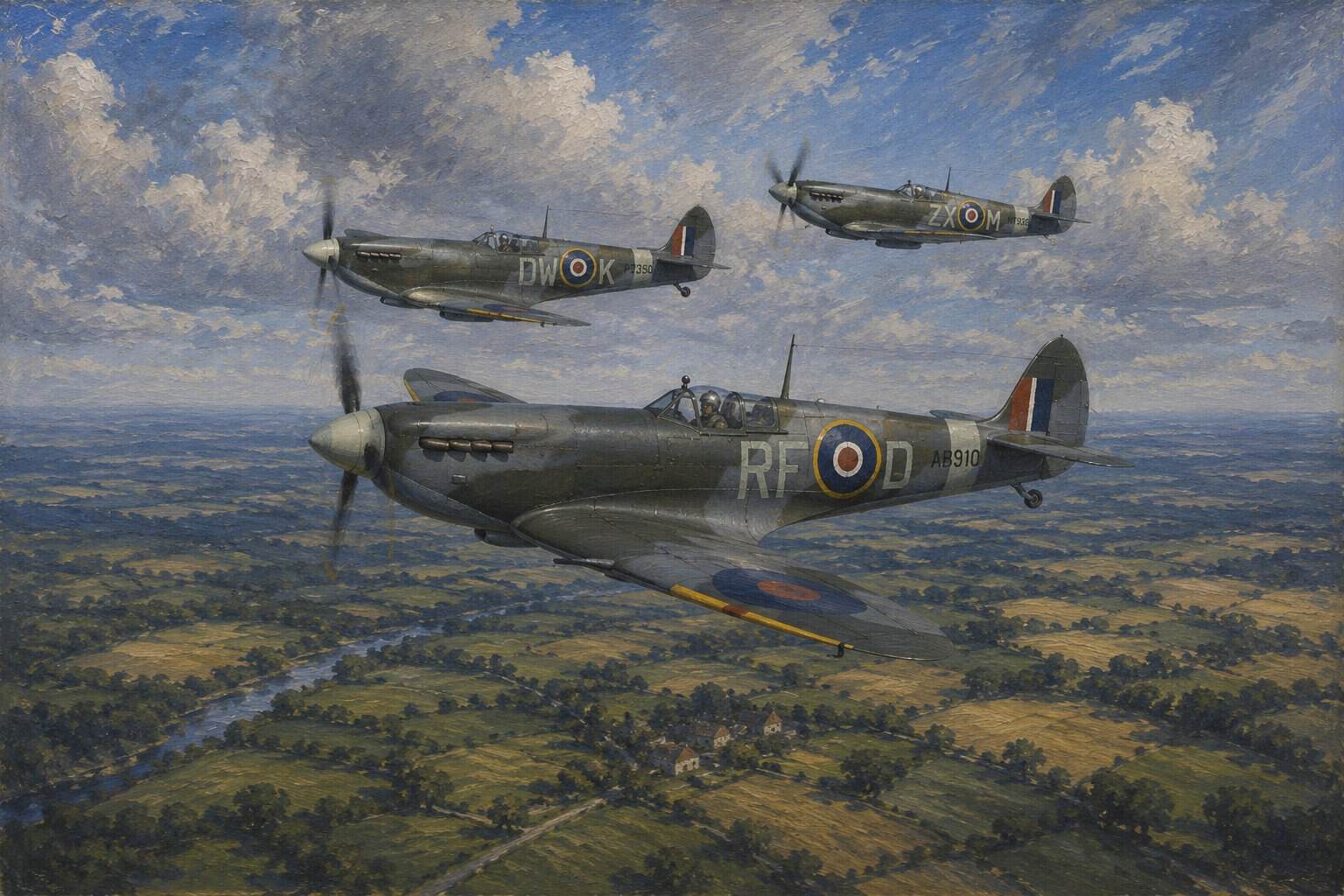
The Battle of Britain fixed RAF fighter power in the public mind as a story of homeland defence in 1940, yet the service’s fighter arm developed far beyond that moment. From wartime reinforcement and overseas deployment to the political demands of the Cold War, fighter power became one of the RAF’s most flexible instruments of presence, control and deterrence.
Beyond The Battle Of Britain
The Supermarine Spitfire remained central to this transition because it was not only a symbol of 1940 but an aircraft capable of adaptation. As the war widened, RAF fighter forces were needed for more than interception over southern England. They supported offensive sweeps, escorted operations, defended overseas bases and helped maintain British air power across multiple theatres.
That shift reflected a broader institutional change. Fighter Command and the RAF’s wider fighter force had to think in terms of sustained deployment, different climates, varying enemy capabilities and the demands of coalition warfare. The fighter arm was becoming a mobile instrument rather than one defined solely by a single defensive campaign.
Wartime Adaptation And Overseas Service
As the war progressed, fighter aircraft and fighter organisation were shaped by range, performance and changing operational roles. Reinforcement remained important, but its meaning shifted once the RAF was supporting fronts well beyond Britain itself. Fighter power had to defend lines of communication, support expeditionary operations and contribute to the control of contested airspace in distant theatres.
This experience mattered after 1945. The RAF had learned not only how to defend Britain but how to maintain aircraft, crews and command structures across a global network of stations and commitments. That practical inheritance helped shape the service’s post-war outlook.
From Presence To Deterrence
In the Cold War, fighter power became part of Britain’s wider deterrent posture. Aircraft based abroad could reassure allies, respond rapidly to regional crises and demonstrate that British air power remained available beyond home waters. Fighter deployments therefore carried political as well as military meaning. They were visible, mobile and adaptable, making them useful instruments in a world defined by tension short of general war.
The aircraft changed, the strategic vocabulary changed and the technological environment changed, but the underlying logic of fighter presence endured. Air power could be used to signal commitment, defend key positions and shape calculations without necessarily being employed in major combat.
Significance
The history of RAF fighter power after 1940 is therefore a story of continuity as well as change. The Spitfire and the Battle of Britain remained central to institutional memory, but the fighter arm’s later importance lay in its ability to operate overseas, support British commitments and contribute to deterrence. In RAF terms, fighter power outgrew the narrow frame of 1940 and became a long-term instrument of global policy.