On This Day, 1940: On 7 October 1940, Hurricane pilot Archie McKellar of 605 Squadron was credited with five Bf 109 victories…
Read the entry →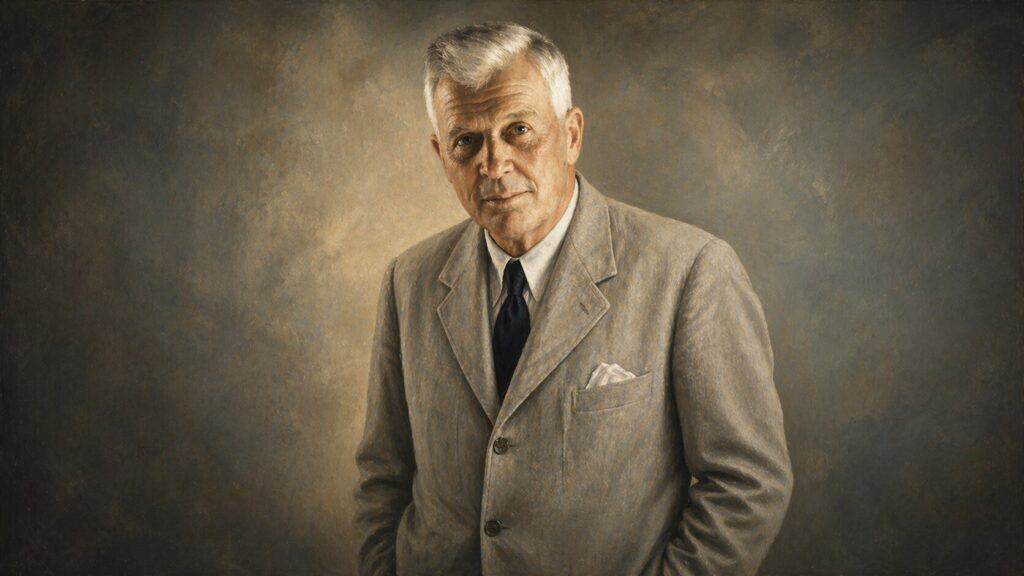
Barnes Wallis
British engineer Barnes Wallis is best known in RAF history for developing the bouncing bomb used in Operation Chastise. His work on specialised weapons made him one of the most recognisable non-service figures linked to the wartime RAF.
Barnes Wallis occupies a distinctive place in RAF history because he was not an RAF officer, aircrewman or commander, yet his name became inseparably linked with one of the service’s most famous wartime operations. Best known for developing the bouncing bomb used in Operation Chastise, Wallis represents the critical role of engineering innovation in modern air warfare. His contribution to the RAF was therefore indirect in service terms but profound in operational effect and historical memory.
Although public attention has focused overwhelmingly on the May 1943 raid on the dams, Wallis’s wider importance lies in his work as an engineer and designer. He belonged to the group of technical minds whose ideas helped shape the weapons, methods and possibilities of twentieth-century air power. His significance rests less in celebrity than in the connection between advanced design and operational reality.
Early career
Barnes Neville Wallis was born on 26 September 1887 at Ripley in Derbyshire. He trained as an engineer and became associated with major British aeronautical and structural work during the early decades of the twentieth century. Before the Second World War, he had already established a serious reputation in engineering, including work connected with airship and aircraft structures.
This pre-war background mattered greatly. By the time Britain entered the war in 1939, Wallis was not an improvised inventor brought in by circumstance, but an experienced engineer with the technical authority to propose ambitious ideas. His later wartime work should therefore be seen in the context of long professional development rather than sudden inspiration.
War work and the road to Chastise. During the war, Wallis worked on a range of weapons concepts aimed at improving the effectiveness of British bombing. His thinking reflected a belief that carefully designed strikes against critical infrastructure could sometimes achieve more than the mere weight of an explosive. That line of thought led him to the idea that strongly defended targets, such as German dams, might be attacked by novel means.
The best-known result was the Upkeep mine, later universally described as the bouncing bomb. Designed to skip across the water, strike the dam wall and then sink before detonating, it required highly specialised operational conditions. Success depended not only on the weapon itself, but on the ability of aircrew to fly at exact height, speed and range at night under combat conditions. In that sense, Wallis’s engineering solution and RAF flying skill were inseparable.
Operation Chastise
Wallis’s name entered permanent RAF history through Operation Chastise on the night of 16–17 May 1943. Carried out by 617 Squadron using specially modified Avro Lancaster bombers, the raid breached the Möhne and Eder dams, though the Sorpe was only damaged. The attack caused severe flooding and has remained one of the most studied RAF precision raids of the war.
Wallis was not part of the squadron command structure and did not fly the mission, but the operation’s public identity became tied almost as much to his invention as to the crews who carried it out. That connection has endured in books, films and wider popular memory. Yet the operation also showed the limitations of innovation: specialised weapons could produce striking results, but only at considerable cost and under very exact conditions.
Beyond the bouncing bomb
Wallis’s wartime contribution should not be reduced entirely to one weapon. He continued to work on large-bomb concepts and on the relationship between engineering design and the destructive effects of air attack. His reputation as a serious thinker about the technical side of bombing has therefore outlived the narrower popular image of the dams raid alone.
For RAF history, this matters because it broadens the way Wallis should be understood. He was not simply the inventor behind a dramatic episode, but part of the wider technical world on which modern air warfare depended. His work demonstrates that the RAF’s operational story was shaped not only by commanders and crews, but also by designers whose ideas expanded what aircraft might do.
Historical significance
Barnes Wallis remains historically significant because he represents the intersection of engineering innovation and RAF operations. Operation Chastise gave him a permanent place in public memory, but his importance lies more widely in showing how scientific and industrial expertise fed directly into air power.
That makes him one of the clearest examples of a non-service figure whose influence on RAF history was nevertheless substantial. In the case of Wallis, the RAF’s story of courage and flying skill cannot be separated from the technical imagination that made one of its most famous operations possible.
| Dates | Role | Unit | Aircraft |
|---|---|---|---|
| 1910s–1930s | Engineering designer and aeronautical researcher | Vickers and associated engineering work | |
| 1930s–1945 | Aircraft and weapons designer | Vickers-Armstrongs | |
| 1943 | Chiefly associated in public memory with the development of the bouncing bomb for Operation Chastise | Special weapons development |
Barnes Wallis is remembered as one of the most important British aeronautical and weapons engineers linked to the RAF war effort. Although not an RAF officer, he became closely associated with Operation Chastise and the development of the bouncing bomb used by 617 Squadron in May 1943. His broader work ranged beyond a single operation, but Chastise fixed his name permanently in popular memory.
His importance lies not simply in technical ingenuity, but in the way specialised engineering could shape RAF operations. Wallis’s work linked scientific design to practical wartime application, and his reputation endures because his ideas influenced both the conduct of the war and the public memory of RAF innovation.
Archie McKellar’s Battle of Britain Ace-in-a-Day Feat
On 7 October 1940, Hurricane pilot Archie McKellar of 605 Squadron was credited with five Bf…
7 October 2026 · 3 minTwo RAF Lancasters Collide Over the Netherlands
On 8 February 1945, two RAF Lancaster bombers collided over the Netherlands after a Dortmund–Ems Canal…
8 February 2026 · 5 minSunderland Sights German Invasion Force off Norway
On 8 April 1940, a No. 204 Squadron Sunderland reported German warships heading for Trondheim, warning…
8 April 2026 · 3 min