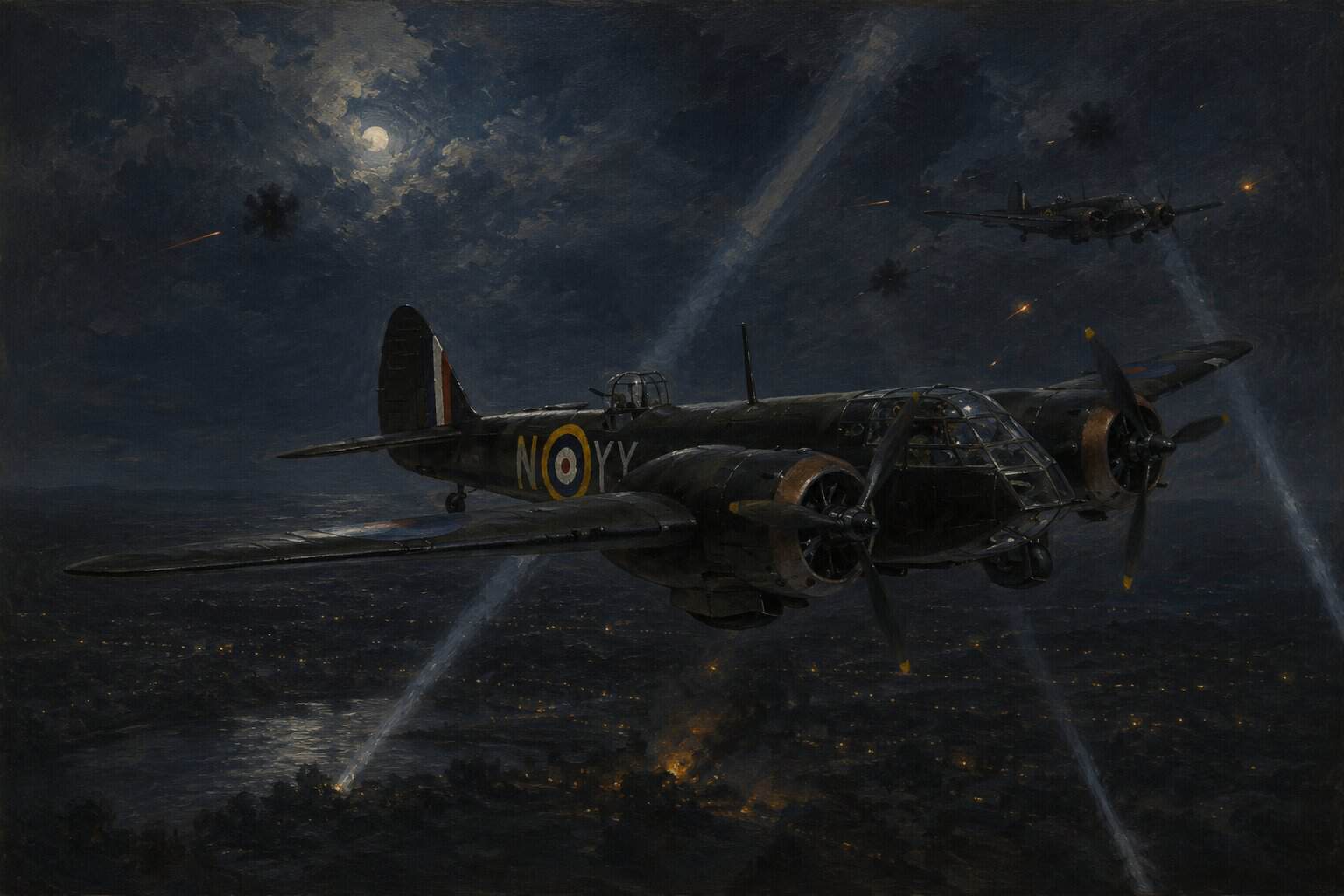
On 22 July 1940, the RAF achieved its first radar-guided night victory when a Bristol Blenheim of the Fighter Interception Unit, using airborne interception radar, destroyed a Dornier Do 17 off Selsey Bill. The engagement was important far beyond the loss of a single German aircraft. It demonstrated that night fighting could be transformed from a largely blind pursuit into a more controlled and increasingly scientific form of interception.
From darkness and guesswork to guided interception
Early night air defence posed severe difficulties. Once daylight faded, the traditional advantages of a fighter pilot were sharply reduced. Searchlights, ground observation and chance all played a part, but locating an enemy bomber in darkness remained exceptionally hard. That weakness mattered in the summer of 1940, when Britain faced the prospect of sustained attack and needed a more effective means of meeting raiders after dark.
Airborne interception radar offered the possibility of change. Instead of relying solely on visual acquisition, a night fighter crew could be guided towards an enemy aircraft by electronic means and then complete the attack at close range. The principle seems familiar now, but in 1940 it was revolutionary. It demanded new equipment, new crew cooperation and new tactical thinking.
The action off the Sussex coast
The Fighter Interception Unit existed precisely to turn emerging technology into operational practice. On this occasion, a Blenheim used its radar to close on a German Dornier in darkness near the south coast. The interception ended with the enemy aircraft being shot down off Selsey Bill, giving the RAF a landmark success.
The immediate tactical result was modest in scale, yet its significance was far greater. This was proof that airborne radar was not merely an experimental aid or a promising laboratory device. It could help crews find and destroy an enemy at night in real operational conditions. That moved radar from theory into demonstrated combat value.
A turning point in night defence
This first success did not solve Britain’s night fighting problem overnight. Equipment would improve, tactics would evolve and specialist units would still need time to mature. Even so, the victory marked the beginning of a new method of air defence. It pointed towards the integrated system that later combined ground-controlled interception, radar-equipped fighters, trained observers and dedicated night fighter squadrons.
The wider implications were profound. Radar reduced the enemy’s natural protection in darkness and restored initiative to the defender. Instead of waiting for bombers to appear by chance, the RAF could increasingly hunt them with purpose. In strategic terms, that mattered because night attack was becoming a central feature of the air war over Britain.
Why the episode deserves attention
RAF history often celebrates the dramatic daylight combats of 1940, but the struggle after sunset required equal ingenuity. The first radar-guided night victory showed that technical innovation, crew discipline and operational experimentation could alter the balance of the fight. It was an early sign that the Service would meet modern war not only with courage, but with invention.
In the longer story of air warfare, the action off Selsey Bill stands as a milestone in electronic combat. The Blenheim was not the RAF’s ideal night fighter for the whole war, yet on this night it helped open a new chapter. The result was more than a victory over one Dornier: it was a victory for a method that would become indispensable to Britain’s air defence.