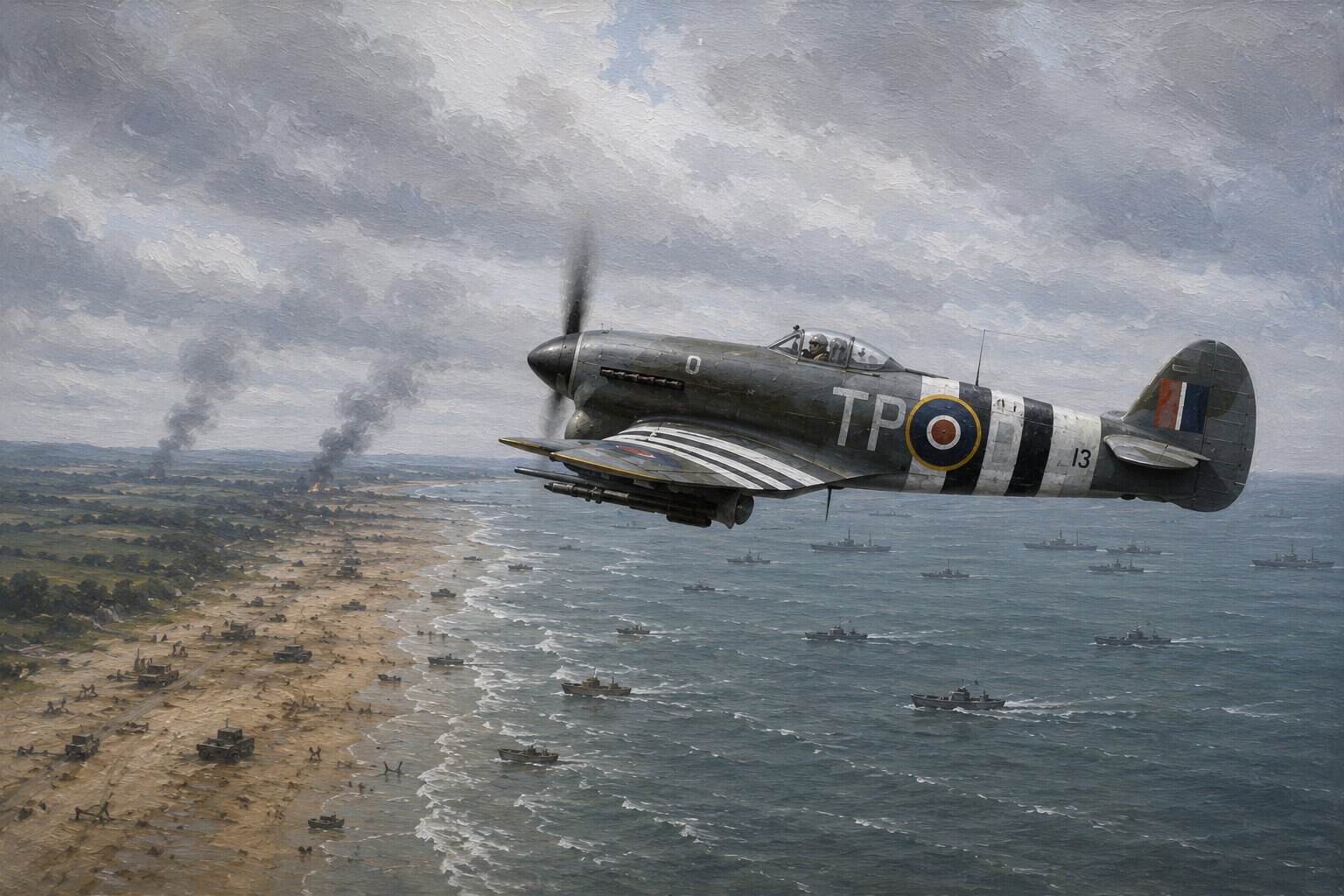
On 6 June 1944, Allied air forces flew nearly fifteen thousand sorties in support of the Normandy landings, while Luftwaffe opposition remained strikingly limited as troops fought their way onto the beaches. For the Royal Air Force, D-Day was not a single dramatic action but a vast, carefully prepared effort in which transport, bombardment, fighter cover, reconnaissance and interdiction all had to work together if Operation Overlord was to survive its first day.
Air power before the landings
The success of the invasion depended heavily on air superiority established in the preceding months. The RAF, working with the United States Army Air Forces, had attacked transport links, airfields and communications across northern France so that German forces would struggle to react quickly when the invasion came. By dawn on 6 June, that preparatory effort was already paying dividends. German air activity over the beaches was weak, and the Luftwaffe could not intervene with sufficient strength to decisively disrupt the crossing.
Yet superiority alone was not enough. Air power also had to shape the battlefield immediately around the landings. RAF bombers attacked selected targets intended to hinder German response, while lighter forces and tactical aircraft remained ready to strike roads, railways and troop concentrations inland. The effect was cumulative. Even where bombing could not solve every tactical problem, it complicated movement and reduced the enemy’s freedom to concentrate.
Supporting the assault on the day
D-Day itself demanded an extraordinary range of RAF effort. Douglas Dakotas and glider forces helped deliver airborne troops during the night, opening the operation before the seaborne assault reached the coast. As daylight came, fighters and fighter-bombers maintained cover, carried out armed reconnaissance and stood ready to attack any German movement towards the lodgement area. Aircraft such as the Hawker Typhoon became especially important in this close-support and interdiction role, combining speed with striking power against transport and armour.
RAF bombers also remained part of the day’s operational pattern. Avro Lancasters and de Havilland Mosquitos represented different ends of the bomber spectrum, but both reflected the scale and flexibility of British air power by mid-1944. Some aircraft were employed in heavy attacks against defensive positions and communications; others in marking, pathfinding or precision work. What mattered was not any single platform, but the fact that the RAF could sustain a dense and varied contribution across the entire battle space.
Results and wider meaning
By the end of 6 June, the Allied lodgement in Normandy was secure, even if the fighting on several beaches had been hard and costly. The relatively slight Luftwaffe response was itself one of the day’s great strategic facts. It showed how thoroughly Allied air preparation had weakened Germany’s ability to contest the invasion from above. For the men landing on the coast, that absence of sustained enemy air attack removed one of the gravest dangers that might otherwise have turned confusion into disaster.
D-Day therefore demonstrated the mature wartime RAF at full stretch: integrated with allies, specialised by command and capable of influencing events far beyond the cockpit of any one aircraft. It was an air battle won partly before it began, through attrition, planning and relentless pressure on the enemy’s capacity to respond. The landings in Normandy are rightly remembered for soldiers, sailors and airmen alike. For the RAF, 6 June 1944 remains a defining example of air power used not as spectacle, but as the essential framework within which a decisive operation could succeed.