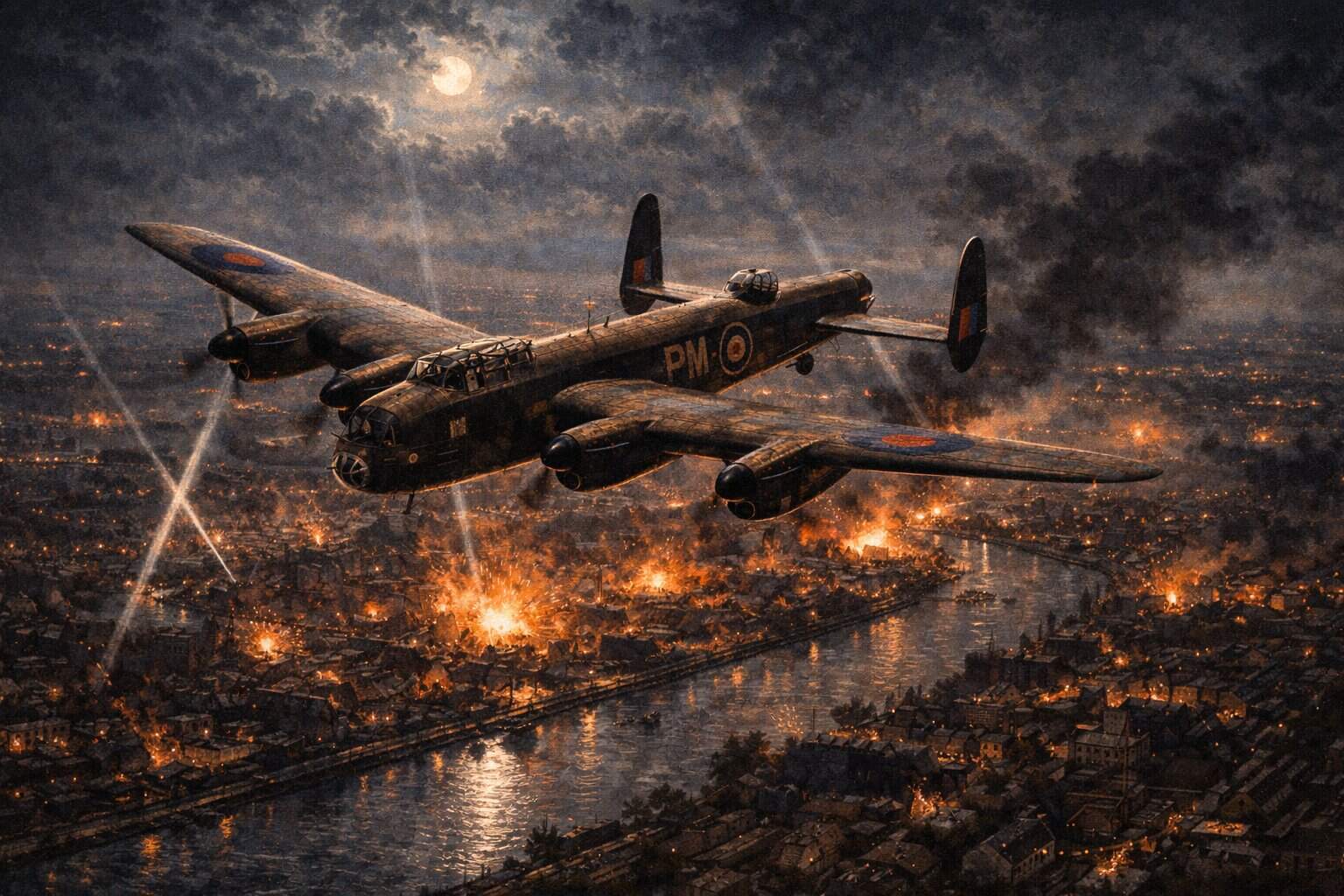
On the night of 8 February 1945, tragedy struck returning aircraft of RAF Bomber Command when two Avro Lancaster bombers collided in mid-air over the Netherlands while returning from a raid on the Dortmund–Ems Canal. One aircraft belonged to No. 83 Squadron and the other to No. 97 Squadron, both units operating within the Pathfinder Force. The collision resulted in the loss of 15 aircrew, with only 1 survivor.
The incident occurred during the final months of the Second World War in Europe, at a time when Bomber Command continued to carry out large-scale operations against critical German infrastructure. Despite Germany’s weakening position by early 1945, the air war remained dangerous, and losses continued to occur not only from enemy action but also from operational hazards inherent in night bombing.
Bomber Command Operations in Early 1945
By February 1945, the strategic bombing campaign had entered its final phase. Allied forces were advancing across Western Europe, and the focus of many Bomber Command operations had shifted toward transportation targets designed to disrupt the movement of German troops and supplies.
One of these targets was the Ems Canal in Dortmund, a major inland waterway that formed part of Germany’s extensive transport network. The canal was used to move coal, industrial materials, and other supplies vital to the German war effort. Attacking such infrastructure formed part of a broader effort to isolate industrial regions and weaken Germany’s capacity to sustain military operations.
Bomber Command raids against these targets typically involved large formations of aircraft operating at night. The scale and complexity of these missions required careful coordination, particularly as hundreds of bombers could be airborne simultaneously across a wide area of Europe.
The Pathfinder Force
Both aircraft involved in the collision belonged to units within the Pathfinder Force, a specialised group within Bomber Command responsible for marking targets for the main bomber stream. Pathfinders flew ahead of the main force and used flares or markers to identify the precise aiming point for the following aircraft.
The role demanded a high degree of skill and precision. Pathfinder crews often operated under difficult conditions, navigating long distances at night and flying over heavily defended areas before the main bombing force arrived.
No. 83 Squadron and No. 97 Squadron were among the units assigned to these duties. Their aircraft were equipped for specialised navigation and target-marking tasks, and their crews were typically among the most experienced within Bomber Command.
The Collision Over the Netherlands
After completing the raid on the Dortmund–Ems Canal, the bomber force began the long return journey to bases in England. Night operations posed numerous hazards even after the aircraft had left the target area. Crews often flew through darkness, clouds, and occasional poor visibility while navigating along routes shared with many other returning bombers.
It was during this phase of the operation that the two Lancaster bombers (one from No. 83 Squadron and one from No. 97 Squadron) collided over the Netherlands. Mid-air collisions were a rare but recognised risk during large bomber operations, particularly when aircraft were flying in darkness without modern collision-avoidance systems.
The impact destroyed both aircraft. Of the sixteen men aboard the two bombers, fifteen were killed, with only one airman surviving the disaster.
Such losses were a sobering reminder of the dangers faced by Bomber Command crews even when enemy defences were not directly involved.
Losses Beyond Enemy Action
Although Bomber Command is often remembered for losses inflicted by German night fighters and anti-aircraft defences, operational accidents were also a significant factor in wartime casualties. Aircraft operating in large formations at night faced hazards including poor weather, mechanical failure, navigation errors, and the ever-present risk of collision.
The intensity of wartime operations meant that hundreds of aircraft could be airborne at once across the same region. Under these conditions, maintaining safe separation was challenging, particularly during the return phase when formations had dispersed and aircraft were navigating independently.
Incidents such as the collision on 8 February 1945 illustrate the constant risks associated with night bombing operations.
Remembering the Aircrews
The loss of the two Lancasters from No. 83 Squadron and No. 97 Squadron came at a time when the war in Europe was approaching its final stages. Despite this, the dangers of operational flying remained very real for RAF crews.
Bomber Command’s campaign required extraordinary endurance from its personnel. Thousands of airmen flew repeated missions over occupied Europe and Germany, often facing extreme danger on every sortie.
The deaths of fifteen aircrew in this single incident form part of the wider story of the sacrifices made by Bomber Command personnel throughout the war.
Significance in the Wider Air War
The events of 8 February 1945 serve as a reminder that the air war over Europe involved dangers beyond direct combat. Large-scale night operations required precision, discipline, and constant vigilance, yet accidents could still occur even among experienced crews.
The loss of the two Lancaster bombers returning from the Dortmund–Ems Canal raid highlights the hazardous conditions under which Bomber Command operated during the final months of the war.
While the strategic bombing campaign ultimately played a major role in weakening Germany’s ability to continue the conflict, it came at a heavy cost. Incidents like this underscore the risks faced by those who flew these missions and the human toll behind the broader story of the Allied air offensive.