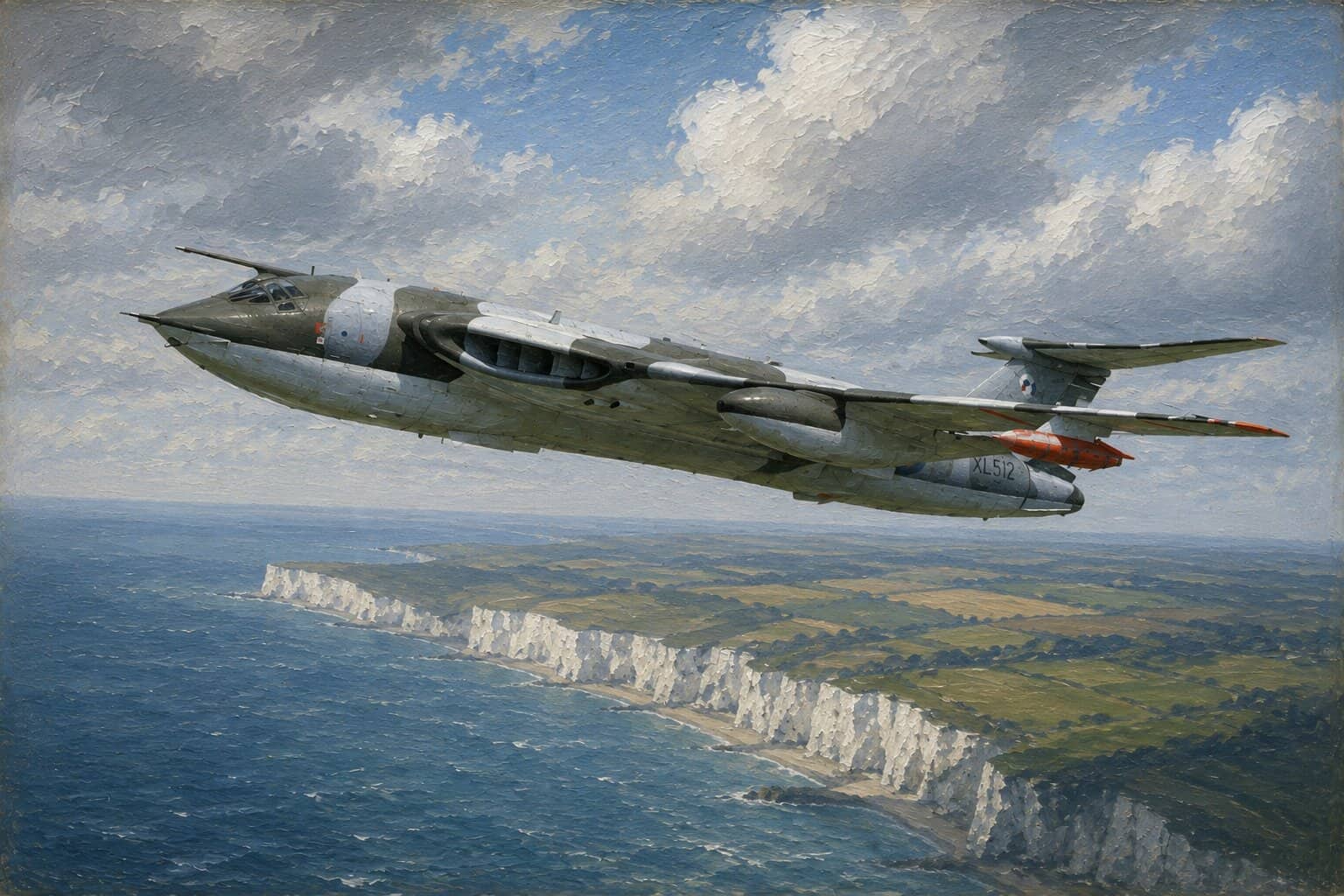
On 15 October 1993, the Handley Page Victor ceased operational service with the Royal Air Force after 36 years, closing the front-line career of the last surviving type from Britain’s V-bomber force. Its final role was air-to-air refuelling. An aircraft developed to carry nuclear weapons had become a means of extending the range and endurance of other aircraft, with operational service reaching from the Cold War to the Falklands conflict and the Gulf War.
The retirement brought together two distinct chapters of RAF history. The Victor belonged to the generation of jet bombers built for Britain’s strategic nuclear force during the 1950s. Its survival into the 1990s rested on the continuing usefulness of its tanker conversion and the growing importance of refuelling in sustained air operations.
From strategic bomber to tanker
The Victor entered Bomber Command alongside the Vickers Valiant and Avro Vulcan. These three aircraft formed the V-force, designed around the demands of delivering nuclear weapons at high speed and altitude. Early Victors carried free-fall nuclear weapons, while the more powerful B.2 subsequently carried the Blue Steel stand-off missile.
Changing air defences reshaped the bomber mission, and the RAF increasingly adopted low-level penetration. At the same time, the withdrawal of the Valiant created an urgent requirement for replacement tankers. Conversion gave the Victor a substantial second career, using its capacity and performance to support other aircraft in flight.
Earlier Victors began tanker service during the 1960s. The later K.2 programme converted 24 B.2 aircraft, with the work undertaken by Hawker Siddeley at Woodford. Refuelling equipment included wing-mounted hoses and a centreline hose drum unit, enabling the aircraft to serve different receiver types. The former bomber’s operational contribution now lay in the fuel it could transfer and the additional distance that fuel allowed another crew to fly.
Supporting operations across the South Atlantic
The Falklands conflict in 1982 demonstrated the importance of that capability. Ascension Island provided a forward base, but the distances to the South Atlantic theatre made aerial refuelling central to RAF operations. Victor tankers supported the deployment and employment of aircraft across an exceptionally long supply route.
Their best-known task was supporting the Vulcan’s Black Buck raids. These required carefully arranged refuelling sequences, including fuel transfers between Victors themselves, to sustain a bomber on its journey towards the Falklands. The tanker effort was an essential part of the operation’s reach.
Victor support also extended to transport, reconnaissance and fighter movements. Hercules, Nimrod and Harrier operations placed different demands on the refuelling force, making the tanker a shared resource across several RAF tasks. This wider work explains the Victor’s importance to the campaign as a whole: it helped move aircraft, maintain contact with distant forces and sustain activity over long stretches of ocean.
A final operational generation
The Victor remained useful during the 1991 Gulf War, where its tanker force again supported combat operations. Its participation carried an aircraft conceived for the early Cold War into a very different operational setting, alongside later generations of RAF aircraft.
By October 1993, the Victor’s place in RAF history rested on both its bomber origins and its long refuelling career. The retirement marked the departure of the final V-bomber type from service, with that lineage ending in a support role that had acquired its own operational significance.
The Victor’s lasting contribution was therefore measured in two forms of reach: the strategic striking range for which it had been designed, and the extended range it subsequently gave to other aircraft. Its tanker service kept a product of the 1950s relevant through major operations more than three decades later.