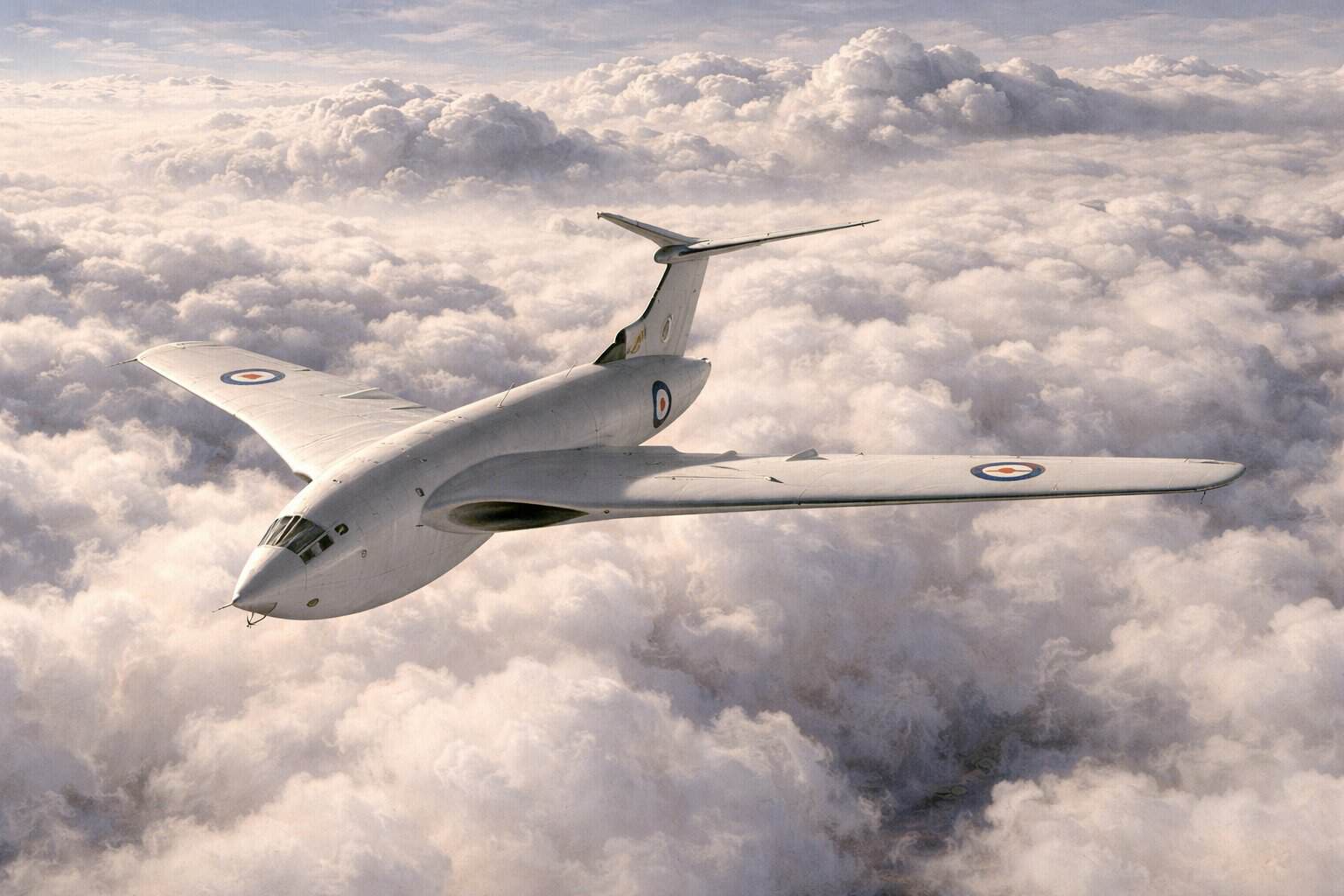
On 1 August 1957 a Defence Committee decision confirmed that the planned frontline V-bomber force would be limited to 144 aircraft. At first sight that looked like an administrative adjustment in a world already crowded with White Papers, nuclear debates and changing strategic assumptions. In reality it said a great deal about post-war British defence policy. The decision preserved the airborne deterrent, but at a lower strength than many in the RAF had once expected, and it reflected the hard balance between ambition, cost and the arrival of the missile age.
Britain’s deterrent in transition
The V-force had been conceived as the centrepiece of Britain’s strategic striking power. The Vickers Valiant, Avro Vulcan and Handley Page Victor were intended to give the United Kingdom a modern bomber arm capable of delivering nuclear weapons at long range and high speed. In the early 1950s these aircraft represented both technological confidence and a belief that manned bombers would remain the principal means of national deterrence.
By 1957, however, the strategic picture was changing. Guided missiles appeared to promise a new form of deterrent, defence budgets were under pressure and ministers were increasingly sceptical about maintaining very large conventional and nuclear air fleets at the same time. The famous defence review associated with Duncan Sandys captured that mood. Manned aircraft were not suddenly obsolete, but they were no longer assumed to have an unquestioned future.
What the reduction meant
The decision to settle on 144 frontline bombers amounted to a compromise. It did not dismantle the V-force. On the contrary, it confirmed that an airborne nuclear striking capability remained central to British policy. Yet it also imposed a more disciplined scale upon the programme. The RAF would retain a formidable strategic arm, but not one built to the larger numbers earlier advocates had imagined.
This mattered both operationally and financially. A smaller force meant greater emphasis on readiness, dispersal, maintenance standards and crew efficiency. The V-bomber force would have to deliver credibility through quality, speed of response and survivability rather than through sheer numerical depth. That pressure helped shape how the force was organised and why alert procedures, rapid-reaction planning, and base infrastructure became so important during the Cold War.
Strategic significance
The decision also illuminates an important moment in RAF history. The Service was moving from the expansive assumptions of the immediate post-war era into a sterner age of prioritisation. Even while strategic bombing remained at the heart of Britain’s nuclear posture, the RAF was being asked to do more with clearer limits. That tension would define much of the next decade.
Seen from a broader perspective, the reduction in principle was not a sign of irrelevance but of adaptation. British defence planners still believed the V-force had major value, particularly while missile systems were immature and uncertain. The Valiant, Vulcan and Victor remained indispensable. What changed was the scale on which ministers were willing to sustain them.
In wider air-war terms, 1 August 1957 showed that air power is shaped not only by combat experience or technical innovation but also by strategic choice. The V-bombers remained the visible embodiment of Britain’s independent nuclear reach. Yet their future would be determined as much in committee rooms as on airfields. That was one of the central realities of the Cold War RAF.