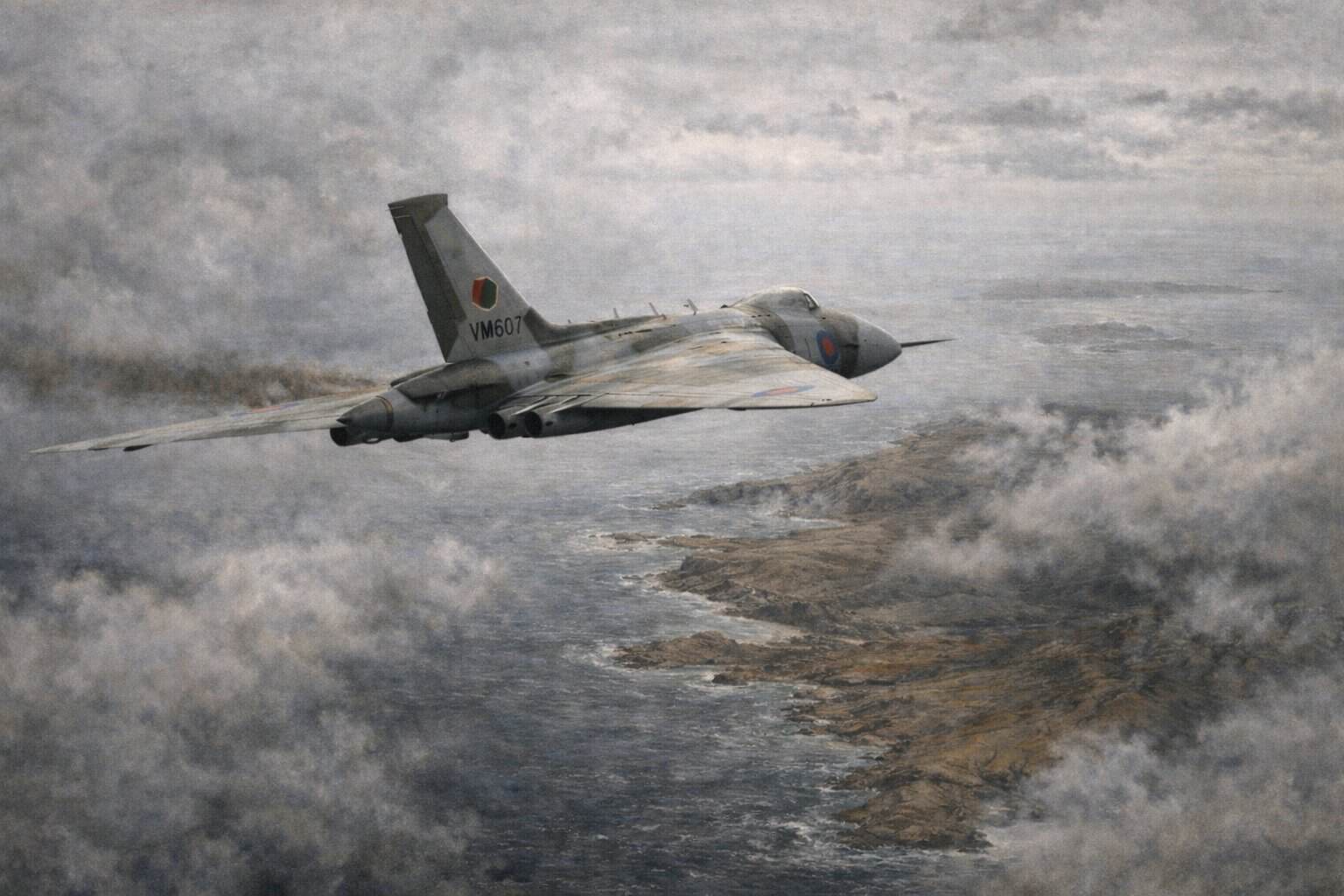
On 30 April 1982, Avro Vulcan XM607 attacked the runway at Port Stanley in the first Black Buck raid, the opening strike of Operation Black Buck within the wider campaign of Operation Corporate, with extensive tanker support from the Handley Page Victor force. Sea Harrier attacks followed, making the day a notable opening moment in Britain’s air offensive in the Falklands War. The operation has remained one of the most discussed RAF actions of the modern era, not simply because of the bomb damage inflicted, but because of what it demonstrated about reach, determination and the willingness to contest Argentine use of the islands from the outset.
A strike at extreme range
What made Black Buck 1 remarkable was the scale of effort required to place a bomber over Port Stanley at all. The South Atlantic distances were immense, and every element of the sortie depended on careful planning and support. The raid became a test not only of a single aircraft and crew, but of the RAF’s wider capacity to mount a coherent long-range attack under severe logistical constraints.
The use of XM607 carried symbolic as well as practical weight. Britain was showing that Argentine positions on the Falklands were vulnerable despite the remoteness of the theatre. In war, the value of a strike can never be measured solely by the crater it leaves. It also lies in the message sent to the enemy: that distance alone will not guarantee safety, that airfields may be threatened, and that defensive calculations must change accordingly.
Port Stanley and the wider campaign
The runway at Port Stanley mattered because control of an airfield can shape the whole character of a campaign. Airstrips are not merely pieces of infrastructure; they are gateways through which reinforcement, supply and combat air operations may pass. By bombing the runway, the RAF aimed to complicate Argentine military use of the islands and impose caution on future planning. The follow-up Sea Harrier attacks underlined that this was not an isolated gesture but part of a broader British effort to reshape Argentine calculations about the defence of the islands. Whatever view is taken of the precise physical effect on the runway, the operation forced the enemy to consider the vulnerability of Port Stanley and the reach of British air power.
Cost, effort and historical place
Black Buck 1 demanded an immense commitment of aircraft, fuel and planning. That alone helps explain why it has remained so prominent in the discussion of the Falklands War. It was not a routine bombing sortie but a highly orchestrated operation in which tanker support, navigation and timing were all critical. The raid stands as a demonstration of the RAF’s ability to impose military effect at exceptional distance under wartime conditions.
In RAF history, Black Buck 1 endures because it united operational daring with strategic signalling. It did not win the Falklands campaign by itself, but it announced from the outset that Britain intended to contest the islands by air as well as by sea. For that reason, it remains one of the defining moments of modern RAF long-range strike history.