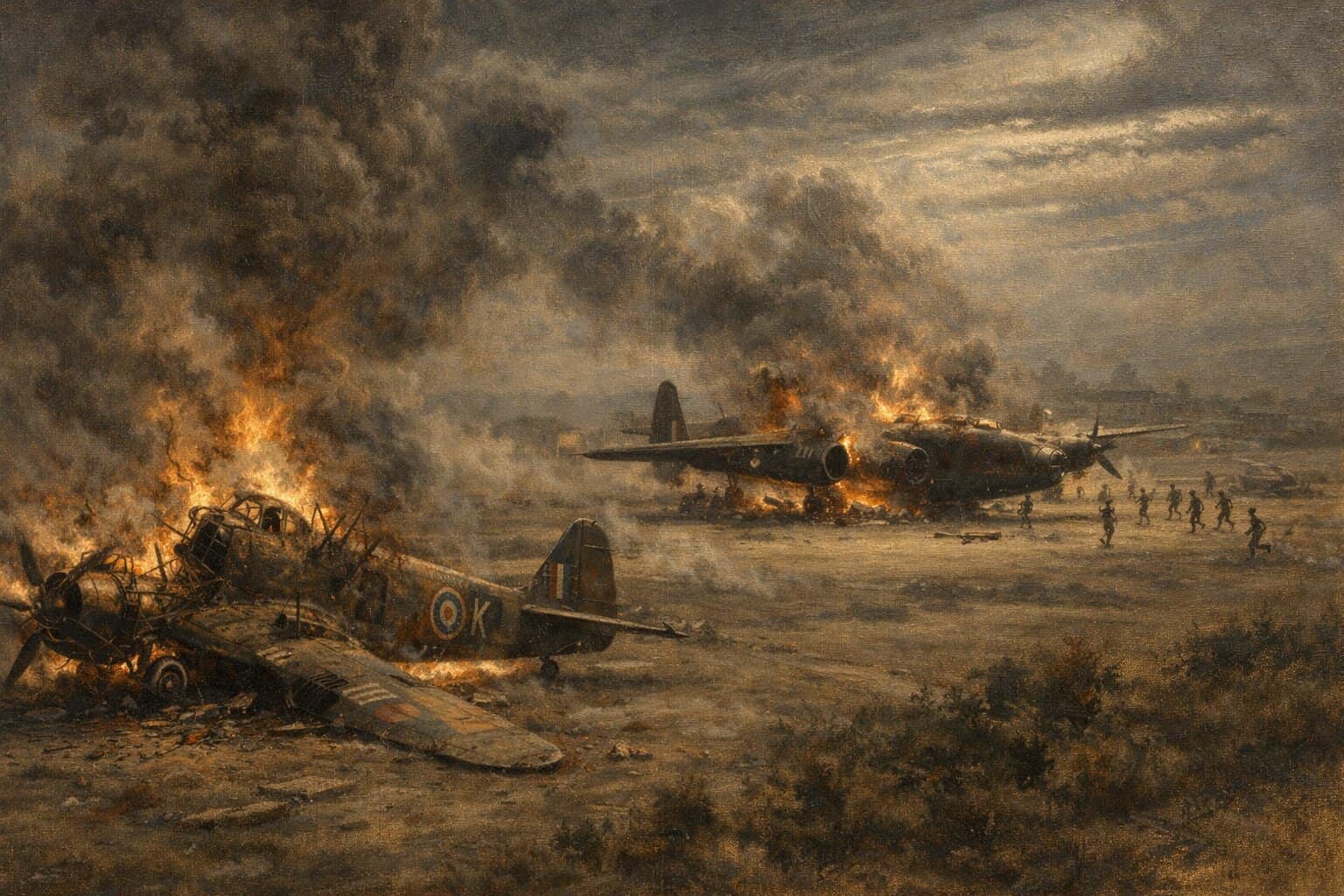
On 25 February 1946, the RAF in Palestine suffered a sharp and embarrassing blow when Irgun mounted coordinated attacks on bases at Petah Tiqva, Qastina and Lydda. Aircraft on the ground were destroyed or damaged, including Supermarine Spitfire fighters, Handley Page Halifax bombers and Avro Anson aircraft. The raids did not alter British air power in any strategic sense, but they showed how exposed that power could be when confronted by a determined underground movement operating in a politically charged environment.
A Post-war RAF in a Changing Theatre
The timing mattered. The Second World War had ended only months earlier, yet the Middle East was far from settled. In Palestine, tension between the British authorities and Zionist militant groups was intensifying, and violence against government and military targets was rising. For the RAF, the region remained important for communications, transport and security duties, but it was no longer a straightforward wartime theatre with a clearly defined front line. Instead, aircraft, personnel and installations found themselves drawn into a struggle shaped as much by politics and insurgency as by conventional military considerations.
That was what made the attacks so significant. They were aimed not at aircraft in the air, where the RAF’s advantages were obvious, but at machines standing vulnerable on their dispersals and at stations whose routine patterns could be observed and exploited.
The Attacks at Petah Tiqva, Qastina and Lydda
Irgun’s operation struck three RAF locations on the same day. At Petah Tiqva, Qastina, and Lydda, the attackers destroyed or damaged a range of aircraft types. The presence of Spitfires, Halifaxes and Ansons among the losses is a reminder of the breadth of RAF activity in the theatre. These were not anonymous assets. They represented fighter strength, transport and communications capability, and the wider administrative reach that underpinned British control.
The attacks also carried a symbolic force beyond the material damage. To hit several bases in one coordinated effort was to challenge British authority publicly. It demonstrated organisation, preparation and a clear understanding that the value of such raids lay not only in wrecked aircraft but in the message sent by their destruction. The RAF, which had played such a visible role in Britain’s wartime power, could be bloodied on the ground in a conflict that offered few of the certainties of conventional war.
Results and Immediate Meaning
In practical terms, the raids caused disruption and loss, and they demanded an immediate response in security, guarding procedures and the protection of aircraft on dispersed stations. Yet their wider importance lay in what they revealed. Air power remained potent, but its effectiveness depended on secure bases, reliable local control, and an environment in which military infrastructure could operate without a constant internal threat. In Palestine in 1946, those conditions were becoming harder to guarantee.
For the British authorities, this was part of a larger warning. The security problem in Palestine was no longer confined to isolated acts of violence. It had become organised, theatrical and strategically minded. Attacks on RAF stations exposed the strain placed upon imperial forces expected to maintain order while political solutions remained elusive.
A Wider Reflection
Viewed in the longer history of the RAF, 25 February 1946 stands as a reminder that the vulnerability of aircraft on the ground has often been as important as their performance in the air. The lesson had been learned repeatedly during the Second World War, and it did not disappear with victory in Europe and Asia. In Palestine, the challenge came not from enemy bombers or fighters but from an insurgent movement willing to attack the infrastructure that made air operations possible.
That is why these raids deserve attention. They mark a moment when the RAF’s post-war role was being tested in a new and uncomfortable way. The aircraft hit at Petah Tiqva, Qastina, and Lydda were part of a force caught between the legacy of total war and the realities of imperial retreat, internal security and political upheaval. The attacks did not decide the future of Palestine, but they revealed how sharply the balance had shifted against any assumption that British military presence alone could guarantee control.