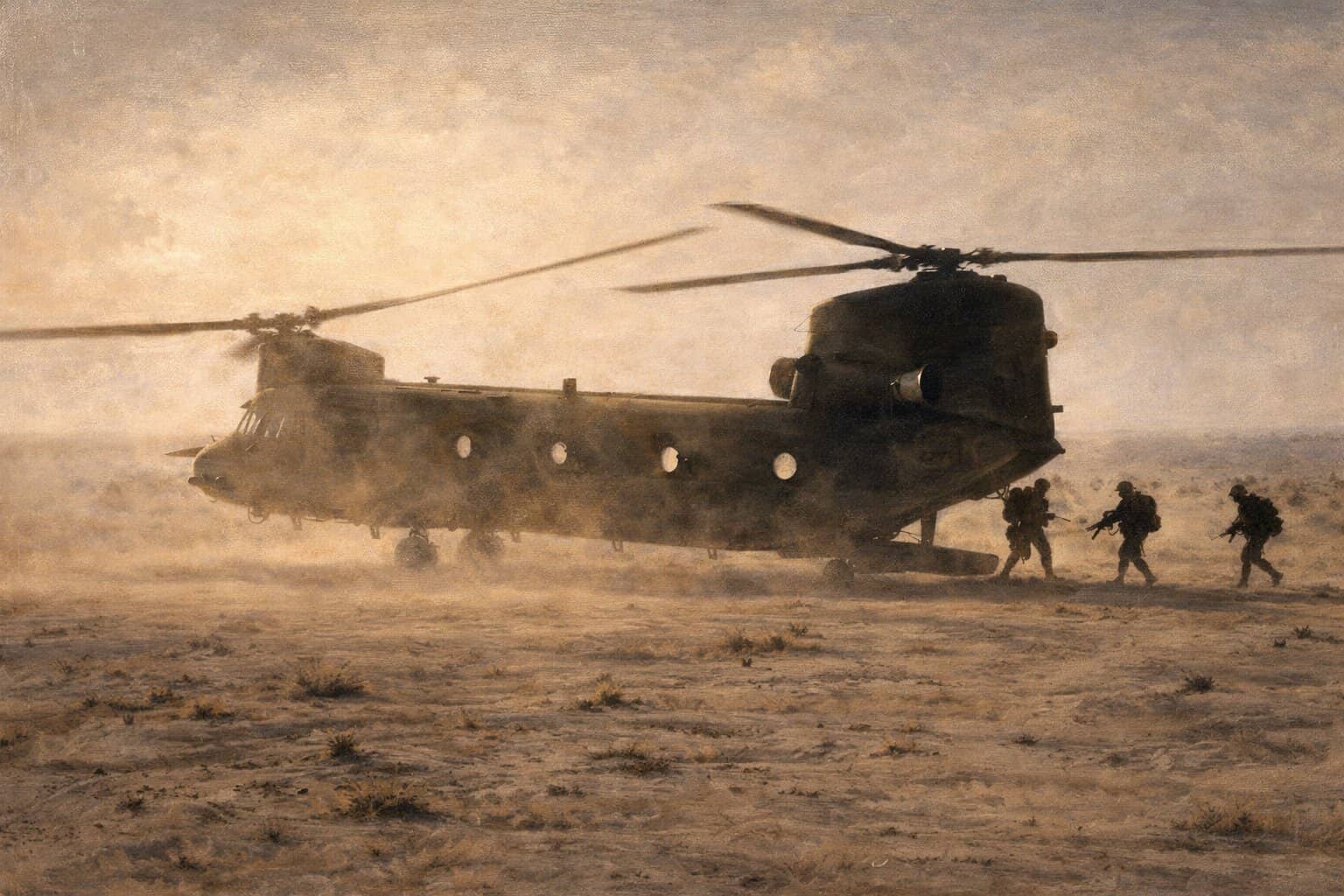
On 14 April 1991, Royal Air Force Boeing Chinook helicopters began lifting aid to Kurdish refugees in Turkey as part of Operation Haven, one of the most urgent humanitarian air efforts of the post-Cold War period. The crisis followed the upheaval that came after the Gulf War, when large numbers of displaced Kurdish civilians were left exposed in harsh conditions near the Turkish border. For the RAF, the task was not a conventional combat mission but an operation in which reach, heavy lift, and endurance became instruments of relief.
Air mobility in a humanitarian emergency
Operation Haven showed how quickly air power could be redirected from warfighting to life-saving support. Helicopters were especially important because the people in greatest need were not always accessible by ordinary road movement. Mountainous terrain, poor infrastructure and the sheer scale of displacement made surface distribution slow and uncertain. Chinooks, with their ability to move bulky loads and operate where fixed systems were limited, gave the relief effort a means of getting food, shelter and essential supplies closer to those who needed them.
That mattered not only in practical terms but in moral ones. Humanitarian crises can worsen rapidly when support is delayed, and delay is often caused not by lack of will but by lack of access. The RAF contribution helped reduce that gap. Airlift turned distant stockpiles into immediate assistance, shrinking time and geography in a way that only military aviation could manage at short notice. In that sense, the first lifts of 14 April were a demonstration of capability under pressure, but also of national intent.
A different face of RAF operations
Operation Haven belongs to the history of the modern RAF because it reflected a broader change in the kinds of missions the service was increasingly expected to perform after the Cold War. The RAF remained a fighting force, but it was also being called upon for rapid intervention, support to coalition action and humanitarian response in unstable regions. Helicopter crews and support personnel had to work in demanding conditions while maintaining the precision and discipline expected of any operational deployment. The fact that the mission aimed at relief rather than attack did not make it simple. It still required planning, coordination, flying skill and resilient logistics.
For the public, such operations also carried political and symbolic weight. They showed that military aircraft could serve not only as tools of coercion but as means of protection and rescue. That did not erase the hard realities of the wider crisis, yet it did illustrate the value of an air force able to respond quickly when events on the ground moved faster than ordinary civilian systems could cope.
The beginning of Chinook aid lifts on 14 April deserves remembrance as more than an isolated transport task. It was a moment when RAF mobility was applied directly to human need, and when the service demonstrated that air power could sustain compassion as effectively as combat. In the years that followed, humanitarian and stabilisation missions would become a familiar part of British military experience. Operation Haven stands as an early and important example of that modern pattern.