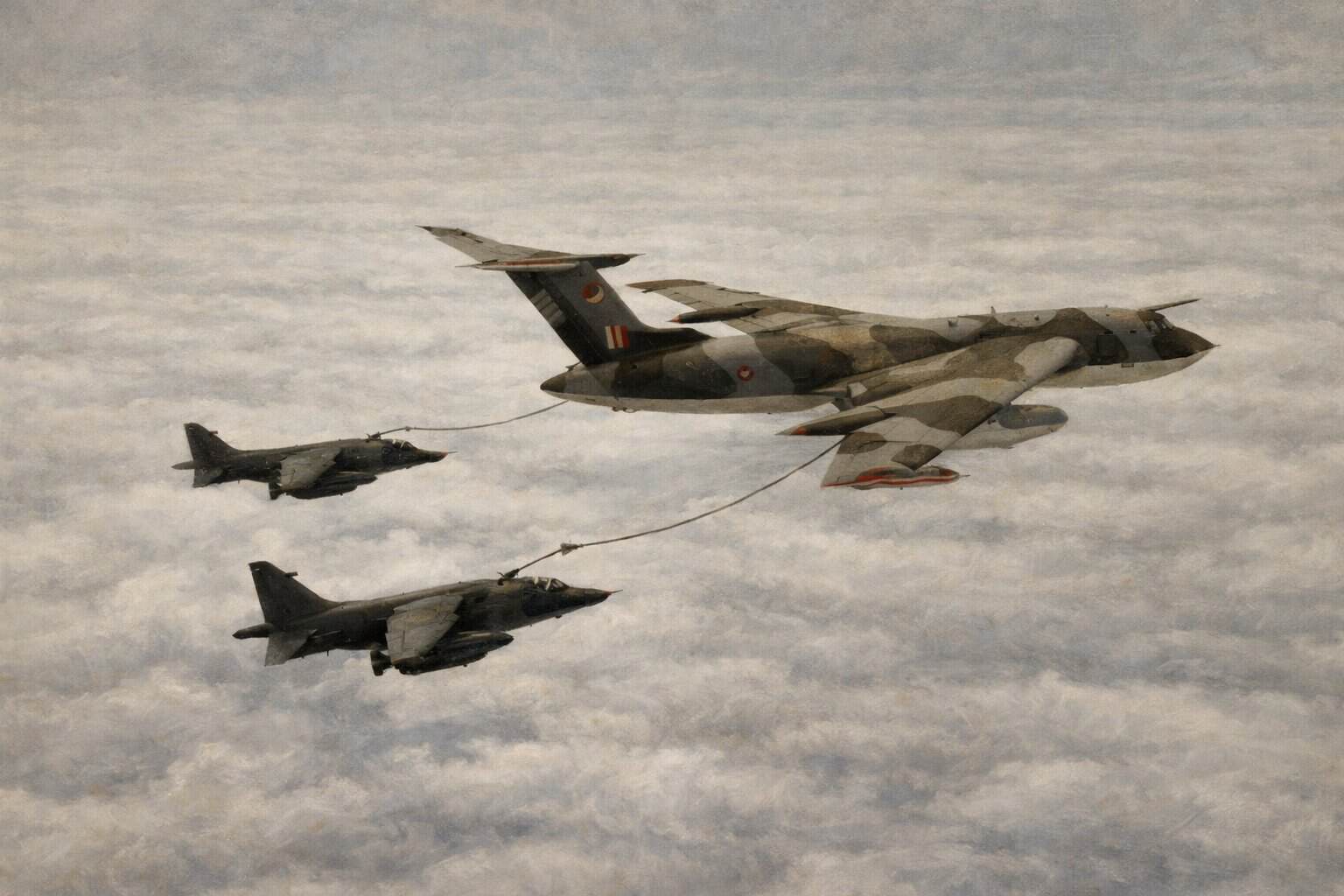
On 18 April 1982, Handley Page Victor K2 tankers staged through Ascension Island as Britain assembled the long-range air component of the Falklands campaign. Their arrival was part of the opening logistical and operational effort of Operation Corporate, which made later reconnaissance and strike missions possible, including support for the Operation Black Buck attacks flown by the Avro Vulcan force. In modern RAF history, the Victor force is often remembered less for glamour than for indispensability. Tankers rarely dominate public imagination, yet without them, long-distance air operations on the scale required in 1982 could not have been sustained.
Building reach in the South Atlantic
The geography of the Falklands crisis imposed exceptional demands from the outset. Britain needed to project power over vast distances, and every plan was shaped by the problem of range. Ascension Island became a crucial staging point because it provided a position from which aircraft, crews and equipment could be organised for the journey south. The Victor K2s were central to that system. Their role in air-to-air refuelling multiplied the effectiveness of other aircraft and turned extreme distance from a prohibitive obstacle into a difficult but manageable operational problem.
This was not merely a technical matter. Strategic reach depends upon support aircraft as surely as upon the platforms that carry sensors or weapons. The early movement of Victors to Ascension showed that the RAF understood the campaign as a chain of dependencies. Reconnaissance, deterrent presence and later attacks all rested on the unglamorous but exacting work of fuel planning, timing and coordination. The tankers made those things real.
The quiet backbone of the campaign
Victor crews and ground personnel were therefore engaged in one of the defining support efforts of the war. Tanker operations required consistency, precision and endurance. The aircraft had to be available, the crews ready, and the system flexible enough to support missions of unusual length and complexity. Such work rarely produces a single dramatic image, but it is often where campaigns are either made possible or quietly fail. In April 1982, the RAF’s tanker force helped ensure the former.
There is also a wider significance in the date. The arrival of the Victors at Ascension marked the beginning of a campaign in which the RAF would demonstrate that strategic air power was not confined to Europe or the North Atlantic. It could be extended, adapted and sustained far beyond peacetime routines. That required not only courage from crews flying long hours, but also a professional support structure capable of operating with urgency under political and military pressure.
The Victors’ presence on Ascension on 18 April 1982 deserves recognition as a foundational moment rather than a background detail. Before the better-known missions could take place, the framework for long-range air action had to be built. RAF tankers were among the first indispensable pieces of that framework. Their arrival signalled that Britain was preparing to fight at a distance, and that the RAF had the means to help make that possible.