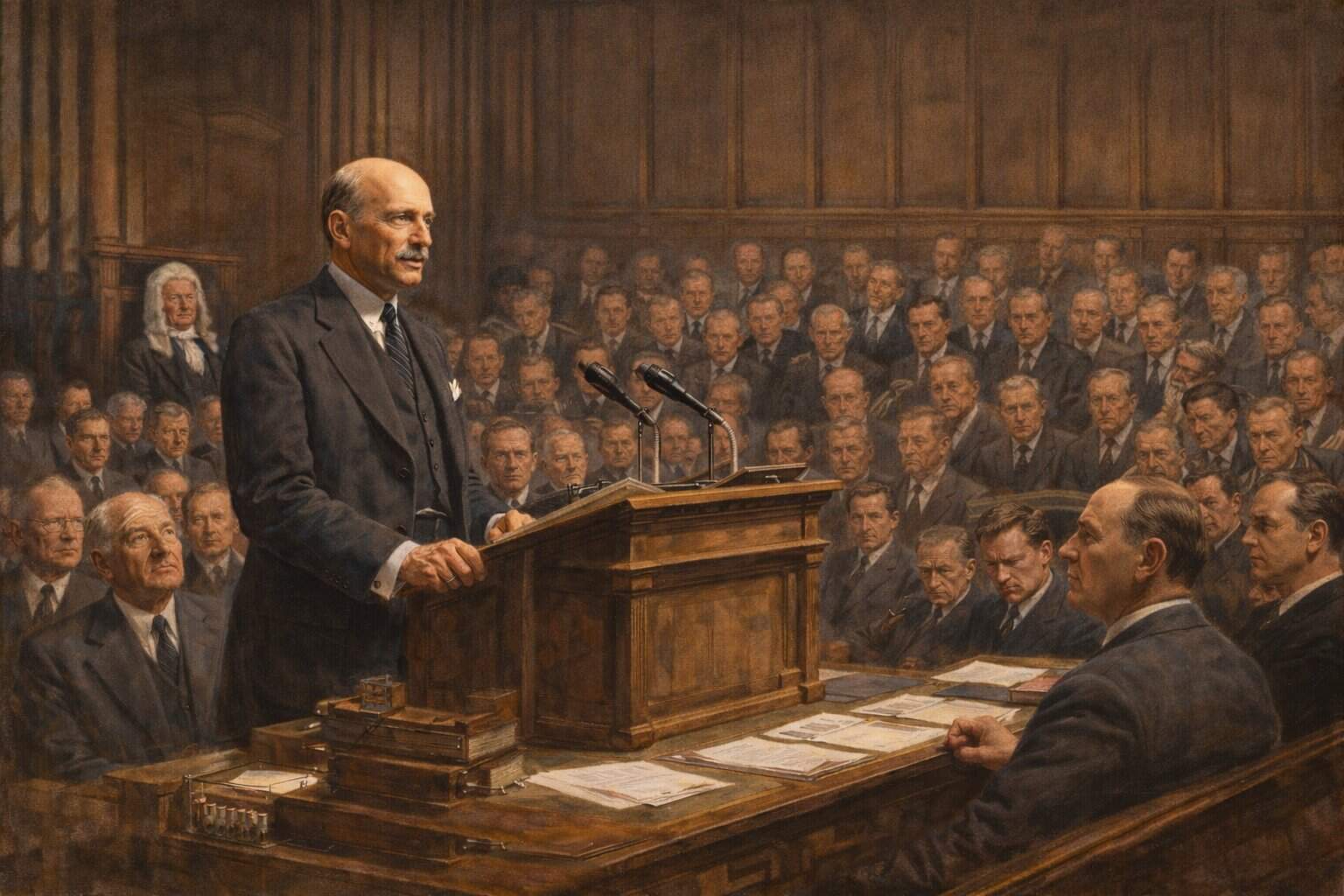
On 29 January 1951, Prime Minister Clement Attlee announced a major programme of British rearmament and military preparedness in response to mounting international tensions. The statement outlined measures, including increased defence expenditure, expanded procurement of military equipment, and the recall of reservists. For the Royal Air Force, the announcement signalled a renewed emphasis on readiness and expansion during the early phase of the Cold War.
The decision must be understood against the backdrop of the Korean War, which had begun in June 1950. The conflict heightened concerns about the balance of power between Western nations and the Soviet bloc. In Europe, the perceived threat of further expansion by communist forces led to an urgent reassessment of NATO’s defensive posture. Britain, as a leading NATO member, faced pressure to strengthen its armed forces and contribute to collective security.
Strategic Context
In the immediate post-war years, British defence policy had been shaped by economic constraints and demobilisation. By 1950, however, the international situation had altered significantly. The Korean War underscored the possibility of large-scale conventional conflict in regions beyond Europe, while tensions in Germany remained acute.
Attlee’s announcement on 29 January 1951 outlined plans to increase military preparedness across all three services. The programme involved substantial financial commitment and aimed to expand force levels, modernise equipment, and enhance readiness. For the RAF, this meant accelerating aircraft production and strengthening operational units both in the United Kingdom and overseas.
Implications for the Royal Air Force
The RAF in 1951 was in the midst of a transition from piston-engined wartime aircraft to jet-powered types. Rearmament funding supported the procurement of modern fighters and bombers, reflecting the growing importance of air power within NATO strategy. The development of Britain’s emerging nuclear capability also influenced long-term planning, although in early 1951, conventional preparedness remained a central focus.
The recall of reservists and expansion of manpower reinforced operational capability. Training establishments adjusted to accommodate increased intake, while frontline units prepared for higher readiness levels. RAF Germany, already a key component of Britain’s continental commitment, benefited from strengthened resources and infrastructure improvements.
Industrial production was another critical element. British aircraft manufacturers were tasked with accelerating output to meet both national and alliance requirements. The rearmament programme thus linked defence policy with industrial mobilisation in a manner reminiscent of wartime planning, though under peacetime conditions.
Domestic and Economic Considerations
The rearmament announcement carried significant economic implications. Increased defence spending strained Britain’s post-war recovery, necessitating difficult fiscal choices. Nonetheless, the Government judged that strengthening military preparedness was essential in light of global developments.
Public reaction reflected a recognition of the changed strategic environment. Memories of the Second World War were still recent, and there was widespread awareness of the risks posed by renewed great-power confrontation. The emphasis on preparedness sought to deter aggression rather than to signal imminent conflict.
Significance in the Wider Cold War Context
The statement of 29 January 1951 represents a pivotal moment in Britain’s Cold War defence posture. It marked the consolidation of a long-term commitment to NATO and to maintaining credible military forces capable of responding to both conventional and strategic threats.
For the RAF, the rearmament programme reinforced the Service’s central role in deterrence and alliance strategy. The expansion and modernisation that followed shaped the development of Britain’s air power throughout the 1950s, including the emergence of jet fighter forces and the strengthening of strategic bomber capability.
In the broader history of military aviation, the announcement illustrates how political decisions translate into operational transformation. Rearmament in 1951 was not merely an administrative adjustment; it set the conditions for the RAF’s Cold War evolution. The measures outlined on this day contributed to the rebuilding and restructuring of British air power at a time when global stability was again uncertain.