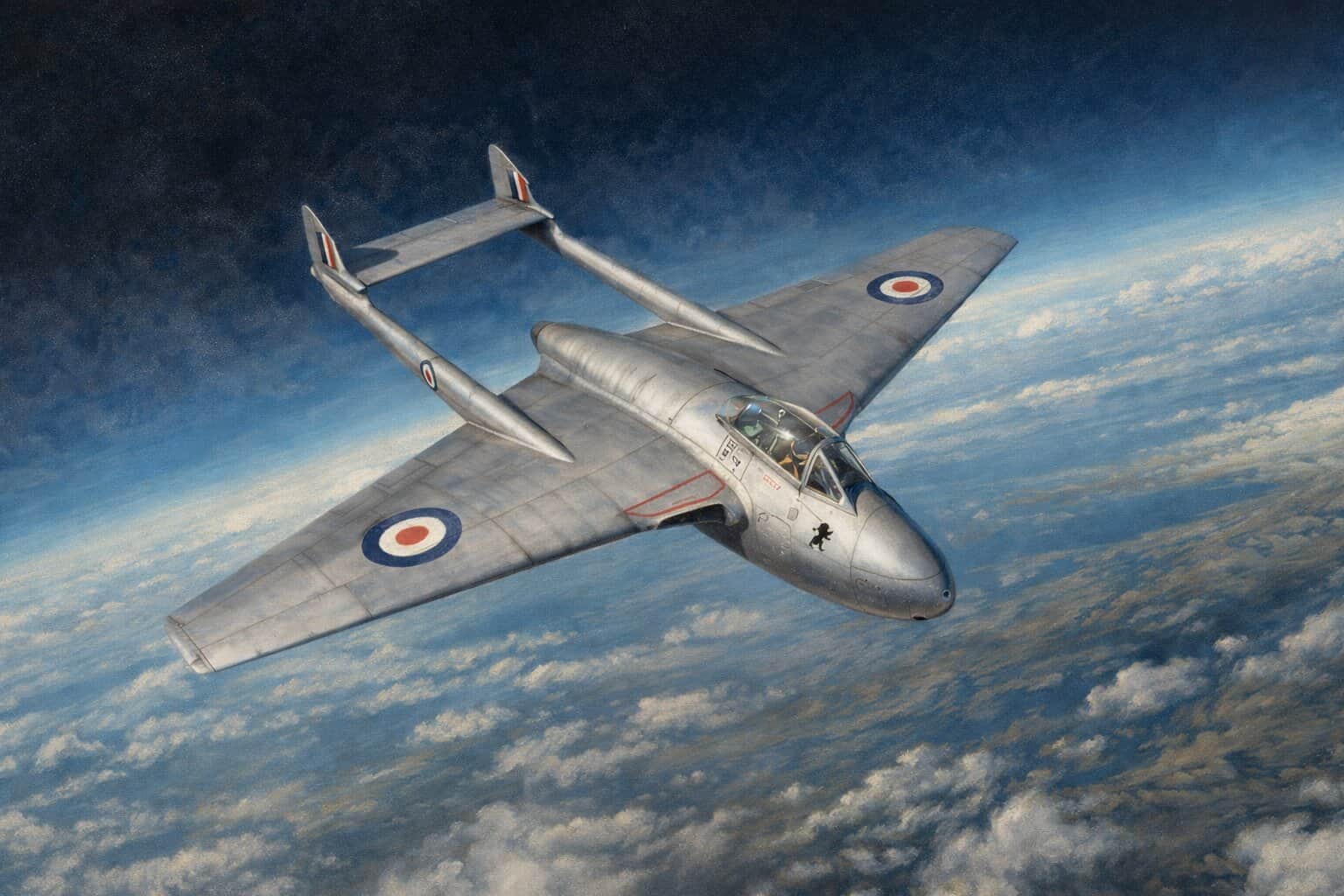
On 23 March 1948, Group Captain J. Cunningham flew a de Havilland Vampire to 59,446 feet, setting a new world altitude record. The achievement came in the early years of the jet age, when the Royal Air Force and the British aircraft industry were pushing rapidly beyond the limits that had defined wartime aviation. Records of this kind were never merely sporting exercises. They demonstrated technical progress, tested aircraft and pilot endurance, and helped establish Britain’s credibility in a fiercely competitive field of aeronautical development.
The Vampire already held a notable place in RAF history as one of Britain’s first operational jet fighters. In appearance and performance, it belonged unmistakably to the future rather than the piston-engine past. Yet the move into jet flight brought fresh problems as well as promise. High altitude imposed severe demands on engines, airframes and pilots. Questions of control, power, cockpit environment and human physiology all became more pressing as aircraft climbed into thinner air. A world record spoke as much to engineering as to courage.
Cunningham and the test pilot tradition
Group Captain John Cunningham was one of the most distinguished aviators of his generation, known in wartime for his skill as a night fighter pilot and in peace for his role in test flying. His altitude record belonged to a wider RAF and British tradition in which experienced operational airmen helped bridge the worlds of combat service and technical experimentation. That connection mattered greatly in the late 1940s.
Britain was trying to convert wartime aeronautical momentum into peacetime leadership, and record attempts offered visible proof of progress. Such flights demanded exceptional discipline. High-altitude flying involved exact preparation, close attention to aircraft handling and a readiness to operate near the edges of known performance. When a record was set, the pilot stood in public view, but behind him were designers, engineers and ground crews whose work made the attempt possible. The Vampire’s success was thus an achievement of a system as well as an individual.
The RAF in the early Cold War
March 1948 fell in a transitional moment. The Second World War was over, but the strategic calm many had hoped for did not arrive. Instead, the Cold War was taking shape, and air power remained central to national prestige and defence planning. In that climate, advances in jet performance carried both military and symbolic importance. Higher-flying, faster aircraft promised tactical and strategic advantages, while also signalling that Britain intended to remain a first-rank air power.
Records cannot be read simply as measures of combat usefulness, yet they were closely related to practical development. They expanded knowledge, encouraged innovation and focused attention on what modern aircraft could achieve. The RAF’s reputation after 1945 depended not only on its wartime memory but also on its ability to master a new technological era. Cunningham’s flight gave the Service a notable public marker of that transition.
More than a number on the altimeter
The figure of 59,446 feet was impressive in itself, but the importance of 23 March 1948 lies in what it represented. It showed the Vampire’s capability, highlighted British progress in jet aviation and associated the RAF with the cutting edge of aeronautical achievement. In the years ahead, aircraft would go higher and faster still, but milestones such as this helped define the path.
The Vampire altitude record is a reminder that RAF history is not only the story of war and operations. It is also the story of experiment, technological ambition and the pilots who took machines into regions where experience was still limited. Cunningham’s climb remains one of the clear early signals that the jet age had truly arrived.