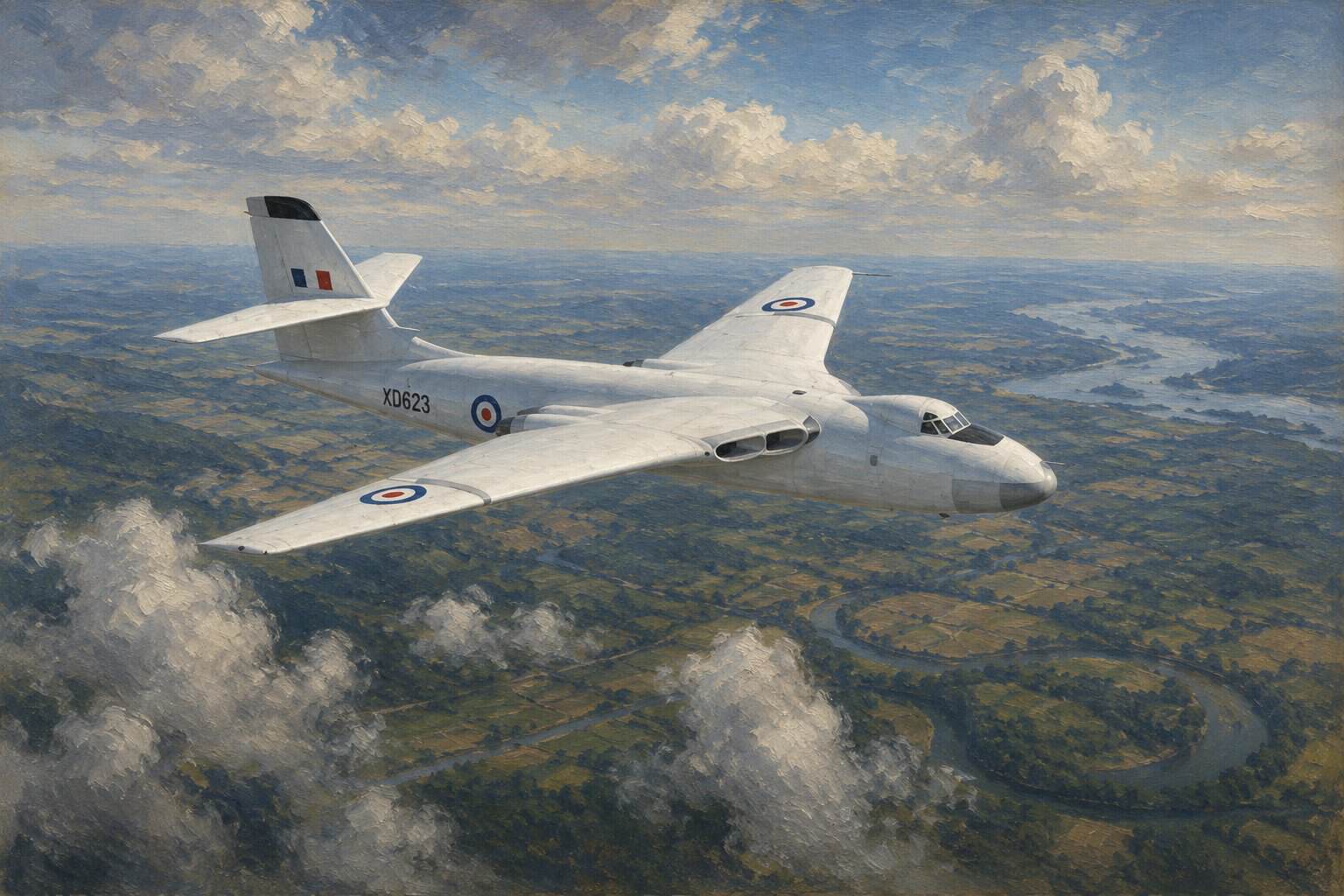
On 30 October 1957, two Vickers Valiants and two Avro Vulcans of RAF Bomber Command entered the Strategic Air Command Bombing and Navigation Competition at Pinecastle, Florida. The competition continued until 5 November and brought together 90 individual crews in 45 two-aircraft teams. For Britain’s developing V-force, it provided a demanding opportunity to compare bombing and navigation standards with its American strategic partner.
RAF participation in the competition dated from 1951, when two Washington crews had competed at MacDill. The distinctive feature of 1957 was the arrival of the V-bombers. Britain’s new jet bombers were taking their place alongside the force with which Bomber Command expected to cooperate in a nuclear war.
Preparing the V-bomber crews
The Valiant preparation programme began months before the competition. Under Operation Longshot, four aircraft and six crews were nominated for the work-up. A British trial competition helped prepare the force, while a specialist competition flight practised demanding profiles combining long navigation legs with radar attacks. The final competition entry comprised two Valiants.
For the Vulcan crews, preparation coincided with the early development of a new operational aircraft. 83 Squadron devoted substantial attention to the competition, concentrating experience and training effort on the task. The Valiant had entered service in 1955; the Vulcan was a more recent addition to Bomber Command’s front line.
The work-up placed particular emphasis on the skills required to bring an aircraft accurately to its target after an extended flight. Radar bombing and navigation depended on the coordinated performance of the crew and the reliability of its equipment. Competition flying gave these elements a common, closely measured test.
Individual success and team results
The strongest British individual performance came from a Valiant crew captained by Squadron Leader R. W. Payne of 214 Squadron. It achieved the competition’s second-best blind-bombing score and finished eleventh among the 90 crews. This was a substantial result for an aircraft operating far from its normal supporting base.
The combined team placings presented a more difficult picture. In blind bombing and navigation together, the Valiants finished 27th and the Vulcans 44th among 45 teams. The overall showing disappointed senior RAF leaders, even as Payne’s result demonstrated the standard an individual British crew could achieve.
The scoring was close. Across the RAF entries, 63 places separated the highest- and lowest-ranked crews, while the difference in their average margin of error was less than 250 yards. Those figures give useful scale to the spread of positions in the final table.
Experience, equipment and cooperation
Pinecastle tested the supporting organisation as well as the aircrews. Familiarity with new equipment, ground-crew experience and the demands of operating overseas all influenced performance. Florida’s humidity exposed electronic reliability problems, adding another difficulty for aircraft and crews still accumulating operational experience.
The competition measured particular bombing and navigation tasks under prescribed conditions. Its results offered evidence about training, equipment and preparation, with wartime nuclear operations involving a much broader set of demands. For Bomber Command, the practical value lay in identifying where its developing force required further work.
Working alongside Strategic Air Command also strengthened professional contact between the two bomber forces. The 1957 entry joined intensive preparation, measurable performance and direct operational exchange at an important stage in V-force development. Pinecastle demonstrated the abilities of individual RAF crews while exposing weaknesses in equipment reliability and operational experience that Bomber Command needed to address as the V-force developed.