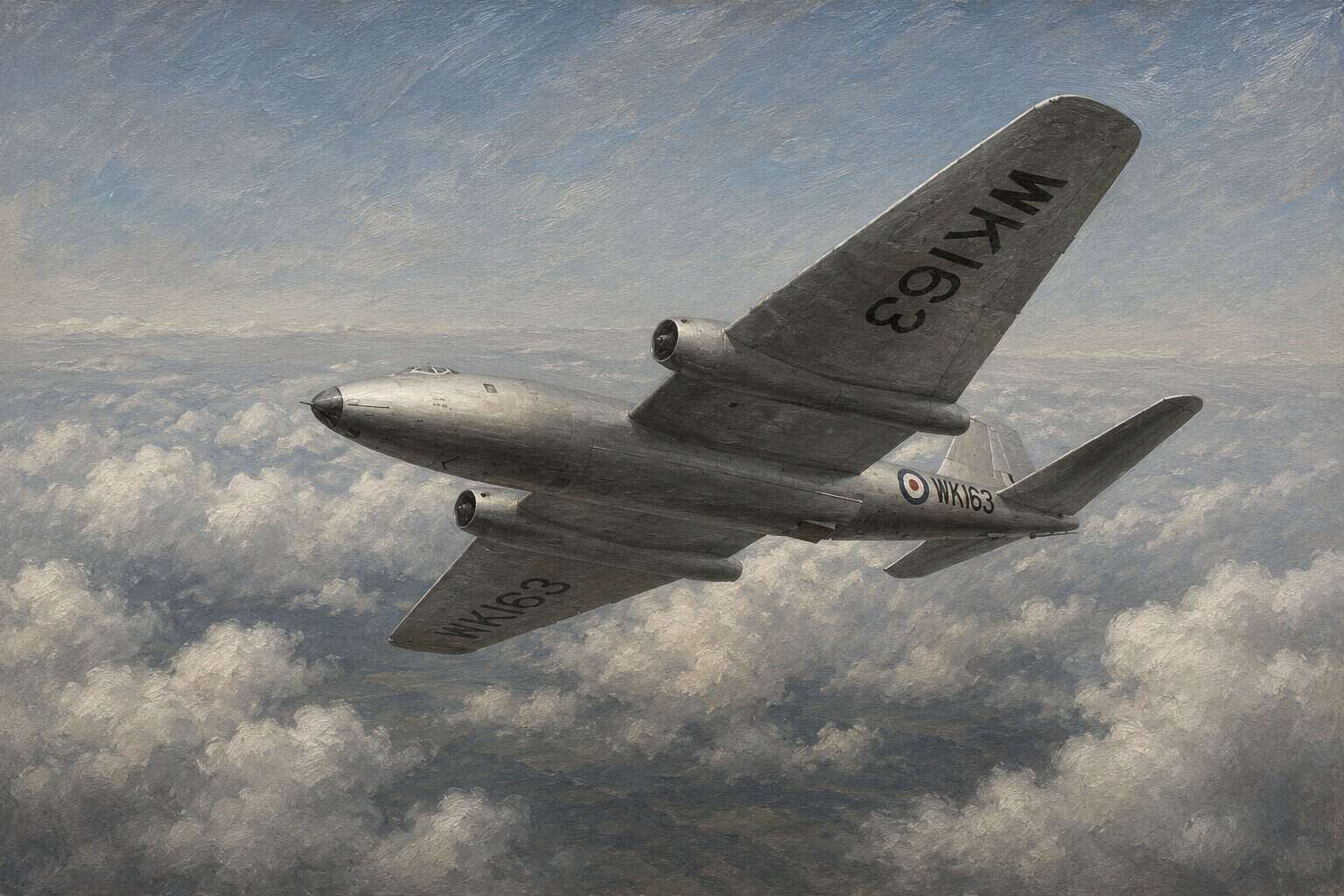
On 29 August 1955, an English Electric Canberra flown by a crew led by Gibb climbed to nearly 66,000 feet and set a new height record. The achievement was more than a neat technical milestone. In the mid-1950s, when jet performance was closely tied to prestige, deterrence and export credibility, such a flight offered public proof of what British aircraft design could still accomplish. For the RAF, it reinforced the Canberra’s standing as one of its most capable early jet aircraft.
The Canberra’s place in the RAF
By 1955, the Canberra had already established itself as an important part of post-war British air power. Entering service as a jet bomber, it had quickly gained a reputation for speed, altitude performance and operational flexibility. It was not simply a replacement for wartime piston-engined bombers. It represented a different standard of aircraft altogether, one suited to the new demands of the early Cold War.
Its success mattered because the RAF in the first jet age was balancing several pressures at once. It needed modern aircraft for strategic credibility, it needed convincing performance in operational service, and Britain more broadly wanted to demonstrate that its aviation industry remained competitive at the highest level. The Canberra fitted all three requirements unusually well. It was effective in RAF service, impressive in performance terms, and widely respected beyond Britain.
Why a height record mattered
Altitude records had a significance in this period that is easy to underestimate now. They were not only about headlines. They suggested engine strength, aerodynamic efficiency, structural confidence, and an aircraft type's ability to operate in demanding conditions. A machine capable of climbing to exceptional heights also projected an image of technical maturity and national competence.
For the Canberra, that image was already strong, but the August 1955 record underlined it further. The aircraft had proven itself a reliable and advanced design, and the altitude reached in this flight added another layer to that reputation. It was a visible reminder that the Canberra belonged among the most impressive RAF aircraft of its generation, not merely as a practical bomber but as a machine of genuine technical distinction.
Performance and credibility in the nuclear age
The timing also matters. Britain in the mid-1950s was entering more deeply into the strategic world of high-speed jet bombers, nuclear delivery systems and long-range air power. Although the V-bombers were becoming the central symbols of that effort, the Canberra still occupied an important place in the RAF’s order of battle and in the wider story of post-war adaptation.
A record flight could not by itself define strategic policy, but it did contribute to confidence. It showed that an RAF-type already in service retained impressive performance margins. That had value both inside the Service and in public presentation. The Canberra’s reputation was not built on publicity alone, but flights such as this helped explain why the aircraft commanded such respect.
Significance
The height record set on 29 August 1955 matters because it captures the Canberra at the height of its prestige. It was already an operationally important aircraft, yet this achievement reminded observers that it was also a remarkably capable design in terms of pure performance. In RAF history, the flight stands as a marker of the moment when one of Britain’s most successful early jets demonstrated again that technical excellence and service value could go together. The Canberra was not simply useful; it was outstanding.