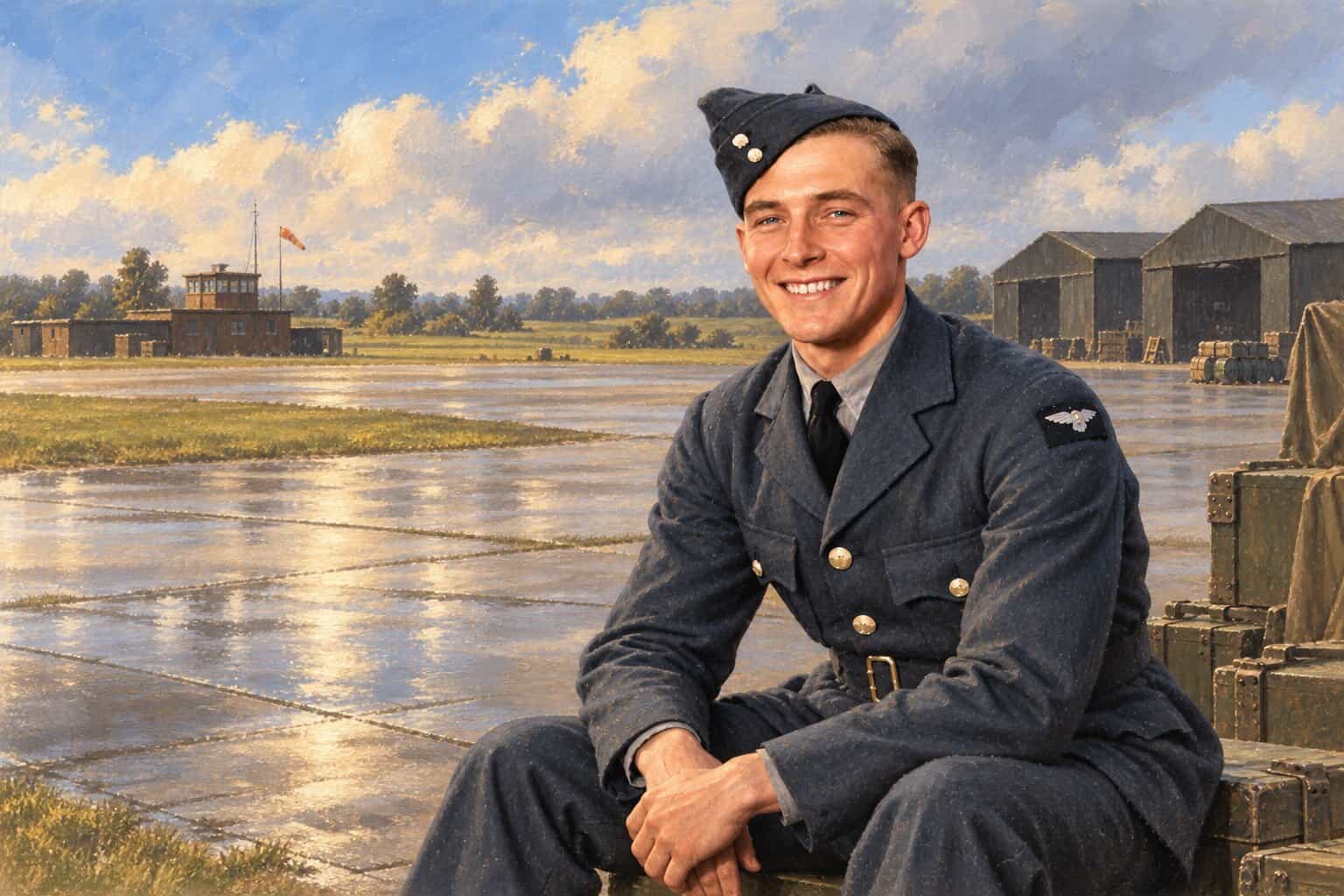
On 25 November 1921, George Leonard “Johnny” Johnson was born at Hameringham in Lincolnshire. He would become a Royal Air Force bomb aimer and take part in Operation Chastise, the attack on German dams in May 1943. His role in Joe McCarthy’s Lancaster crew placed him at the centre of the difficult attack on the Sorpe Dam.
Johnson’s career connected the wartime expansion of RAF aircrew training with the specialised demands of 617 Squadron. His later accounts preserved the experience of a crew whose contribution depended on patient flying, precise judgement and close cooperation.
From Lincolnshire to Bomber Command
Johnson grew up in an agricultural family and attended Lord Wandsworth Agricultural College in Hampshire. He volunteered for the RAF in 1940, initially seeking to become a navigator. Selected for pilot training, he travelled to Florida in 1941 before changing specialisation and training as an air gunner.
In July 1942 he joined 97 Squadron at Woodhall Spa. As a reserve gunner he flew with different crews, gaining experience of operational bombing over occupied Europe and Germany. That service gave him operational experience over occupied Europe and Germany and familiarised him with the coordination required within a bomber crew.
A further opportunity brought another change of role. Johnson trained as a specialist bomb aimer late in 1942 and joined the crew of Joe McCarthy, an American pilot serving with the Royal Canadian Air Force. Flying together on operations established the working relationships they would carry into the dams raid.
Preparing for the dams
In March 1943 McCarthy’s crew transferred to the newly formed 617 Squadron at Scampton. The squadron was preparing for Operation Chastise, using modified Avro Lancaster bombers to deliver the Upkeep mine against major German dams. Intensive low-level training placed particular demands on pilots and bomb aimers.
Johnson’s wedding also fell within this period of preparation. With leave restricted, McCarthy intervened on his behalf and Johnson received permission to marry Gwyn Morgan in April. The episode reflected the personal ties within a crew preparing for a highly specialised operation.
On 16 May 1943, 617 Squadron launched the dams raid with Upkeep mines. A technical problem with McCarthy’s intended aircraft forced his crew to transfer to a spare Lancaster before departure. Their assigned target was the Sorpe Dam.
Johnson’s attack on the Sorpe
The Sorpe’s earth embankment and concrete core required an approach along the dam. Johnson had to release the weapon close to the structure’s centre, with McCarthy positioning the Lancaster for the drop. Nearby buildings and rising ground made the approach demanding.
McCarthy made repeated approaches while the crew worked to establish the correct line and height. Johnson released the mine on the tenth approach. The explosion damaged the dam, which remained intact and continued to retain its reservoir.
The crew returned to Britain, and Johnson received the Distinguished Flying Medal for his part in the operation. His experience demonstrated the importance of the bomb aimer’s decisions during the final approach, when the crew’s training had to be translated into an accurately placed weapon.
Service and the preservation of experience
Johnson continued flying with 617 Squadron before moving to instructional duties in 1944. He remained in the RAF after the war, qualified as a navigator and retired in 1962 as a squadron leader. A subsequent career in teaching extended his work in education into civilian life.
In later years, interviews, commemorations and his autobiography brought his recollections to a wide audience. He died on 7 December 2022, aged 101, as the last surviving participant in the Dambusters raid. His testimony preserved the Sorpe crew’s experience alongside the better-known breaches of the Möhne and Eder dams, giving the operation’s history a detailed account of preparation, crew cooperation and the judgement involved in releasing a single weapon.