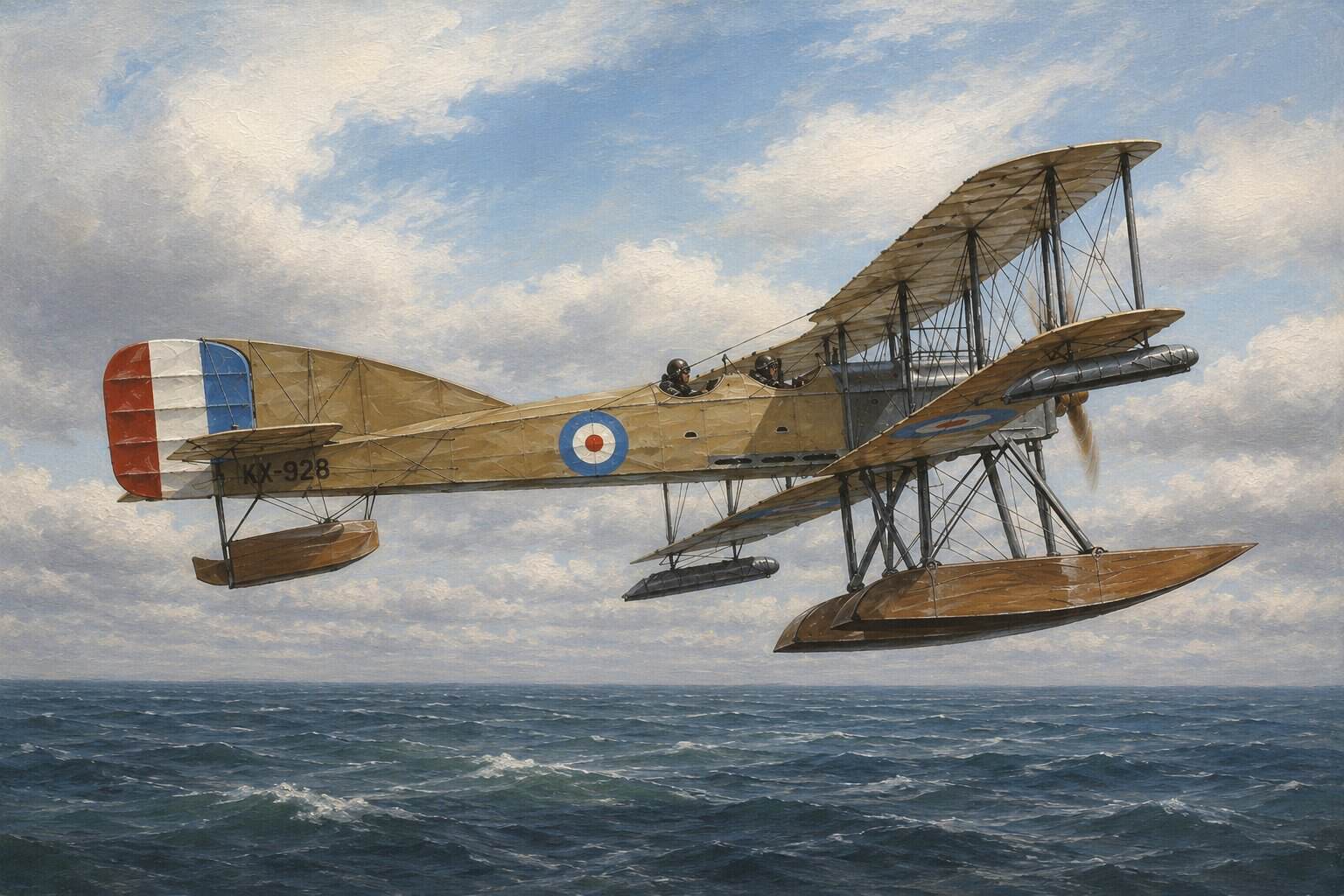
On 30 July 1919, a joint British force struck the Bolshevik naval base at Kronstadt, bringing together Royal Air Force aircraft and Royal Navy support in one of the more unusual operations of the North Russia intervention. The attack did not involve the massed formations later associated with inter-war and Second World War air power. Instead, it was a small, carefully judged expedition against a heavily defended objective, intended to harass the enemy fleet, damage facilities and show that British forces could still reach an important base close to Petrograd.
A raid from sea to shore
By the summer of 1919, Britain was still involved in the confused and politically awkward intervention in the Russian Civil War. In the Baltic and around North Russia, British policy aimed to support anti-Bolshevik forces, protect wider Allied interests and contain the spread of instability after the First World War. Air power was still young, but it already offered something traditional naval forces alone could not: the ability to strike over harbour defences and attack targets ashore with speed and surprise.
For the Kronstadt operation, aircraft were launched from HMS Vindictive, showing how quickly British planners had begun to think in combined and flexible terms. The force employed a small number of aircraft in a night attack rather than a large-scale bombardment. Even so, the mission demanded navigation, timing and nerve. Kronstadt was a major naval base, and any approach exposed the raiders to anti-aircraft fire and the risks of operating over hostile water in primitive conditions.
The attack itself
The raid was modest in scale but meaningful in execution. British aircraft reached the base, pressed home their attack and dropped their bombs on facilities within the harbour area. Contemporary accounts credited the force with several hits and with starting fires, which was enough to demonstrate that Kronstadt was vulnerable. In operational terms, that mattered almost as much as the physical damage. A defended anchorage is less secure once the enemy has shown he can reach it.
The mission also illustrated the improvisational character of early RAF warfare. These were not long-range strategic bombers attacking with elaborate electronic aids and a vast support system. They were comparatively fragile aircraft flown in difficult conditions by crews working at the edge of what contemporary aviation could achieve. Their success rested on judgment, discipline and cooperation with the Navy rather than on the weight of numbers.
Why Kronstadt mattered
The attack fitted the wider pattern of the North Russia intervention, in which air power was used as a practical tool of influence rather than as an independent war-winning arm. Aircraft could scout, intimidate, disrupt and strike in areas where movement by land or sea alone was slow and uncertain. In that sense, Kronstadt was not simply an isolated raid. It was part of the RAF’s early demonstration that air units could support expeditionary policy in remote and politically complex theatres.
There is also a wider historical significance. Coming barely a year after the RAF itself had been formed, the raid showed how quickly the Service was adapting to joint operations and overseas intervention. It was a reminder that British air power’s formative years were not confined to lessons on the Western Front. They also included improvised, maritime-linked operations on the fringes of a collapsing empire and a revolutionary civil war.
In wider air-war terms, the attack on Kronstadt pointed towards a future in which air power would increasingly be used to penetrate defended bases, pressure fleets and shape events beyond the front line. On 30 July 1919, the scale was small, but the underlying idea was modern.