On This Day, 1940: On 7 October 1940, Hurricane pilot Archie McKellar of 605 Squadron was credited with five Bf 109 victories…
Read the entry →Sopwith Camel
Sopwith Aviation Company
Explore the Sopwith Camel, the agile RAF fighter that helped secure air superiority in 1918 and became a symbol of late-war air combat.
The Sopwith Camel was one of the most effective British fighters of the First World War, flown first by the Royal Flying Corps and the Royal Naval Air Service from 1917 and inherited by the Royal Air Force when the new service was formed on 1 April 1918. It arrived at a point when British air units needed a fighter capable of meeting improved German scouts such as the Albatros D.III on more equal terms, and it combined concentrated firepower with an unusually sharp turn of speed once a pilot had learned to fly it well.
Its reputation rested on demanding handling as much as on its combat record. The close grouping of engine, guns, pilot and fuel tank near the aircraft’s centre of gravity made it extremely agile, and just as unforgiving of poor technique. Properly flown, the Camel proved adaptable across offensive patrols, home defence, ground attack and, in its naval form, some of the earliest carrier strike operations in history.
Development and Design
The Camel was designed by Herbert Smith at the Sopwith Aviation Company as a successor to the Sopwith Pup, developed once the Pup could no longer compete with newer German fighters. Test pilot Harry Hawker flew the prototype for the first time on 22 December 1916, and production machines began reaching front-line squadrons during 1917.
The aircraft took its name from the distinctive metal fairing over its twin synchronised .303-inch Vickers machine guns, which gave the forward fuselage a humped profile. That armament, standard on the F.1 production version, gave pilots concentrated forward firepower once they had mastered the aircraft, and it remained the Camel’s defining feature throughout its service life. Compared with the earlier Pup, the Camel traded some of its predecessor’s gentler manners for a heavier, more powerful and considerably more dangerous fighter, a deliberate exchange given how quickly German fighter design was improving on the Western Front. Around 5,490 Camels of all versions were eventually built, with production shared across several British manufacturers alongside Sopwith itself.
Why the Camel Handled Differently
Much of a Camel’s weight, including its rotary engine, guns, pilot and fuel, sat within a few feet of the aircraft’s centre of gravity. That concentration, combined with the strong gyroscopic effect of a spinning rotary engine and unusually sensitive controls, made the aircraft highly manoeuvrable in experienced hands, but demanding and unforgiving for anyone who had not mastered it. Handled without care, particularly at low speed on takeoff or landing, the same characteristics could produce a sudden and sometimes fatal spin.
This demanded a level of skill that many new pilots had not yet developed when they reached their squadrons. Losses among inexperienced Camel pilots, both in training and in their first operational flights, were a real and openly acknowledged cost of an aircraft that rewarded experience so heavily. RFC and RAF instructors treated the type with particular respect, and pilots who mastered it typically became some of the most effective fighter pilots of the war’s final years.
RFC and RNAS Service in 1917
The Camel entered frontline service in 1917, more than a year before the Royal Air Force existed. Naval squadrons of the Royal Naval Air Service received the type first, with No. 4 Squadron RNAS operating Camels from June 1917. Royal Flying Corps units followed close behind, with No. 70 Squadron re-equipping with the Camel the same year. Through the second half of 1917 the aircraft spread across further RFC and RNAS squadrons, replacing older Sopwith and other types and giving British air units a fighter able to contest German scouts on more even terms.
By the time the Royal Air Force was formed on 1 April 1918 through the merger of the RFC and RNAS, the Camel was already an established front-line fighter with a substantial combat record behind it. The new service inherited existing Camel squadrons and aircraft rather than introducing the type itself, and RAF units went on to expand its use through the war’s final year.
Combat Performance and Tactics
Once in RAF hands, the Camel remained one of the principal single-seat fighters flying offensive patrols, escort work and low-level attack over the Western Front. It is commonly credited with around 1,294 enemy aircraft destroyed, the highest total attributed to any Allied fighter of the war. Figures of this kind depend on wartime claims systems and later analysis, but the scale of the total reflects how widely the Camel was flown and how effective it became in experienced hands. Flying the same Camel, serial B6313, Canadian pilot William Barker was credited with 46 victories, the highest total recorded by any pilot in a single aircraft during the conflict.
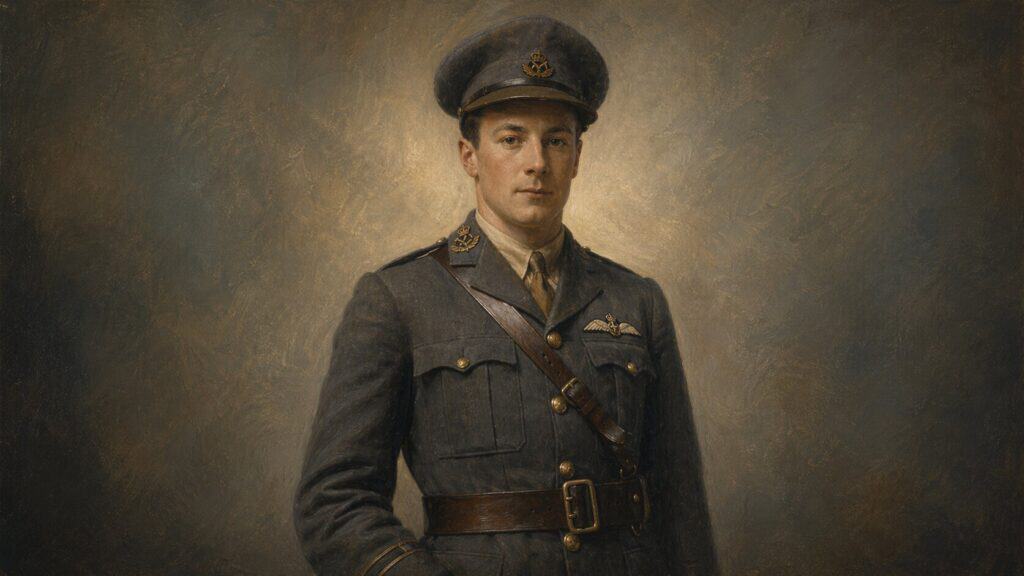
Lieutenant Alan Jerrard of No. 66 Squadron received the Victoria Cross for an action over northern Italy on 30 March 1918, when he attacked a much larger formation of enemy aircraft near an enemy aerodrome and continued fighting until he was shot down and taken prisoner. His award remains one of the clearest examples of the aggressive close combat the Camel was built to fight.
Camel squadrons flew offensive patrols over and behind the German lines, seeking to bring enemy scouts into combat rather than waiting to be attacked. The aircraft’s manoeuvrability rewarded pilots who could hold a target in their sights even briefly, giving a real chance of a decisive burst of fire from the twin Vickers guns. Camels also flew escort duties, protecting reconnaissance and bombing aircraft from German fighters over the lines.
The 2F.1 and Naval Operations
The Royal Navy’s requirement for a shipboard fighter led to the 2F.1, a navalised Camel with a shortened wingspan, a fuselage that could be separated for storage aboard ship, and an armament of one Vickers gun and one Lewis gun rather than the F.1’s twin Vickers guns. The 2F.1 was built around the Bentley BR1 engine and was intended to operate from platforms fitted to warships as well as from early aircraft carriers.
The type’s most striking naval achievement came on 19 July 1918, when Camels launched from HMS Furious carried out the first carrier-borne air strike against a land target, destroying the Zeppelins L54 and L60 in their sheds at Tondern. The raid demonstrated that a carrier could project offensive air power ashore rather than simply supporting the fleet at sea, a principle that would shape naval aviation for decades afterwards.
Home Defence and Night Fighting
From the second half of 1917, Camels also took on home defence duties against German bomber raids on Britain. Standard day-fighter Camels flew defensive patrols, and a dedicated night-fighter conversion known as the “Comic” was developed specifically for the role. The Comic moved the cockpit aft by about a foot and repositioned the fuel tank forward to compensate, and it replaced the fuselage-mounted Vickers guns with twin Lewis guns on the upper wing, a change that made reloading easier in the air. Several home defence squadrons flew Camels or Comics against Gotha bombers and Zeppelin airships during the raids of 1917 and 1918.
Ground Attack and RAF Service in 1918
By 1918 newer German fighters had begun to outclass the Camel as a pure day fighter, but the aircraft found a demanding new role in low-level ground attack. RAF squadrons flying the Camel, including Nos. 43, 54, 70, 73, 80 and 209 Squadrons among others, used it to strafe troops, transport and gun positions and to drop small bombs during the intense fighting of the Hundred Days Offensive from August 1918. Flying at treetop height over roads and rail lines, Camel pilots attacked retreating columns, artillery batteries and airfields in support of the advancing Allied armies, work that demanded a different kind of nerve from the high-altitude dogfighting the aircraft had been built for.
Ground attack had already become an important secondary role for the Camel from the Battle of Cambrai in November 1917, when RFC squadrons first flew low-level attacks against German positions in close support of the ground offensive. Losses in this role were often heavy: low-level attack exposed pilots to concentrated ground fire from rifles and machine guns as well as anti-aircraft artillery, and Camel squadrons suffered heavy casualties in ground attack work during 1918. Even so, it ranked among the RAF’s most important uses of the type once its days as a front-rank fighter were numbered.
Engines and Variants
Camels were built around several different rotary engines, reflecting wartime supply pressures as much as design choice. The 130 hp Clerget 9B was the most widely used engine on the F.1, but it proved a persistent source of trouble in service, and units often replaced it with the 110 hp Le Rhône 9J or the more powerful 140 hp Clerget 9Bf. Synchronisation problems with the Clerget’s gun gear were resolved on Le Rhône-powered aircraft by fitting the improved Constantinesco gear. The 150 hp Bentley BR1 powered most naval 2F.1 Camels and some later F.1s, giving improved performance over the standard Clerget installation. Various Gnome Monosoupape engines were also fitted to some aircraft. As with other rotary-engined fighters of the war, all of these engines spun with the propeller as a single unit, which produced the gyroscopic effects described above and required ground crews to keep them supplied with castor-based lubricating oil suited to their unusual construction.
Beyond the standard F.1, the naval 2F.1 and the night-fighting Comic, small numbers of Camels were adapted for other specialist roles, including trials aircraft and a twin-gun home-defence version distinct from the Comic. None of these variants matched the F.1 in numbers, but together they show how adaptable the basic Camel airframe proved to be.
Post-War Service and Legacy
After the Armistice of November 1918, some Camels stayed in RAF service on occupation duties, training and other secondary roles into the early 1920s before the type was finally retired as newer designs took its place. Its place in RAF history was secure long before that final retirement.
The Camel occupies a distinctive position in the story of British air power. It carried the RFC and RNAS through the hardest fighting of 1917 and 1918, passed into the newly formed Royal Air Force as one of its most important inherited types, and proved itself in roles well beyond the dogfighting for which it is best remembered, from carrier strikes to night defence to low-level ground attack. Fast, compact and uncompromising, it stood at the point where the improvised air fighting of the war’s early years gave way to the more organised air service that emerged by 1918.
| Dimensions | |
| Wingspan | 28 ft 0 in (8.53 m) |
| Length | 18 ft 9 in (5.72 m) |
| Height | 8 ft 6 in (2.59 m) |
| Wing area | 231 sq ft (21.5 m²) |
| Weights | |
| Empty weight | 930 lb (422 kg) |
| Max takeoff weight | 1,455 lb (660 kg) |
| Max bomb load | 100 lb (45 kg) |
| Performance | |
| Maximum speed | 113 mph (182 km/h) |
| Service ceiling | 19,000 ft (5,790 m) |
| Range | 300 mi (485 km) |
| Powerplant | |
| Engines | 1 × Clerget 9B nine-cylinder rotary engine |
| Power | 130 hp (97 kW) |
| Armament | |
| Guns | 2 × synchronized .303 in Vickers machine guns; up to 4 × 25 lb bombs |
| Bombs / weapons | 100 lb (45 kg) |
First Carrier-Borne Air Strike Destroys Zeppelins at Tondern
On 19 July 1918, Sopwith Camels from HMS Furious struck Tondern’s airship sheds, proving the carrier-borne…
19 July 2026 · 3 minAlan Jerrard VC Awarded for Gallantry over Italy in 1918
On 30 March 1918, Lieutenant Alan Jerrard received the Victoria Cross for gallantry over Italy while…
30 March 2026 · 3 minDeath of the Red Baron
Death of the Red Baron: On 21 April 1918, Manfred von Richthofen was shot down on…
21 April 2026 · 3 min