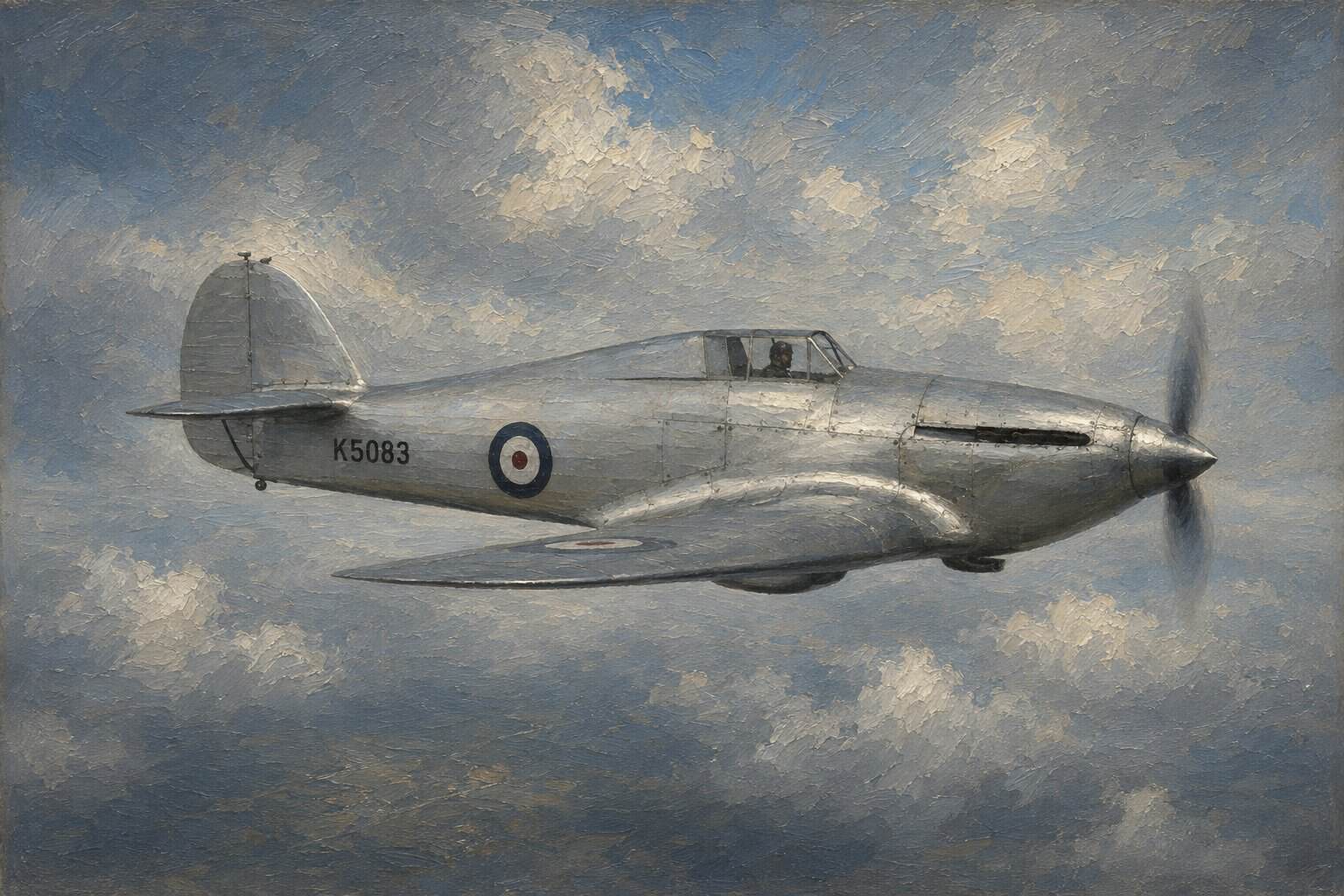
On 6 November 1935, Hawker Hurricane prototype K5083 made its first flight at Brooklands in Surrey, with Hawker’s chief test pilot, Flight Lieutenant P. W. S. ‘George’ Bulman, at the controls. The flight brought Sydney Camm’s new monoplane fighter into airborne testing and marked an important stage in the modernisation of British fighter aircraft.
K5083 combined a low-wing layout, retractable undercarriage and an enclosed cockpit with structural methods developed through Hawker’s earlier aircraft. Its maiden flight began the practical assessment of a design that would become central to RAF fighter expansion in the years before the Second World War.
Camm’s new fighter
The Hurricane emerged from Hawker’s work on a high-performance monoplane during the early 1930s. Camm’s team drew on experience with aircraft such as the Hawker Fury, while developing a layout suited to greater speed and a more powerful engine. Air Ministry Specification F.36/34 formalised the requirements around the developing design.
The aerodynamic changes were substantial. A single cantilever wing dispensed with the external bracing associated with biplanes, while retracting the main wheels reduced drag in flight. Together with an enclosed cockpit and the new Rolls-Royce powerplant, these features offered a route towards the performance demanded of the next generation of interceptors.
Within that modern outline, Hawker retained a tubular metal fuselage structure, with wooden formers and fabric covering giving much of the aircraft its external shape. The prototype also had fabric-covered wings. This combination connected the new fighter with established factory skills and construction practices, an approach that would later assist manufacture and repair.
From assembly to airborne trials
K5083’s components were manufactured at Hawker’s Kingston works before being transported to Brooklands for final assembly in October 1935. Ground running and taxi tests preceded Bulman’s first flight on 6 November, when the prototype entered its airborne development programme.
Its engine belonged to the Rolls-Royce PV-12 development programme that produced the Merlin. Airframe and engine were therefore progressing through development together. The prototype carried ballast representing its armament, while the final wing-gun installation remained part of the aircraft’s continuing development. Its immediate purpose was to establish the flying qualities and potential of the new design.
The first flight opened a sequence of tests through which handling, performance and technical reliability could be assessed. Further company flying and RAF trials followed, turning the experience gained with K5083 into the basis for a production fighter. At each stage, the prototype provided a means of examining how the new engine, retractable undercarriage and monoplane airframe worked together.
Towards squadron service
The Air Ministry placed its first substantial production order in June 1936. The first production Hurricane, L1547, flew on 12 October 1937, and deliveries to No. 111 Squadron at RAF Northolt began in December. These successive milestones carried the design from experimental flying into RAF squadron service.
For Fighter Command, the Hurricane became an important part of the transition to fast monoplane fighters. Its introduction combined a major increase in performance with a structure familiar to personnel accustomed to Hawker aircraft. The type’s subsequent wartime service grew from this pre-war process of design, testing, production and squadron adoption.
K5083’s flight at Brooklands established the airborne starting point of that development. By bringing Camm’s design into practical flight testing, Bulman and Hawker began the work that would turn a new experimental monoplane into one of the RAF’s principal fighters.