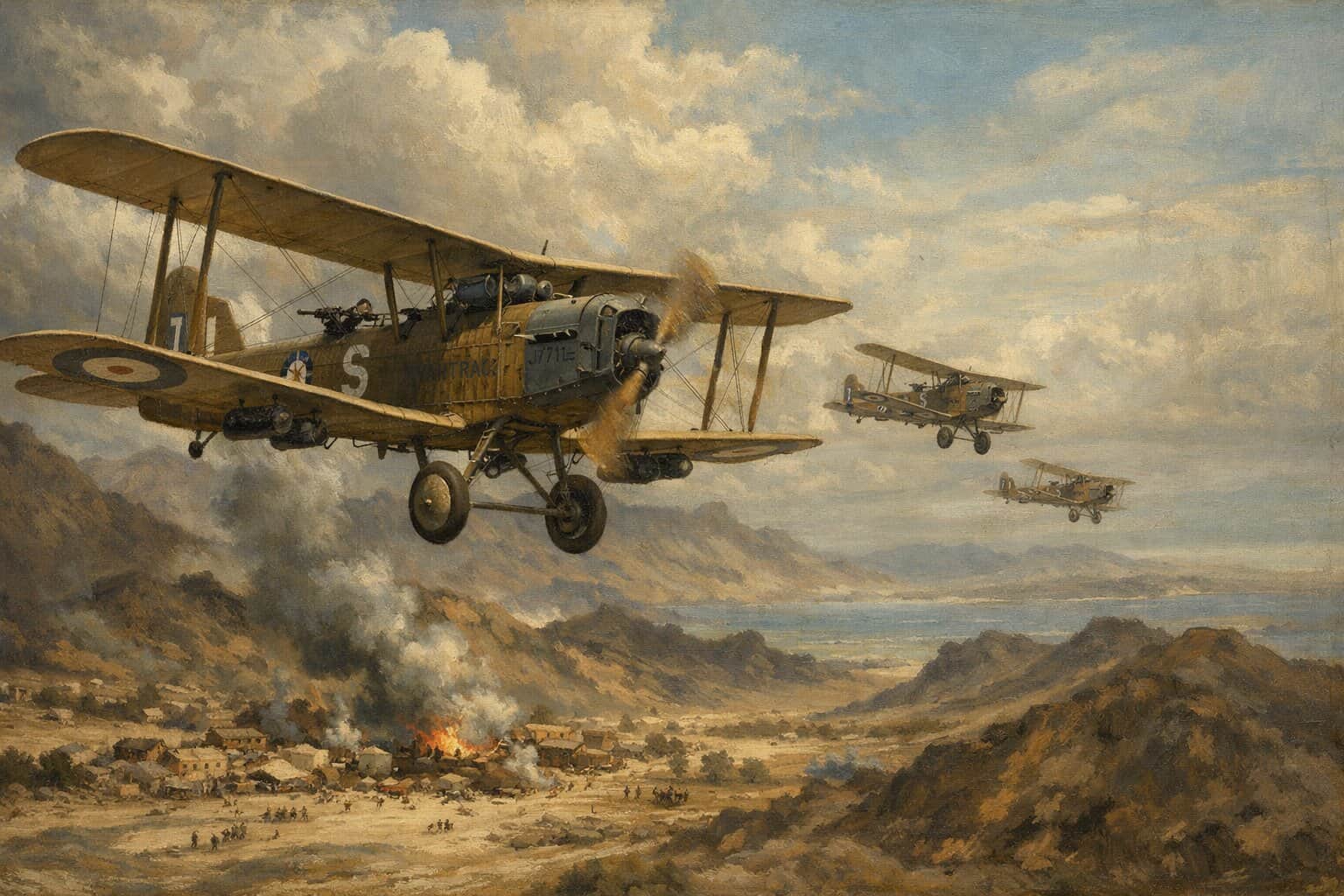
On 21 February 1928, Royal Air Force operations began against the Zeidi tribes after a Yemeni tribal incursion into Aden. The immediate cause was a local frontier crisis, but the event also illustrated a wider reality of interwar British air policy. In territories on the Empire’s margins, the RAF was increasingly expected to provide a rapid response where distance, terrain and cost made large conventional deployments less attractive. What began as a local emergency therefore sat within a broader experiment in the political and military use of air power.
The incident followed fighting along the Aden frontier, where the security situation had been disturbed by the advance of tribal forces linked to the Imam of Yemen. Aden itself was of considerable importance to Britain because of its position on the route to India and the wider imperial communications network. Any challenge to stability in the surrounding area was therefore treated seriously. In that context, the decision to employ aircraft was not simply tactical. It reflected the British preference for speed, reach and visible coercive effect in a difficult border region.
The RAF Response
According to the surviving summary for the day, No. 8 Squadron opened operations against the Zeidi forces. That marked the beginning of an aerial response intended to check the incursion and support British authority in the Aden Protectorate. Aircraft could reach areas that were hard to police by ground movement alone, and in the late 1920s, the RAF had become closely associated with this kind of imperial air control.
Such operations were rarely fought on the scale of a major European campaign, yet they mattered greatly in the places where they occurred. Air action offered the possibility of quick reconnaissance, rapid attack and a demonstration that the British state could act at once over wide distances. In the period’s official thinking, this made air power a practical instrument for frontier warfare and punitive expeditions. At the same time, these methods have to be understood in their imperial setting: they were designed to enforce British political control, not merely to win a battlefield encounter in isolation.
Truce and Immediate Outcome
The available outline also notes that a truce was agreed and that operations were temporarily suspended. That point is important. The significance of 21 February 1928 lies not in a prolonged air campaign with a clear-cut military climax, but in the opening use of RAF force at a moment of regional tension. The fact that operations were paused after a truce suggests that the immediate British objective was limited: to apply pressure, stabilise the situation and create conditions in which fighting might be checked.
This was often the pattern in imperial policing actions. Aircraft were used to influence events quickly and to strengthen Britain’s negotiating position, rather than to pursue a long war of attrition. The RAF’s role in Aden combined military action with political signalling. Its value, from the British point of view, lay as much in deterrence and control as in physical destruction.
Wider Air-War Reflection
Seen in a wider perspective, the opening of RAF operations against the Zeidi tribes reveals how the Service was shaping its interwar identity. Between the world wars, the RAF had to justify its independence, its budget and its strategic usefulness. Frontier operations in places such as Aden became part of that argument. They demonstrated that air power could be presented as flexible, economical and immediately available.
Yet these episodes also remind us that the RAF’s history was not confined to home defence or the great air battles of 1914–18 and 1939–45. Much of its interwar experience was gathered in imperial theatres, where aircraft were used as tools of surveillance, coercion and colonial control. The beginning of operations on 21 February 1928 is therefore best understood as a small but revealing moment in that larger story: a frontier crisis in Aden that showed how Britain intended to use air power in the age between the wars.