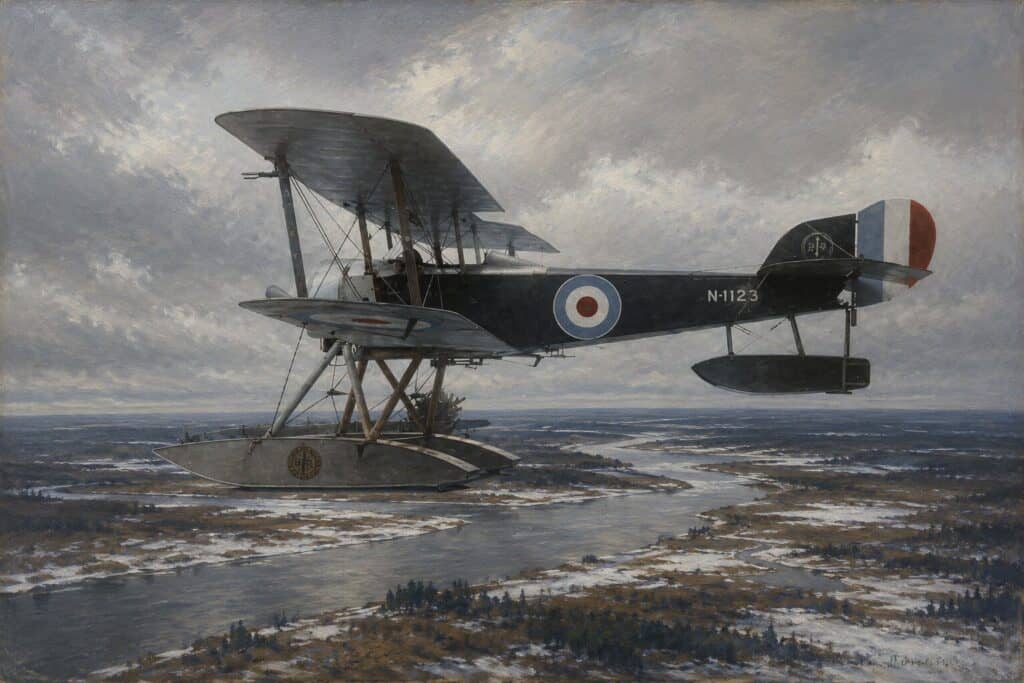
The North Russia Intervention was the British and Allied expedition undertaken in northern Russia during 1918 and 1919, and it drew the newly formed Royal Air Force into one of the earliest remote operations in its history. The intervention developed out of the collapse of Russia in the final phase of the First World War, concern over northern ports and stored war material, and a wider wish to influence events as revolution and civil conflict spread across the region. For the RAF, its importance lay not in the scale of air fighting, but in the speed with which air power was absorbed into an expeditionary campaign conducted far from the main European fronts.
Strategic Context And Planning
The intervention emerged from a confused strategic situation rather than from a single, neatly bounded war aim. Allied leaders feared that the Russian collapse would alter the balance of power, expose important ports and stores, and leave a political vacuum in which hostile forces could gain ground. Northern Russia became a theatre in which military, naval and political considerations overlapped.
When Allied approval for intervention was given in June 1918, aircraft were already understood to have practical value in such a theatre. North Russia combined vast distances, weak infrastructure, poor communications and severe weather, all of which made movement slow and uncertain. In those circumstances, air power offered reconnaissance, liaison, local support and a means of projecting authority beyond the immediate reach of troops on the ground or ships offshore. The RAF was still in its infancy, but the logic of employing aircraft in a remote expedition was already clear.
Forces, Aircraft And Command Structure
The RAF contribution to the North Russia Intervention was expeditionary and improvised rather than large-scale. Aircraft were committed in small detachments, supporting British-led operations around key points such as Archangel and, later, maritime-linked actions against Bolshevik positions and bases. The intervention never resembled the massed air campaigns of a later generation. Instead, the service provided mobility, observation and limited striking power in support of wider military and naval objectives.
Command arrangements reflected the nature of the expedition itself. Air activity formed part of a combined effort rather than an independent air campaign directed to a single operational design. RAF units worked alongside ground forces and in close association with the Royal Navy, especially where coastal movement and harbour operations shaped the conduct of the campaign. That made North Russia an early example of the RAF operating within a joint framework in which practical coordination mattered more than institutional scale.
Execution Of The Intervention
Once the intervention had been sanctioned, the problem was how to establish and sustain a foothold in a politically unstable, physically difficult region. In August 1918, British-led forces occupied Archangel, and RAF aircraft supported the move. Their role was enabling rather than decisive in itself, but it mattered in a theatre where intelligence, communications and visible support could influence events out of proportion to the number of aircraft available.
From that point, the intervention became a prolonged and ambiguous commitment. The RAF helped extend awareness beyond the immediate line of advance, supported the expedition's security, and contributed to the wider effort to hold positions and assist anti-Bolshevik forces. Air power in North Russia was therefore used as a practical arm of an expedition rather than as an end in itself. Its value lay in flexibility, reach and the ability to respond quickly in a region where movement by land and water was often slow and uncertain.
Maritime-Linked Operations And Kronstadt
One of the clearest demonstrations of the RAF's role in this wider interventionary setting came with the attack on Kronstadt in July 1919. In that operation, British aircraft launched from HMS Vindictive struck the Bolshevik naval base in a carefully judged raid intended to harass an important defended position. The scale was modest, but the operation showed how quickly British air power had become part of combined planning in difficult overseas conditions.
Kronstadt also illustrated the character of the wider intervention. North Russia and the adjoining maritime theatre did not permit the kind of clear front line found in conventional continental warfare. Instead, the campaign depended on ports, waterways, shipping routes, local footholds and limited but agile forces. Aircraft became instruments of reconnaissance, intimidation and selective attack. Their ability to reach defended targets, however modest the physical damage inflicted, carried operational and psychological value.
Results, Losses And Immediate Outcome
The immediate results of the North Russia Intervention were mixed. Allied forces secured temporary positions and demonstrated that they could intervene at distance, while the RAF showed that air units could contribute meaningfully to a politically complex expedition despite harsh conditions and limited resources. Yet the intervention never resolved the wider conflict decisively, and its military achievements remained constrained by an uncertain political purpose, logistical difficulties, and the changing circumstances of the Russian Civil War.
For that reason, the campaign is better understood as a limited and complicated expedition than as a clear-cut success or failure. The RAF's contribution was real, but it was made within a wider operation whose aims were shifting and whose strategic end state was never simple. Precise cumulative sortie, aircraft-loss and aircrew-loss figures are not safely recoverable from the present page context, so the operational record is best summarised in broad terms rather than by doubtful totals.
Historical Significance
North Russia Intervention occupies an important place in RAF history because it shows how quickly the service was drawn beyond the familiar geography of the Western Front. Within months of its creation, the RAF was participating in a remote expedition in which climate, distance, maritime dependence and political ambiguity mattered as much as direct combat. That experience foreshadowed later RAF roles in imperial policing, overseas intervention and joint operations conducted far from Britain's main bases.
The campaign also demonstrated that early British air power was not confined to dramatic bombing narratives. In North Russia, the RAF's importance lay just as much in reconnaissance, communications and support to dispersed forces as in attack. The intervention reveals an early form of operational thinking that would recur throughout the service's later history: aircraft as tools of reach, awareness and influence in theatres where conventional movement was difficult, and decision-making remained entangled with politics.
Conclusion
North Russia Intervention was a difficult and ambiguous campaign, but it remains a revealing early chapter in the story of the Royal Air Force. It placed the service in a harsh and remote theatre, required cooperation with naval and ground forces, and demonstrated the utility of air power in expeditionary operations long before the RAF developed the larger doctrines and structures of a later era. Its significance lies less in its dramatic scale than in what it revealed about the service's early adaptability, reach, and usefulness in complex overseas campaigns.