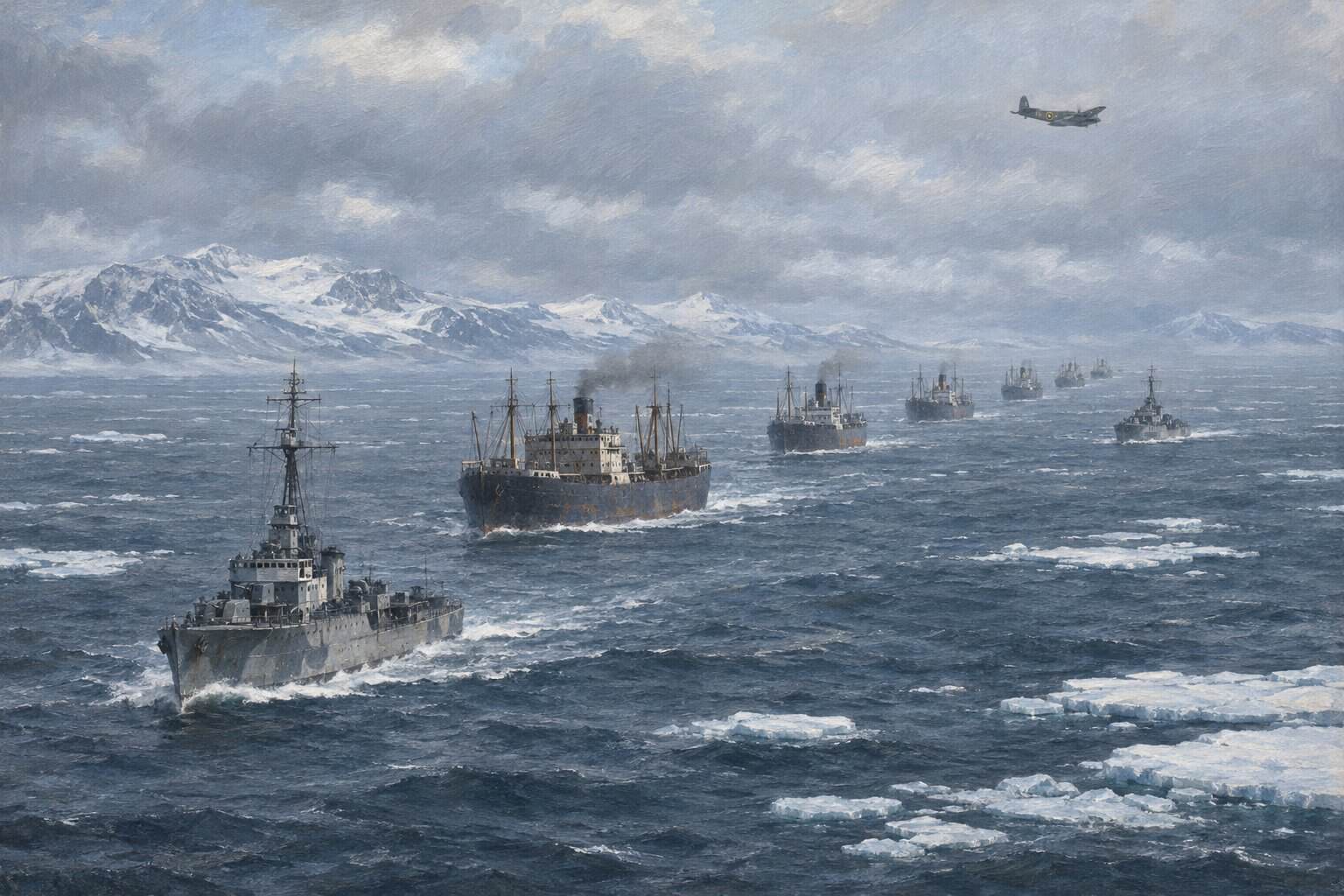
The Arctic convoys sailed through a narrowing space between sea ice and German-occupied Norway. Along this route, the ability to find a ship, report its position or put aircraft over it could influence events far beyond the reach of a single patrol. Yet the air forces supporting the convoys faced a geography that repeatedly frustrated those tasks. Distance consumed flying time, weather concealed targets and airfields, and the bases needed to sustain operations lay far apart.
For the RAF, the northern maritime war therefore demanded several different kinds of effort. Fighters operated from Soviet territory, maritime aircraft searched exposed waters, torpedo bombers undertook hazardous deployment flights, and heavy bombers attacked the German battleship Tirpitz. Later, strike wings based in Scotland pressed attacks against shipping along the Norwegian coast. Each answered a particular operational problem. Together they helped support the sea route to the Soviet Union, although they could never provide it with continuous air protection.
The convoys themselves depended on the Merchant Navy, Royal Navy escorts and wider naval covering forces. Fleet Air Arm and Soviet aircraft had their own responsibilities, distinct from those of the RAF. Their overlapping contributions made this a coalition campaign in which a successful passage depended on more than the performance of any one service. The RAF’s place in that campaign was shaped by the difficulty of maintaining an effective presence so far north. Its achievements, and the losses accompanying them, reveal the practical demands of bringing air power to a distant maritime battlefield.
Norway Changes the Northern War
The German invasion of Norway in April 1940 transformed the strategic position along Britain’s northern maritime approaches. Norway offered airfields from which aircraft could search neighbouring seas, ports from which warships could operate, and fjords that sheltered naval forces. Its occupation extended German power along a coastline facing the routes that would later carry Allied supplies to the Soviet Union. Coastal shipping also helped sustain the German presence, giving the maritime war an offensive dimension as well as a defensive one.
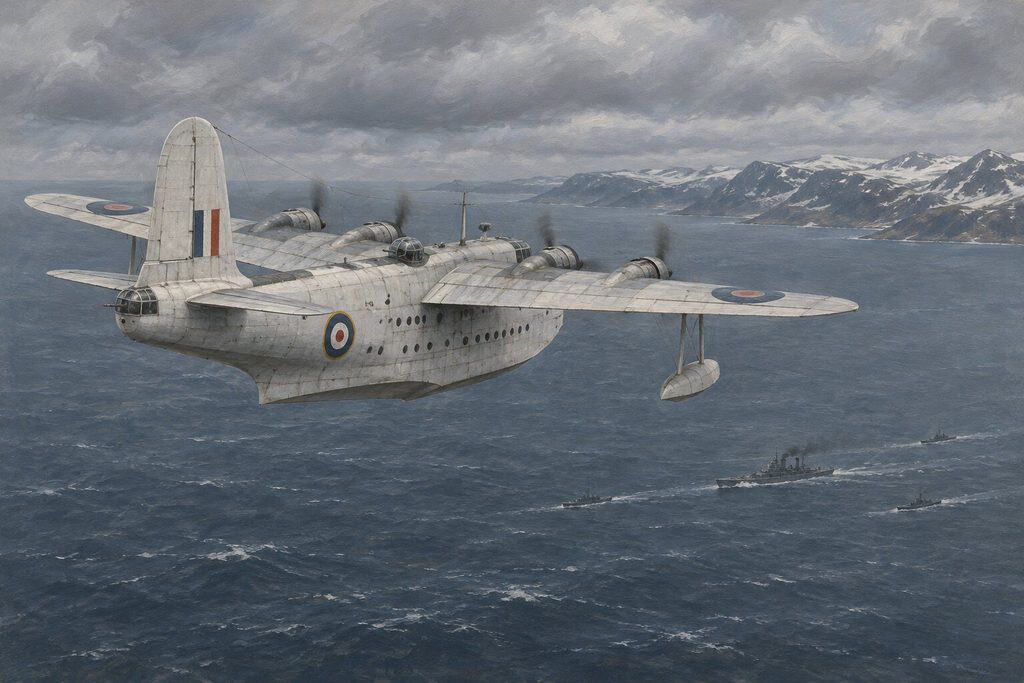
RAF reconnaissance had already encountered the approaching danger. On 8 April 1940, a No. 204 Squadron Short Sunderland reported the German cruiser Admiral Hipper and escorting destroyers heading towards Trondheim. The sighting belonged to the opening of the Norwegian campaign, before the Arctic Soviet supply convoys existed. It nevertheless demonstrated a task that would remain essential throughout the northern war: using aircraft to locate naval movement across sea areas too extensive to watch continuously from the surface.
A sighting could establish that ships were moving in a particular direction. It could not by itself determine their ultimate destination or guarantee that another aircraft would regain contact. Naval commanders had to weigh such reports alongside other information, often while deciding where to place forces already separated by considerable distances. The value of reconnaissance lay partly in reducing that uncertainty, even when the observing aircraft lacked the means to attack the force it had found.
Germany’s invasion of the Soviet Union on 22 June 1941 gave the northern sea route a new purpose. Allied aid had to reach Soviet ports, including Murmansk and Archangel. The route passed through different maritime environments: the Norwegian Sea on the western approach, the Barents Sea farther east, and the White Sea on the approach to Archangel. Murmansk lay on the Kola Inlet. These places imposed different demands on shipping and aviation; they were not interchangeable points on a single uniform Arctic passage.
Around Bear Island and North Cape, convoy movement had to take account of both German bases and the changing ice edge. Ice could restrict the available sea room, while proximity to occupied Norway brought ships within reach of German reconnaissance and attack. Moving farther from enemy airfields could increase the distance from friendly support. The geographical choices available to convoy planners were consequently constrained before any enemy force appeared.
The Royal Navy bore responsibility for escorting and covering the convoys at sea. RAF support could assist that work through observation, local protection and attacks on threats, but aircraft needed somewhere to refuel, rearm and undergo maintenance. Extending British air operations towards the Kola Peninsula therefore meant solving a problem of access and support as well as one of aircraft range. The first substantial fighter deployment made that requirement tangible.
The Hurricanes of No. 151 Wing at Vaenga
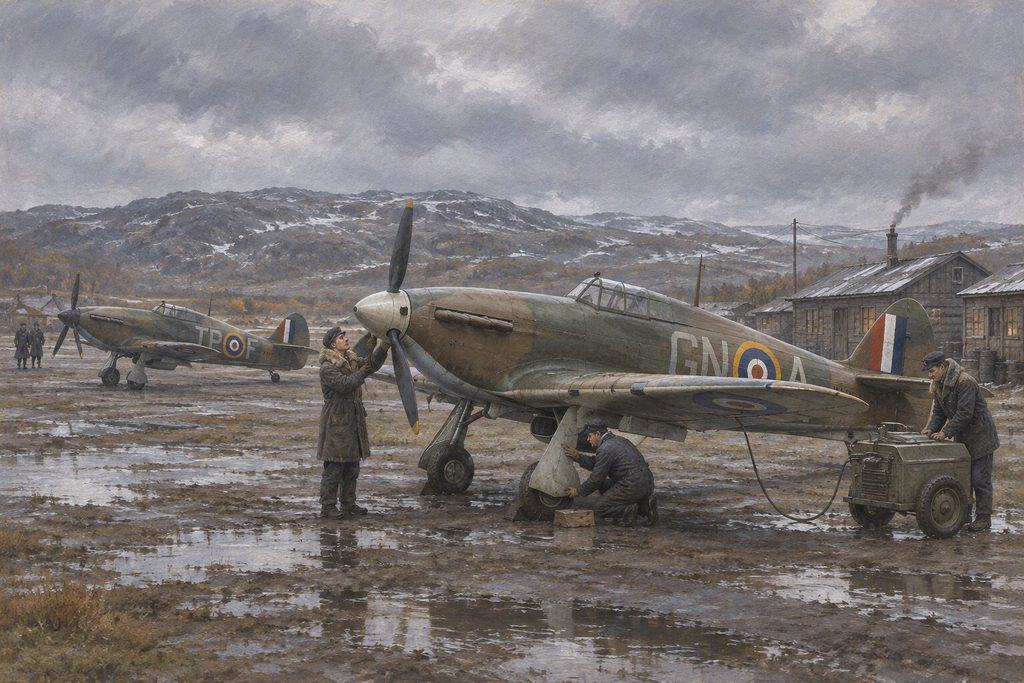
The movement of No. 151 Wing to northern Russia in 1941 combined an immediate fighting task with the transfer of aircraft and operating knowledge to a Soviet ally. Its two squadrons, Nos. 81 and 134, brought Hurricanes into the defence of the Murmansk area. Their presence also provided an opportunity to train Soviet pilots on the type before the aircraft passed into Soviet hands. Combat operations and instruction formed connected parts of the mission.
The deployment travelled by two different means. Operation Dervish in August carried personnel and 24 crated Hurricanes, while the aircraft carrier HMS Argus separately brought 16 aircraft for a fly-off. On 7 September, those Hurricanes flew from Argus to Vaenga. The carrier passage allowed fighters to cross a distance that could not be treated as an ordinary move between nearby land bases. Arrival by sea, however, left much of the work of establishing the wing still to be done.
Crated aircraft required preparation before they could join operations. Personnel, ammunition and spares had to reach the place where the fighters would actually fly. The movement of supplies from Archangel to Vaenga was a concrete reminder that unloading cargo in northern Russia did not deliver it automatically to the operational airfield. A wing could possess aircraft yet remain dependent on transport arrangements linking widely separated facilities. Its useful strength rested on what could be kept serviceable and supplied at Vaenga.
The first full operational day was 11 September. The Hurricanes defended the Murmansk area and escorted Soviet bombers, placing British pilots within the local air battle. These were geographically limited tasks around a vital destination of the supply route. They should be distinguished from escorting merchant ships throughout their passage from the west. A fighter force based near Murmansk could contribute to the security of the receiving area without closing the extensive air-cover gaps along the ocean route.
The airfield itself became part of the operational struggle. Deteriorating conditions and worsening weather complicated maintenance and flying. Ground crews had to sustain aircraft whose ammunition and replacement parts had travelled through a lengthy supply chain. Under those circumstances, each serviceable fighter represented the combined work of shipping, inland transport, maintenance and flying personnel. The deployment’s effectiveness depended on keeping those activities connected while continuing operations and instruction.
Training Soviet pilots gave the mission a purpose extending beyond the British wing’s own sorties. The aircraft were subsequently handed over, allowing the recipient force to continue using the capability introduced at Vaenga. This placed practical knowledge alongside the material aid carried in the convoys. The British contribution was temporary, but the transfer was intended to outlast it. No. 151 Wing’s experience established both the possibilities and the demands of operating with a Soviet ally in the far north: access to a forward base could bring fighters into the local battle, provided aircraft, supplies and trained people reached it together.

Convoys and the Air-Cover Gap
The early outbound convoys carried PQ designations and the returning convoys QP; the later system used JW and RA. Beneath those designations lay a layered naval undertaking. Merchant ships carried the supplies, close escorts accompanied them, and covering forces addressed threats beyond the immediate convoy formation. Air operations fitted into that arrangement through reconnaissance, attacks and protection where aircraft could reach. No single layer could remove all the dangers facing the ships.
German forces in Norway possessed a geographical advantage in finding approaching traffic. Reconnaissance aircraft could report convoy movements, creating opportunities for bombers, torpedo aircraft and submarines. Heavy surface ships added another possibility that naval commanders had to consider even when those ships remained in harbour. The threats interacted: information obtained by one arm could assist another, while the prospect of a surface attack could influence Allied decisions before any attack occurred.
Weather complicated this contest for information. Poor visibility could conceal merchant ships from aircraft while also concealing approaching attackers from the defenders. Darkness affected visual searching and navigation; changing ice constrained the routes ships could take. Conditions that hindered German reconnaissance could also prevent Allied aircraft from locating the convoy they were supposed to help. An interval without a reported enemy contact consequently offered limited reassurance when observation itself was uncertain.
PQ 17 in July 1942 exposed the consequences of this uncertainty with exceptional severity. Amid fear of an attack by Tirpitz, the Admiralty ordered the convoy to scatter. The merchant ships then faced German air and submarine attacks as isolated vessels. Imperial War Museums records that only 11 of the convoy’s 34 merchant ships reached Soviet ports. That figure describes the convoy’s overall outcome, not losses belonging to the RAF or to any single attacking arm.
The scatter order was a naval command decision. Explaining the disaster requires keeping that decision separate from the Luftwaffe and U-boat attacks that followed, and from the limits of Allied air support. Tirpitz mattered through the threat attributed to her. The destruction of merchant vessels should not be turned into an account of the battleship herself attacking and sinking them. The distinction is fundamental to understanding how a potential surface threat could influence a battle largely fought by other forces.
Aircraft could assist commanders by reporting a convoy, an enemy formation or an apparent danger. Such reports were still bounded by their time and position. A maritime patrol aircraft could leave the area, lose contact or reach the limit of its endurance. Fighters operating locally from Soviet territory had a different reach from naval aviation or long-range patrol aircraft. Treating these forces as a continuous protective screen obscures the different jobs they could perform.
The air-cover gap was therefore more than an empty stretch on a map. It involved periods when aircraft were absent, conditions in which searching failed, and places beyond practical support from available bases. Convoy protection demanded decisions within those limits. PQ 17 demonstrated how vulnerable the merchant ships could become when their protective arrangements broke apart, while the subsequent effort to bring additional air striking power to northern Russia showed the continuing search for ways to confront the surface threat.
Operation Orator and the Torpedo Hampdens
Operation Orator brought torpedo-bomber capability towards the Kola Peninsula in September 1942. The intention was to help protect the convoy route against German surface forces by placing aircraft nearer the area in which those ships might threaten it. Forward deployment promised a stronger local response, but the aircraft first had to complete a difficult passage from Britain. The journey itself became one of the operation’s defining hazards.
The force consisted of torpedo-converted Handley Page Hampdens from No. 144 Squadron RAF and No. 455 Squadron RAAF. In TB.I form, the Hampden adapted an existing bomber design to carry a torpedo. That conversion gave it a maritime striking role distinct from searching for ships or patrolling above merchant vessels. Its intended contribution depended on reaching and attacking an enemy surface force under suitable conditions, a demanding task separate from the ferry flight needed to establish it in theatre.
Thirty-two aircraft left Sumburgh on the night of 4/5 September. Their destination required a long flight across northern waters, with the difficulties of navigation compounded by weather and the proximity of enemy-controlled territory. The aircraft were travelling to a forward operating area, carrying the human and mechanical resources from which a striking force had to be assembled. Losses on that passage reduced what could be available before the intended operational task began.
Hampden P1344 provides a precise example of the dangers. Its flight involved icing, navigational difficulty and interception near Petsamo. Three of those aboard died and two became prisoners. The loss brings together hazards that could reinforce one another: weather complicated the passage, uncertainty about position made an already difficult route more dangerous, and enemy interception converted the deployment flight into a combat encounter. It also shows why a tally of aircraft dispatched gives an incomplete picture of the strength that could eventually be employed.
The problems did not end when aircraft reached northern Russia. A torpedo-bomber force required serviceable machines, weapons, fuel and crews able to undertake further sorties. It also needed information about the enemy and coordination with the naval forces it was intended to support. Moving bombers forward shortened some operational distances while lengthening the chain through which British units had to be sustained. The forward base offered access to the battle at the cost of a more demanding supporting organisation.
Orator’s limited operational outcome should be kept distinct from its intended purpose. The deployment does not provide grounds for claiming a successful Hampden attack on Tirpitz. Its importance lies in the effort to establish an additional striking capability against a serious potential threat, and in the cost of moving that capability into position. The ferry losses reveal how expeditionary air power could be weakened by weather, navigation and enemy action before an operational plan had the chance to be tested. In the Arctic, transferring aircraft was itself a substantial military undertaking.
Maritime Patrol and the Work of Endurance
The work of RAF Coastal Command connected the northern campaign with the wider maritime air war. Sunderlands, Catalinas, Hudsons and other aircraft provided capabilities for searching sea areas, reporting contacts and threatening submarines. Those general capabilities must be distinguished from the aircraft available for any particular Arctic task. The existence of a long-range patrol fleet did not mean that each type continuously covered the entire convoy route.
A patrol’s useful time over an assigned area was only part of its total flight. Transit from base and the need to return safely consumed endurance, while the position of a moving convoy changed the relationship between distance and time on task. Longer range could extend the area accessible to an aircraft, but it could not place that aircraft everywhere at once. Maintaining a succession of patrols demanded additional crews and serviceable machines, with weather affecting both departures and returns.
Searching was also a navigational task. A contact report needed a useful position if ships or other aircraft were to act upon it. Radio could carry that information beyond the observer’s immediate reach, making an aircraft valuable even when it could not mount an effective attack. An imprecise or delayed report was less useful against a moving target. The practical chain ran from finding something, through identifying and locating it, to communicating information in time for another force to respond.
Radar widened opportunities for detection in suitable circumstances, while visual observation remained vulnerable to cloud, darkness and visibility. Improvements made across the maritime air war did not remove the northern theatre’s basing and availability limits. An aircraft equipped to detect a target still needed to arrive in the relevant sea area and remain there long enough to search. Technical capability and actual coverage were different measures, especially along a route with widely separated supporting bases.
Against a surfaced U-boat, even the appearance of an aircraft could have a protective effect. A submarine compelled to submerge lost the immediate freedom of movement and observation it enjoyed on the surface. This sometimes described ‘scarecrow’ effect gave patrols value beyond recorded sinkings. Its importance depended on circumstances: a submarine forced down in one place could not be assumed to have abandoned the wider pursuit, and an aircraft’s departure could restore opportunities to the enemy.
Aircrew endurance and ground maintenance underpinned all of this work. Long searches demanded sustained attention, while the next patrol depended on servicing and preparing aircraft after they returned. No. 330 (Norwegian) Squadron, serving under RAF Coastal Command, flew Catalinas on Arctic convoy escorts and anti-submarine patrols in 1942 before converting to Sunderlands. Its service brought Norwegian aircrew directly into the northern maritime campaign. The results were often less visible than those of a concentrated bombing attack. A useful report or an interrupted submarine approach might leave no sinking to count. Alongside this persistent defensive work, the RAF increasingly sought opportunities to attack the ships and coastal communications sustaining German power in Norway.
Tirpitz and Bomber Command’s Northern Strikes
Tirpitz imposed demands on Allied naval planning through the possibility that she might sail against the convoy route. Protected within Norwegian fjords, the battleship could remain a strategic concern without regularly appearing at sea. The Royal Navy had to consider the consequences of a sortie and provide for a threat whose timing and direction could be uncertain. PQ 17 had already demonstrated the influence that fear of the ship could exert over decisions affecting merchant vessels.
The Allied campaign against Tirpitz involved distinct services and methods. Royal Navy midget submarines and Fleet Air Arm aircraft undertook operations against her; those actions belonged to naval forces. RAF Bomber Command later brought a different means of attack through Nos. 9 and 617 Squadrons. Keeping these contributions separate makes the sustained pressure on the ship clearer and avoids assigning the results of one service’s operations to another.
The RAF squadrons used specially adapted Lancasters carrying 12,000-lb Tallboy bombs. This was a concentrated heavy-bombing task against a defended warship, requiring aircraft and weapons suited to it. Aircraft had to reach the target, identify the ship and achieve conditions in which bombing could be effective. A battleship lying in a known area might appear easier to find than a convoy at sea, yet cloud and distance could still defeat an attack. Knowing where the target should be was insufficient if crews could not obtain the required view of it.
Operation Paravane on 15 September 1944 staged from Yagodnik in the Soviet Union and damaged Tirpitz. The use of a Soviet staging base brought heavy bombers into a northern operation through coalition arrangements, echoing the earlier need to establish British aircraft beyond their normal home bases. It also made the approach to the target dependent on an additional movement and supporting facilities. Forward staging created an operational opportunity while placing further demands on preparation and coordination.
Damage assessment then became a problem of its own. British commanders needed to judge what the attack had achieved and what threat the ship could still represent. Wartime estimates of damage and prospects for repair must be understood as assessments made with incomplete information. Later knowledge of a ship’s condition does not automatically describe what those planning the next operation could confidently know. Decisions about further attacks depended on uncertainty as well as on reports of visible damage.
Operation Obviate on 29 October demonstrated the continuing power of the weather. Cloud frustrated the attack and no hit was scored. The failure cannot be explained through bomb weight or aircraft range alone. The force had to bring its striking power into an effective relationship with the target at the moment of attack. Without that opportunity, even specialised aircraft and heavy weapons could produce little result.
On 12 November, Operation Catechism sank Tirpitz near Tromsø. The sinking removed the ship as a potential surface threat and ended the need to allow for her recovery as an operational battleship. It was a major outcome of the northern bombing effort, but the convoy war continued. Submarines, aircraft and the environment remained dangers to merchant vessels and escorts. Tirpitz’s destruction therefore belongs within the changing balance of threats along the route. The RAF had eliminated a powerful naval contingency; it had not made the northern seas safe. The sequence from Yagodnik to the final attack also showed that achieving a decisive result could require repeated operations, reliable intelligence and a favourable meeting of distance, weather and bombing opportunity.
Norwegian Strike Wings and the Final Convoys
By late 1944, Coastal Command was concentrating strike aircraft against German shipping along Norway’s coast. This offensive addressed the maritime communications supporting the occupation and brought sustained pressure against vessels using coastal waters. Its geography differed from the open-sea passage of Arctic convoys, but it belonged to the same wider contest over Germany’s ability to use Norway as a military position. Aircraft could attack the coastal system from which northern naval and air operations drew support.
Banff and Dallachy were separate strike wings based in Scotland. Banff’s multinational force included Mosquitos and Beaufighters; Dallachy operated Beaufighters. Their identities matter because operations, squadron establishments and losses cannot be transferred indiscriminately between them. The concentration of aircraft into strike wings made coordinated attacks possible, but each force retained its own operational history. Treating every Norwegian-coast strike as a Banff operation erases those distinctions and can misattribute the men and aircraft involved.
Attacking coastal shipping presented a different problem from searching broad sea areas. Fjords and coastal features could shelter vessels and constrain the directions from which aircraft approached them. A target discovered within such waters might be visible yet difficult to attack without entering a defended space. Anti-aircraft fire could cover likely approaches, while enemy fighters added a threat that had to be confronted during the same operation. Geography channelled the attack as well as protecting the target.
The Dallachy Strike Wing attacked the German destroyer Z33 in Førde Fjord on 9 February 1945, an operation remembered as Black Friday. Four Beaufighter squadrons participated, and nine of the wing’s Beaufighters were lost. Accurate anti-aircraft fire and German Fw 190 fighters combined with the restricted fjord geography to make the attack exceptionally costly. The episode belongs specifically to the force and circumstances involved, not to an undifferentiated record of all Scottish strike-wing activity. It showed that an offensive conducted late in the war could still meet concentrated resistance and exact a severe price from attacking aircrew.
Such operations worked against German coastal communications; they were different from flying close escort over an Arctic convoy. A strike on shipping in a Norwegian fjord could disrupt the enemy’s maritime activity without placing a fighter above a merchant ship farther north. The distinction helps explain the RAF’s widening contribution. Its resources were being used both to support Allied movement and to restrict German use of the sea, with different aircraft and tactics serving those purposes.
Meanwhile, Arctic convoys continued into 1945. Their cargoes still had to be carried by merchant ships and brought through by naval escorts, regardless of successes elsewhere in the air campaign. Imperial War Museums records that the convoys delivered more than four million tonnes overall. That was a maritime supply achievement involving the whole convoy system, not a tonnage delivered by RAF aircraft. Air operations contributed to the conditions in which the passage could be sustained, alongside the seamanship and protection provided at sea.
The political purpose remained as important as the operational one: maintaining material support for the Soviet Union required ships to arrive with their cargoes. British aircrew at Vaenga, the Orator force, maritime patrol crews, Lancaster squadrons and coastal strike wings each contributed to a different part of the northern war. Their experience also records its human cost, from losses on deployment flights to casualties in defended fjords. By the final convoys, the RAF possessed a varied record of local defence, observation and offensive action. Its contribution had grown through several complementary methods, while the passage itself remained a coalition undertaking carried across dangerous waters.
Conclusion
The northern campaign made the relationship between air power and sea power unusually visible. Aircraft could locate threats beyond an escort’s horizon, help defend a receiving port, bring weapons against a battleship or attack the shipping sustaining an occupied coastline. Making any of those capabilities effective required a route to the operating area and the means to support further flights once aircraft arrived.
The Hurricanes at Vaenga and the Hampdens of Orator showed the demands of establishing forward forces. Maritime patrols gave naval commanders information and imposed interruptions on the enemy. The destruction of Tirpitz removed a major potential danger, while coastal strikes carried the offensive into defended Norwegian waters. Across these operations, the RAF helped sustain the wider struggle around the Soviet supply route. The convoys’ continued passage depended on that assistance alongside merchant shipping, naval protection and Soviet effort, under conditions in which distance and weather remained active constraints to the end.